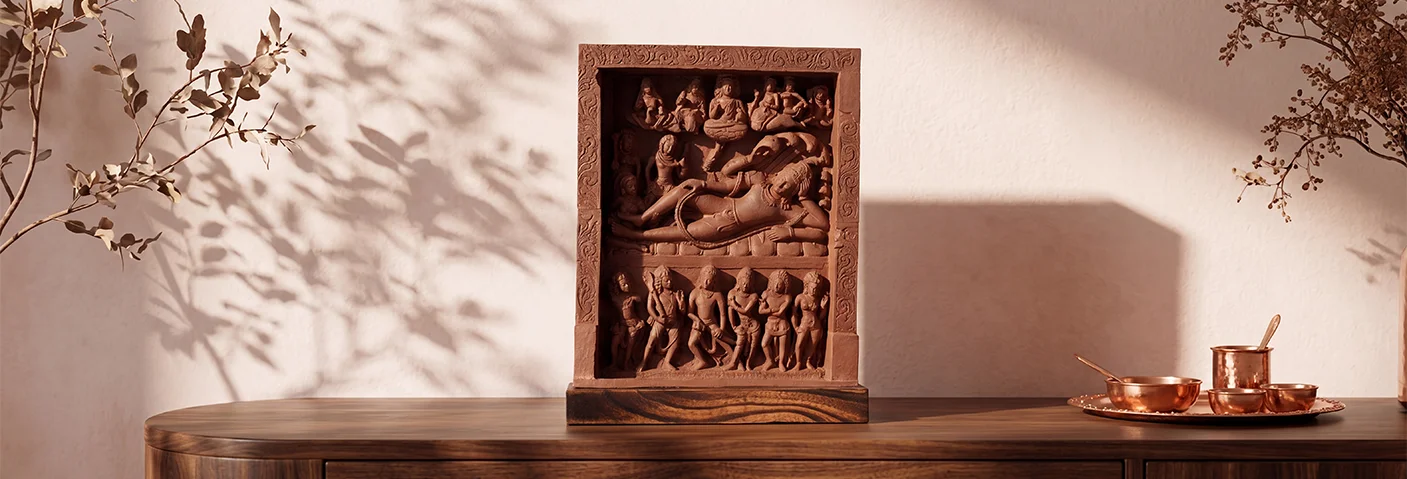
The Sculpture That Captured a Universe Being Born
Long before "home decor" became a phrase, Indian craftsmen were already carving stories into stone that would outlast empires. Among the most enduring of these is the image of the reclining Vishnu - Anantasayana Vishnu - resting on the coiled body of the serpent Ananta. This is not a picture of sleep. It is a picture of the pause between one universe ending and the next beginning, carved by Gupta-era artisans who understood that stillness could hold more meaning than motion.
Today, a hand-finished reclining Vishnu statue is one of the most thoughtful home decor gift ideas available - not because it is decorative, but because it carries fifteen centuries of craftsmanship, theology, and artistic intent into a modern living room.
Where This Image Was First Carved in Stone
The image of Vishnu reclining on the serpent has its roots in the Gupta period (c. 320–550 CE), an era often called the classical age of Indian art, when sculpture moved from symbolic representation toward serene, idealised naturalism. The most celebrated surviving example of this iconography is found on the Dashavatara Temple at Deogarh, in the Lalitpur district of Uttar Pradesh - a site sometimes searched online under the near-homophone "Deoghar," though the temple itself stands in Deogarh, on the banks of the Betwa river.
Scholars, working from paleographic evidence on an inscribed pillar at the site, date the temple to roughly the last quarter of the 5th century to the first quarter of the 6th century CE - a window centred on approximately 500 CE. This makes the Dashavatara Temple one of the earliest surviving free-standing stone temples in North India, and its southern niche panel of Vishnu reclining on the serpent Sheshnag one of the oldest large-scale depictions of the theme to survive intact.
What Archaeologists Actually Found at Deogarh
The Dashavatara Temple was documented by the Archaeological Survey of India (ASI) in the late nineteenth century, when its profusion of Vishnu imagery led surveyors to associate it with the ten avatars - hence the popular name "Dashavatara," even though no complete Dashavatara panel has been found at the site. Architecturally, the temple is significant for another reason entirely: it shows one of the earliest known transitions toward the shikhara, the curved temple tower that would go on to define North Indian Nagara-style architecture for the next thousand years.
The temple originally followed a Panchayatana plan - a central shrine surrounded by four subsidiary shrines - of which only the main shrine and its plinth survive today. Of its three great exterior relief panels (Gajendra Moksha, Nara-Narayana, and Anantasayana Vishnu), the reclining Vishnu on the southern wall is widely regarded as the artistic high point.
The Craftsmanship Behind a 1,500-Year-Old Composition
What makes this reclining statue of Lord Vishnu remarkable is not just its subject but its composition. Gupta sculptors arranged the entire panel around a single reclining diagonal, using the serpent's coils to create both a resting surface and a halo-like canopy of hooded heads above the god. The modelling is soft and rounded rather than sharply linear, a hallmark of Gupta classicism, and the drapery clings in the thin, almost transparent folds characteristic of the period's workshops at Mathura and Sarnath.
Multiple planes of action are layered into one frame: Vishnu at rest in the centre, Brahma seated above on his lotus, celestial witnesses flanking the scene, and a lower register of figures preparing for battle. Far from cluttered, the composition reads almost like a diagram of cosmic order - every figure placed with theological, not merely decorative, intent.
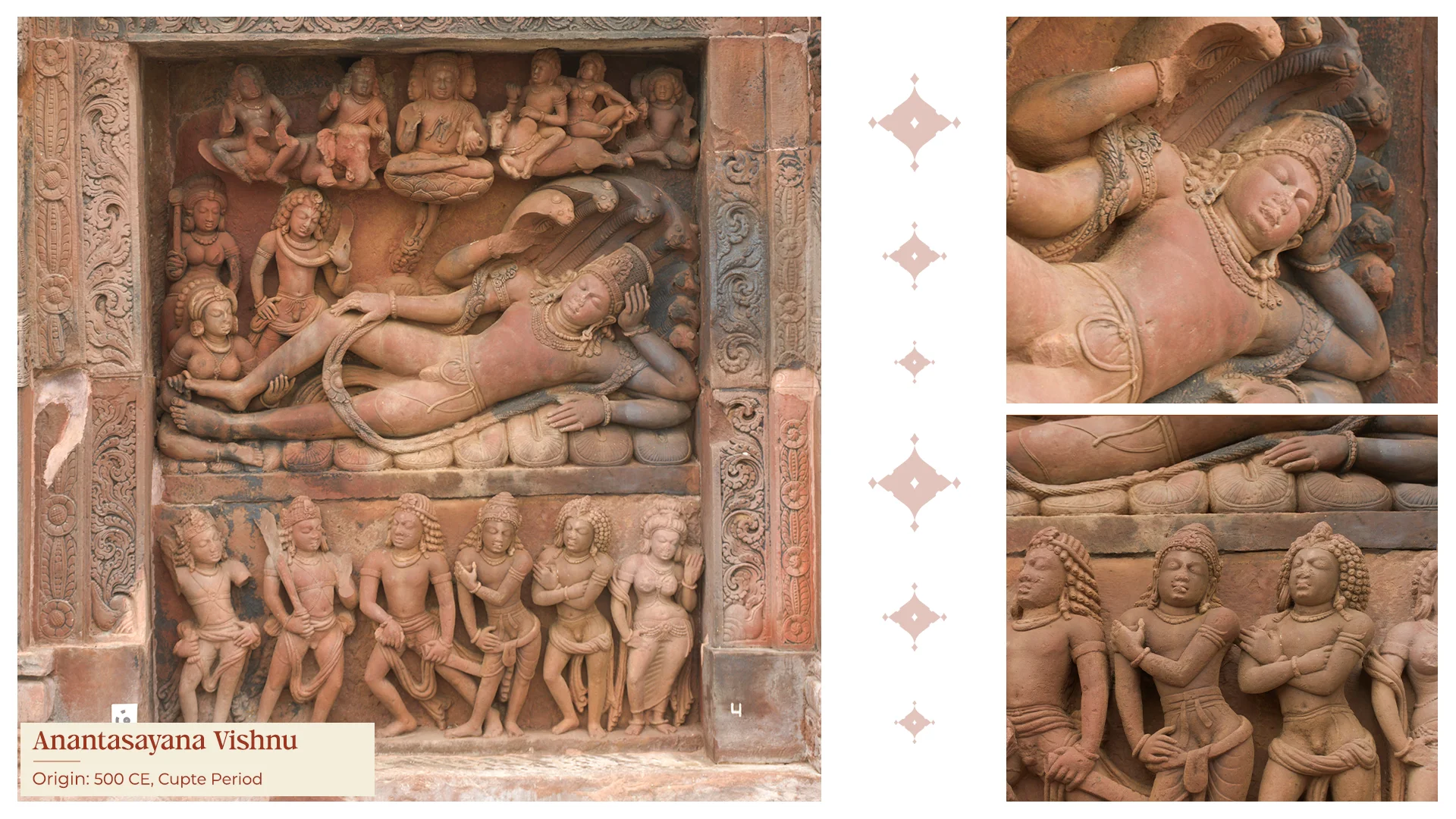
Every Figure in This Panel Was Placed There on Purpose
The panel visualises the moment of Anantasayana Vishnu - Vishnu resting in Yoganidra, the deep, generative sleep between the dissolution of one universe and the creation of the next. He reclines on Ananta, the multi-hooded cosmic serpent whose name literally means "the endless one" - a figure also called Sheshnag, and the reason the pose is often searched as "Vishnu reclining on the serpent Ananta" or "Vishnu reclining on the serpent Sheshnag."
From Vishnu's navel rises a stem of lotus, upon which four-headed Brahma sits, poised to begin the work of creation. Goddess Lakshmi, seated near Vishnu's feet, gently touches his leg - present here not only as consort but as Sri, the goddess of prosperity who accompanies Vishnu wherever he rests. Behind her stand Bhudevi, the earth goddess, and Garuda in personified human form, both in quiet attendance.
The upper register places Brahma at the centre, flanked by Kartikeya on his peacock and Indra on his elephant to one side, and Hara-Gauri - Shiva and Parvati - seated on Nandi to the other. In the lower register, five or six figures accompanied by a woman have traditionally been read by popular tradition as the Pandava brothers and Draupadi. Art historians offer an alternative reading: the same figures as the personified weapons of Vishnu - Ayudhapurusha - preparing to confront the demons Madhu and Kaitabha, a story drawn from the Puranas in which Vishnu's own arms rise from his sleeping body to destroy chaos before creation can begin.
Why Is Vishnu Shown "Sleeping" at All?
It's one of the most searched questions on the subject - "why Vishnu is in sleeping pose" - and the answer reframes the entire image. Anantasayana is not inactivity. It is potential. Hindu cosmology imagines existence as cyclical, unfolding through vast ages (kalpas) of creation, preservation, and dissolution. Between each cycle, the universe is folded back into Vishnu, who rests upon Ananta - a serpent whose endless coils are themselves a symbol of time without beginning or end.
Read this way, the reclining figure is less "asleep" and more "gestating." Everything that will exist - Brahma, the gods, the cosmos itself - is present in that single moment of rest, waiting to unfold. It is one of Indian art's most elegant solutions to representing something as abstract as infinite time: not through violent motion, but through perfect, deliberate calm.
More Than a Carving: A Belief Still Practised Today
Across India, temples and shrines dedicated to this form - often generically referred to as a reclining Vishnu temple - carry deep devotional weight within Vaishnavism, the tradition that holds Vishnu as the supreme, all-pervading reality from which the universe emerges. The Deogarh panel is among the earliest surviving expressions of this theology in stone, translating a purely textual, Puranic idea into a visual narrative that ordinary worshippers could read and understand without needing to know Sanskrit scripture.
This willingness to give abstract philosophy a human, legible form is part of what makes Gupta-era religious art so influential - it set patterns of composition and symbolism that later regional schools of sculpture, from Odisha to Tamil Nadu, would continue to reinterpret for centuries.
Why This Panel Was Never Moved to a Museum
The Anantasayana panel remains in situ at the Dashavatara Temple in Deogarh, rather than in a museum collection, which is part of what makes the site so valuable to art historians - the sculpture can still be studied in its original architectural context, alongside the temple's other Gupta-period reliefs. Institutions such as the Archaeological Survey of India continue to document and conserve the site, and the panel is widely reproduced in surveys of Indian art history as a defining example of Gupta classicism.
For collectors and heritage enthusiasts who cannot visit Deogarh in person, a faithful, hand-finished replica offers a way to bring the artistry - though not, of course, the sanctity or scale - of this panel into a personal space.
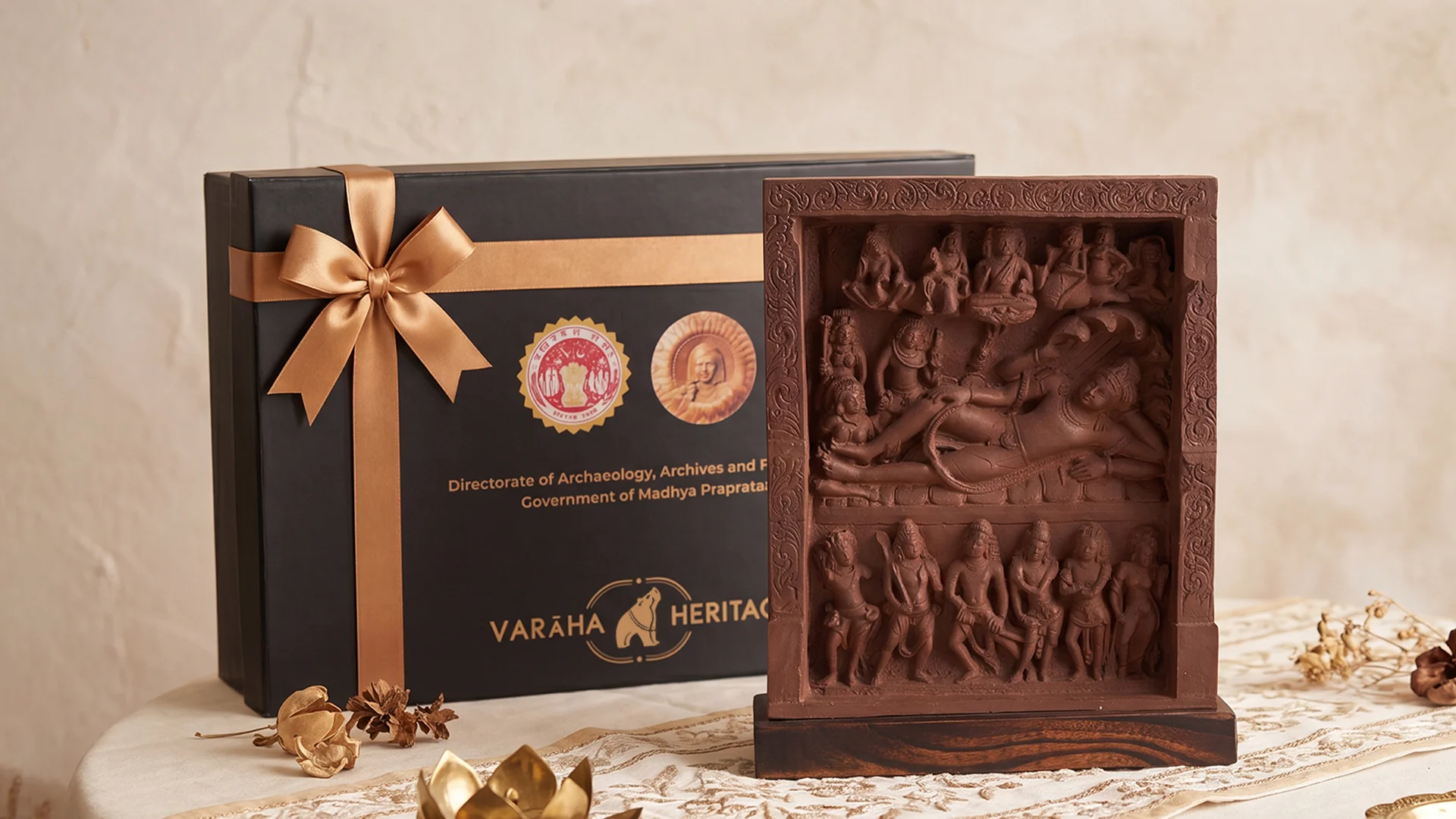
Why Collectors Are Returning to This 1,500-Year-Old Design
Interest in Indian temple art has grown steadily among collectors, interior designers, and gift-givers looking for pieces with genuine cultural depth rather than generic ornamentation. A reclining Vishnu statue answers that interest directly: it is instantly recognisable as art with a story, not just an object with a shape. In contemporary interiors - whether a formal living room, a meditation corner, or a corporate reception - the piece signals an appreciation for craftsmanship and continuity with a much older visual language.
This is also why it endures as one of the more distinctive home decor gift choices for milestones such as housewarmings, anniversaries, and corporate occasions - it offers something a painting or a mass-produced showpiece rarely can: a documented historical original behind the design.
Own a Piece of the Deogarh Panel, Reimagined for Your Home
Varaha Heritage's Anantasayana Vishnu is inspired directly by the circa 500 CE Gupta-period panel from the Dashavatara Temple in Deogarh - one of India's earliest surviving stone temples. Every detail of the original composition has been faithfully recreated: Vishnu reclining on the coiled serpent Shesha, Lakshmi at his feet, Brahma seated on the lotus above, and the attendant deities that frame the scene.
This roughly 1,500-year-old design is hand-finished from stone composite, capturing the softness of Gupta-era modelling rather than a flattened, mass-produced likeness. In Vastu tradition, placing this serene, cosmic form of Vishnu in the South-West of a home is considered to bring mental peace, ground the family, protect stability and wealth, and invite positive energy - though the piece stands on its artistic and historical merit even without this consideration.
As a gift, it suits occasions that call for something more considered than convention: a wedding, a corporate milestone, a housewarming, or simply a gesture toward someone who values art with meaning.
A Gift That Carries a Story Longer Than a Lifetime
A reclining Vishnu statue is, at its heart, a fifteen-hundred-year-old idea about time, rest, and creation - carved once at Deogarh, and now reimagined for a home that values more than décor. Whether chosen as a personal piece or as a gift for someone starting a new chapter, it carries a rare combination: genuine art history, spiritual depth, and quiet visual presence. That is what separates it from ordinary home decor gift ideas, and why it continues to find a place in homes that want their objects to mean something.
Final FAQ Section
Can we keep a sleeping Vishnu idol at home?
Yes. A reclining Vishnu, or Anantasayana Vishnu, is considered auspicious in Hindu tradition and is commonly kept at home as both a devotional object and a piece of heritage art. It is generally placed in a clean, respectful space away from footwear and clutter.
Which type of Vishnu idol is good for home?
Both the standing and reclining forms of Vishnu are considered appropriate for home worship and decor. The reclining form, Anantasayana Vishnu, is particularly favoured by those who want a piece that also reflects classical Indian temple art and sculpture history.
When does Vishnu recline on the serpent Shesha?
In Hindu cosmology, Vishnu reclines on the serpent Shesha, or Ananta, during the interval between the dissolution and re-creation of the universe. This period is called Yoganidra - not literal sleep, but a state of deep, generative rest from which creation eventually unfolds.
Where should a Vishnu idol be placed at home?
Vastu tradition generally favours the north or northeast for most deity placements, while a reclining Anantasayana Vishnu is specifically associated with the South-West direction, believed to bring stability, grounding, and protection to the household. The idol should be placed at a respectful height, facing into the room.
Which is the largest reclining Vishnu in the world?
One of the largest and most renowned stone reclining Vishnu images is the roughly 5-metre stone sculpture at Budhanilkantha Temple in the Kathmandu Valley, Nepal, carved from a single block of black stone and dated to around the 7th–8th century CE. It remains among the most famous large-scale depictions of the Anantasayana form.