
Among the surviving stone carvings of early India, few have been studied as closely as the reclining Vishnu panel on the southern wall of the Dashavatara Temple at Deogarh. Carved in sandstone around the turn of the sixth century CE, it is one of the earliest and most complete depictions of Vishnu Anantasayana - Vishnu resting on the coiled body of the serpent Shesha - to survive from the Gupta period. It is also, increasingly, an image finding its way onto reception desks and into conference rooms, not as a religious statement but as a considered piece of office decor with a documented history behind it.
Historians consider the panel important for two reasons. First, it is one of the few Gupta-era reliefs that can be studied largely intact, in its original architectural setting, rather than as a fragment recovered from a ruined site. Second, it captures a moment when many of the visual conventions later used across Hindu temple art - the arrangement of attendant deities, the proportions of the reclining figure, the layered composition of sky, water, and earth - were still being worked out.
The Gupta Workshop Behind the Carving
The panel belongs to the Gupta period, conventionally dated from the 4th to the 6th century CE, a time often described by historians as a high point of North Indian art and architecture. It was during this period that temple building in dressed stone became widespread, replacing the wood and brick shrines of earlier centuries. Regional workshop traditions centred on Mathura, Sarnath, and Kosambi began to converge into a shared visual language that would go on to shape temple sculpture across North India for centuries.
Gupta sculpture is generally noted for its restraint: carefully proportioned figures, minimal ornamentation compared to later periods, and drapery suggested through fine incised lines rather than heavy carved folds. Many iconographic templates for Hindu deities - the arrangement of attributes, the seated and reclining postures, the treatment of crowns and jewellery - were established during this period and carried forward by later dynasties.
A Temple Rediscovered on the Betwa
The Dashavatara Temple stands at Deogarh, in the Lalitpur district of Uttar Pradesh, on the banks of the Betwa River. It is generally dated to around 500-525 CE, making it one of the earliest surviving stone temples in North India. No inscription naming a patron or ruler has survived at the site, so historians place it within the Gupta period on the basis of its architectural style, construction technique, and sculptural treatment rather than any documentary record.
The British archaeologist Alexander Cunningham visited the site in 1875, describing its setting as "singularly picturesque," and is credited with giving the temple its popular name, "Dashavatara," after its association with the ten incarnations of Vishnu. Decades later, Madho Sarup Vats of the Archaeological Survey of India produced a detailed monograph on the temple, which remains a standard reference for its architecture and sculpture. The temple follows the panchayatana plan, with a central shrine originally accompanied by four smaller corner shrines, and is notable for carrying one of the earliest largely intact stone shikharas - temple towers - to survive in North India, though much of its upper structure has since been lost. Locally, it is also known as Sagar Marh, "the temple on the tank," after the stepped water pool cut into the rock in front of it.
Today the surviving structure is protected as a Monument of National Importance under the Archaeological Survey of India. Three major carved panels remain on the temple's outer walls: Gajendra Moksha, Nara-Narayana in meditation, and the Anantasayana Vishnu on the south wall, which this article - and the sculpture it inspired - is built around.
Reading the Panel: A Composition in Three Registers
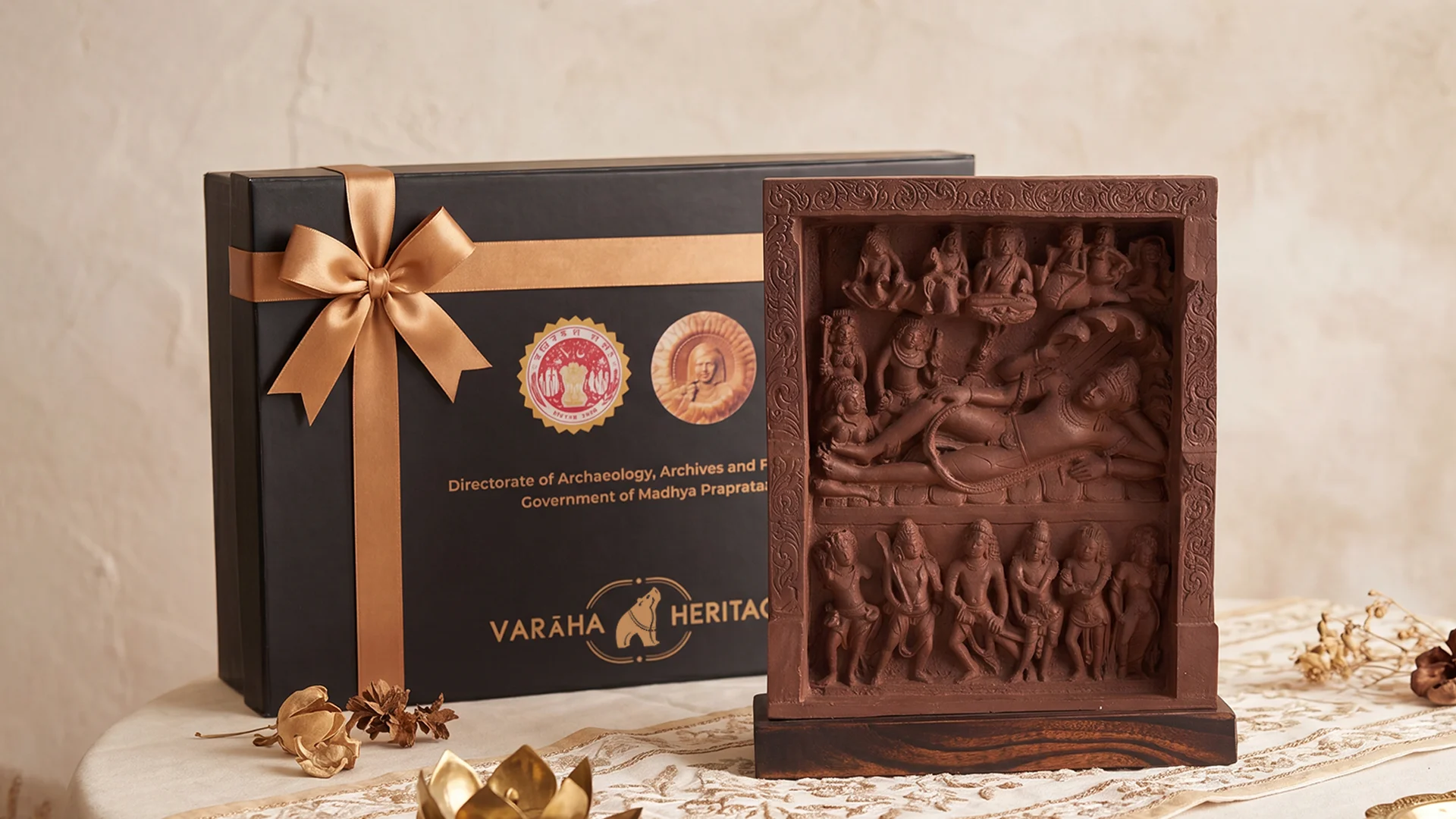
The southern niche panel is carved from local sandstone characteristic of the Bundelkhand region, worked in relief so the principal figures stand out clearly against the background. The composition unfolds in three horizontal registers, moving from a celestial scene at the top, through the central figure of Vishnu on the serpent, down to a debated narrative scene at the base - a layered, almost architectural approach that is itself considered a hallmark of Gupta-period relief carving.
At the centre, Vishnu reclines on the coiled body of the multi-hooded serpent Shesha, which rises behind him like a canopy. He is shown four-armed, wearing a tall crown (kiritamukuta), one leg extended and the other bent, one hand supporting his head, the remaining hands holding a discus (sudarshana chakra) and a conch (panchajanya), with one hand in a gesture of reassurance (abhaya mudra). At his feet sits Lakshmi, with Bhudevi - representing the earth - and a personified Garuda standing in attendance nearby.
The upper register shows a celestial assembly witnessing the scene: a four-headed Brahma, holding a water vessel (kamandalu), seated on a lotus at the centre, flanked by Indra on his elephant and Kartikeya on his peacock on one side, and Shiva and Parvati seated on Nandi on the other. A lower register of six figures remains genuinely debated among scholars - read by some as the five Pandava brothers and Draupadi, and by others as Vishnu's personified weapons confronting the demons Madhu and Kaitabha. Neither reading has been conclusively settled, and both remain current in the scholarship.
Rest That Precedes Creation
What makes this composition worth pausing on - literally and figuratively - is what it is not. It is not a picture of rest as the absence of activity. Vishnu's posture here is yoganidra: a state of deep, generative consciousness, not withdrawal from the world but the still point from which the world is produced. Brahma does not appear despite Vishnu's repose; he appears from it, rising on a lotus stem at the exact moment of creation.
That single idea travels surprisingly well from a sixth-century temple wall to a twenty-first-century office. It suggests that stillness and output are not opposites - that the pause, the moment of not-doing, can be exactly where the next decision or idea originates. Most workplaces are built to visibly reward motion: full calendars, constant messages, the appearance of being busy. A sculpture built entirely around the opposite idea - that clarity follows quiet, not noise - sits differently in a room than the usual desk ornament.
Where the Composition Belongs in a Modern Office
Because the panel carries genuine documented history rather than being purely decorative, it functions in a workspace the way a well-chosen piece of art functions in any considered interior - as a point of reference rather than filler.
Reception desk - the first thing a visitor encounters, setting a tone of depth and intentionality rather than generic corporate polish, and giving your front-of-house a genuine talking point rooted in a documented temple, not a decorative cliché.
Recreational or break-out area - reinforcing, quite literally, that the space is built for a genuine pause rather than a gap between meetings.
Conference room - a quiet visual cue that clarity in a discussion tends to follow a moment of stillness rather than constant noise.
It also serves well among office desk gift ideas for occasions that deserve more thought than typical desk clutter - a founder's work anniversary, a corporate inauguration, a colleague's promotion, or a client relationship worth marking properly. Because the piece is tied to a specific, documented panel rather than being a generic idol, it tends to read as considered rather than default corporate gifting.
Recreated with Historical Precision
Varaha Heritage's Anantasayana Vishnu is modelled on the south panel of the Dashavatara Temple at Deogarh. The piece is made from a hand-finished stone composite, selected and toned to approximate the weight, texture, and colour of the original Bundelkhand sandstone. Each element of the composition - the coils of Shesha, the celestial figures of the upper register, and the debated lower scene - is reproduced closely from the original relief, based on documented photographs and published scholarship rather than approximation.
Dimensions: 12.0" x 10.0" x 3.0"
Weight: Approx. 5.50 kg
Finish: Hand-finished stone composite, sacred detailing faithfully recreated from the original temple carving
Care: Wipe gently with a soft, dry cloth; keep away from direct sunlight and moisture; avoid harsh chemical or water-based cleaners
Delivery: Dispatched within 7 business days across India, with same-day delivery available in Delhi NCR on lunch-time orders, securely packed in premium protective packaging
For those who follow Vastu principles, this reclining, peaceful form of Vishnu is traditionally associated with the South-West direction of a home or workspace, believed to support mental calm and stability. This is worth noting for context, though the piece holds its own as a heritage object regardless of directional placement.
As work office desk decor, it suits a personal collection as easily as a corporate reception, and as office decor more broadly, it offers something most desk accessories cannot: a documented fifteen-century lineage behind a single, considered object.
The Last Word
The Anantasayana Vishnu is, in the end, an image about beginnings disguised as an image of rest. Carved at Deogarh some fifteen hundred years ago within a workshop tradition still working out its own visual language, it has quietly become one of the most enduring compositions in Indian sculpture - and, in its own modest way, a genuinely useful object for anyone spending long hours at a desk to have nearby. The best ideas, as the Gupta sculptors seem to have understood, rarely arrive from constant motion. Sometimes they arrive from the still point in the middle of everything.
FAQ :
What does the Anantasayana Vishnu panel at Deogarh depict?
It shows Vishnu reclining on the coiled serpent Shesha, attended by Lakshmi, Bhudevi, and Garuda, with a celestial assembly of deities above and a separately debated narrative scene below. It is carved on the south wall of the Dashavatara Temple at Deogarh, Uttar Pradesh, and is generally dated to around 500 CE.
Why is the Deogarh panel considered historically important?
It is one of the most complete surviving examples of this subject from the Gupta period, still largely intact in its original architectural context. Art historians use it as a reference point for dating and comparing later versions of the same iconography elsewhere in India.
Is a heritage-inspired Vishnu sculpture a meaningful corporate or office gift?
Yes - a heritage-inspired Vishnu sculpture works well as a corporate or inauguration gift precisely because it carries documented historical depth rather than being purely decorative. A piece tied to a specific Gupta-era temple, like the Anantasayana, gives the gift a genuine story, and fits naturally into reception areas or leadership offices, where it doubles as both a gift and lasting decor.
What material is the Varaha Heritage replica made from, and how closely does it follow the original?
It is made from a hand-finished stone composite toned to match the weight, texture, and colour of the original Bundelkhand sandstone, with each register of the composition reproduced closely from the documented Deogarh relief.