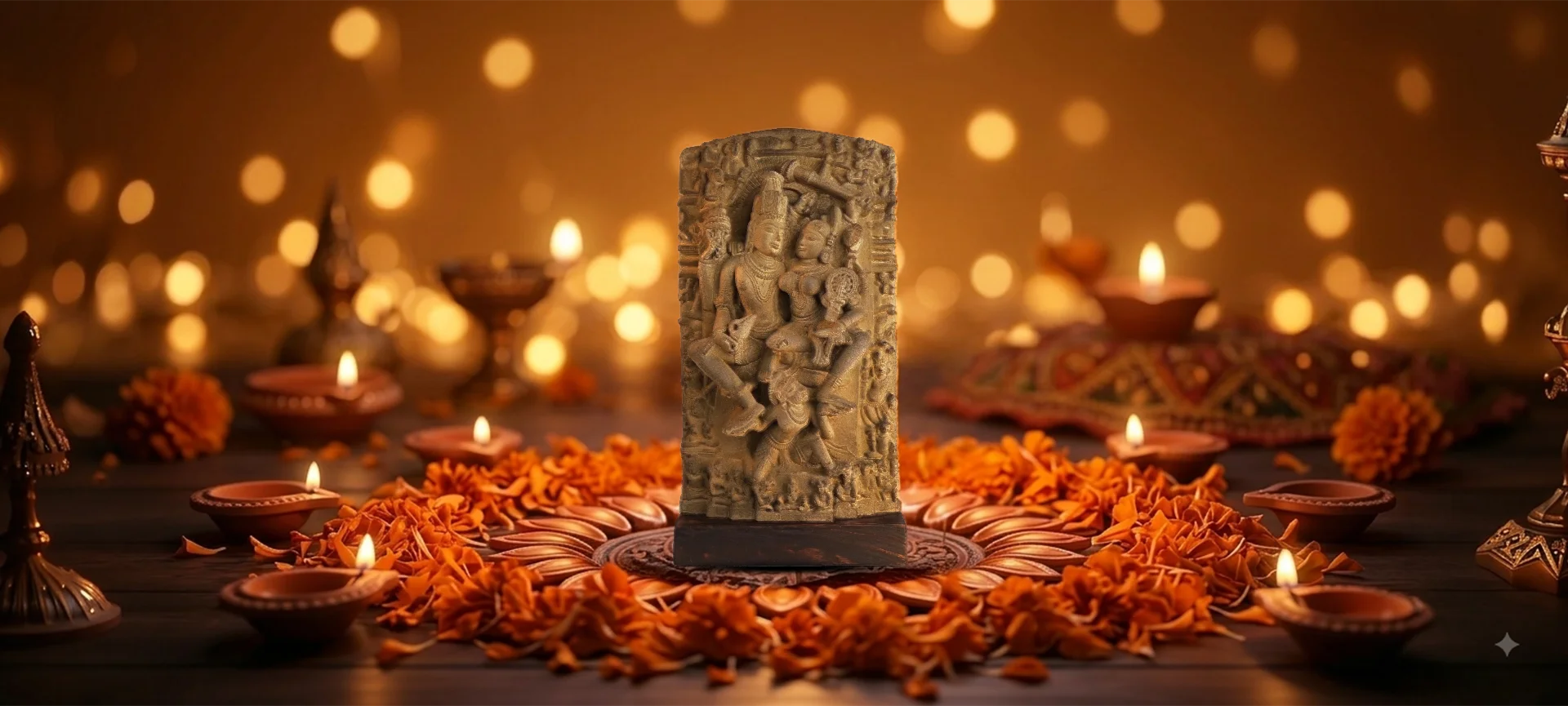
Most Diwali idols are bought for the festival and put away with the decorations. The ones Varaha Heritage makes are meant for the opposite: Hand-Finished replicas of sculptures that have outlasted nearly a thousand years, like a 10th-century dancing Ganesha from Ashapuri and a 12th-century Lakshmi Narayan from Dhanauli, both preserved at the Triveni Museum. Choosing between Diwali puja idols like these starts with a bigger question than which one looks best: which deity do you want presiding over your mandir? This guide covers which deities are considered auspicious for Diwali, why Lakshmi and Ganesha are worshipped together, which other deities belong in the puja room, and the material, size and placement that suit a diwali puja idol for home use.
Which Deity Idol Is Considered Auspicious for Diwali?
Diwali puja is built around inviting Lakshmi, the goddess of wealth and prosperity, into the home, which makes a Lakshmi idol the single most central of all auspicious idols for home worship during the festival. She is rarely worshipped alone, however, Ganesha, Saraswati, Kubera, Vishnu, Kamdhenu and Goddess Durga all have established roles in Diwali's puja tradition, each representing a different kind of blessing the festival invites. Among god idols for home in general, Diwali is the one occasion in the year when most households actively choose or refresh which deities sit on their altar, which is exactly why this choice matters more during this festival than at almost any other time of year.
Auspicious Diwali Deities at a Glance
Lakshmi: Goddess of wealth and prosperity and the festival’s central deity, worshipped alongside Ganesha on Lakshmi Puja night.
Ganesha: Remover of obstacles, invoked before any new beginning and worshipped alongside Lakshmi as a pair.
Saraswati: Goddess of knowledge and the arts, often included as a third figure, especially in business households.
Kubera: Treasurer of the gods and guardian of wealth, worshipped on Dhanteras and Diwali alongside Lakshmi.
Vishnu (with Lakshmi): Preserver of dharma and Lakshmi’s eternal consort, worshipped as Lakshmi Narayan in households that prefer the divine couple together.
Kamdhenu: The wish-fulfilling divine cow and a symbol of nourishing abundance, worshipped on Vasu Baras (the day before Dhanteras) and Govardhan Puja, alongside Lakshmi.
Goddess Durga: The Devi as protector of the home and family, worshipped as Kali on Diwali night in Bengal and as Mahakali during chopda pujan.
Why Are Lakshmi and Ganesha Worshipped Together on Diwali?
A lakshmi ganesh idol is by far the most common pairing bought for Diwali, and the reason goes beyond tradition for its own sake. Lakshmi represents wealth and abundance, but in Hindu belief, wealth without wisdom can be squandered or misused, which is where Ganesha comes in. As the remover of obstacles and the deity invoked before any new venture, Ganesha's presence beside Lakshmi is believed to ensure that the prosperity she brings is matched with the wisdom to use it well. This is also why Ganesha is worshipped first in most pujas, including Diwali's, before Lakshmi is formally invited in.
A lakshmi ganesh murti built around this pairing typically shows the two deities seated side by side, Lakshmi with her lotus and gestures of blessing, Ganesha with his usual modak and blessing hand. A ganesh lakshmi idol for diwali chosen as a single combined piece, rather than two separate sculptures, is the most traditional format for a home's main diwali lakshmi puja altar, since it reflects the two deities' roles as a single, complete blessing rather than two independent ones.
The ritual sequence followed on Diwali night reinforces this same logic. Ganesha is invoked and worshipped first, before Lakshmi is formally welcomed in, a sequence followed in almost every Diwali puja regardless of region. Lakshmi is traditionally described as restless and fickle in her blessings, moving on quickly if not anchored by stability and right conduct, qualities Ganesha represents as the deity of wisdom and considered action. Worshipping him first is believed to prepare the home, and the household's own intentions, to receive and retain the prosperity Lakshmi brings that night, rather than simply inviting wealth without the groundwork to keep it.
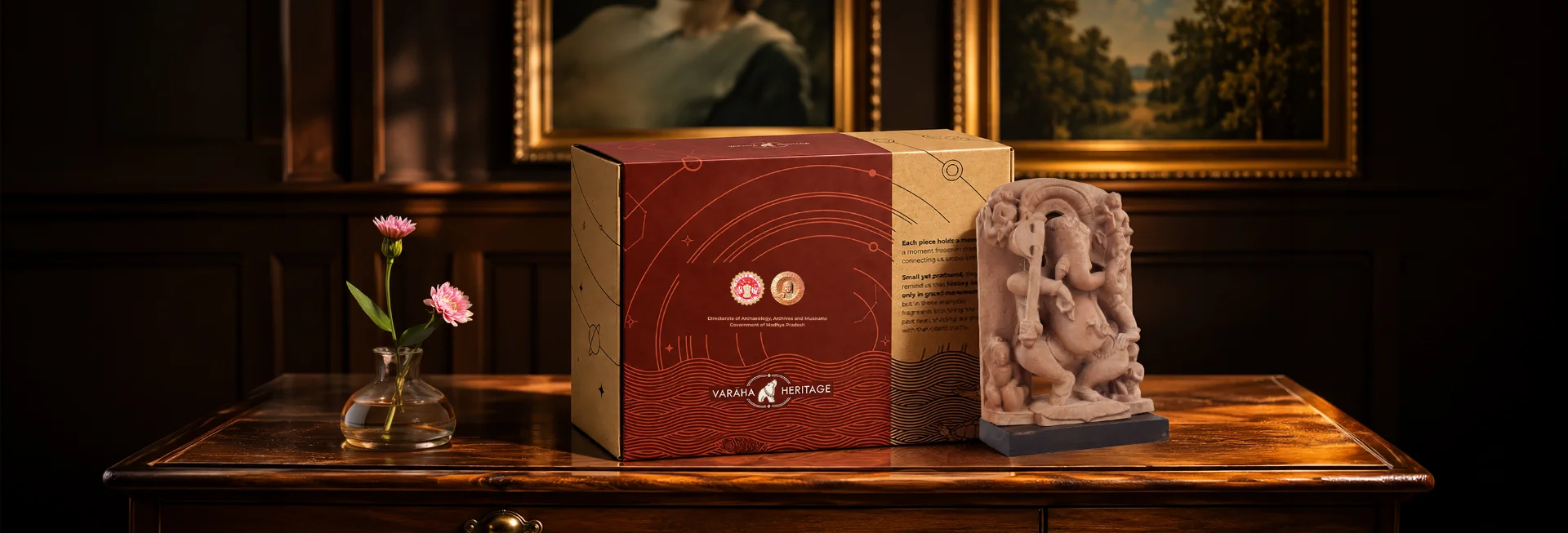
This is exactly the role Varaha Heritage's Ganesha Sculpture is built to anchor. It is a Hand-Finished replica of a 10th-century dancing Ganesha from Ashapuri, Raisen district, now preserved at the Triveni Museum, Madhya Pradesh, following the Rupamandana's own description of Vighnaharta accompanied by his attendants, rather than a generic market casting of the deity. A documented piece like this, with a known period, site and museum of record, is what separates a durable Diwali fixture from a disposable festival idol, and it is the kind of detail most mass-produced Ganesha idols simply don't carry.
Other Auspicious Diwali Deities: Saraswati, Kubera, Vishnu-Lakshmi, Kamdhenu and Durga
Beyond the core Lakshmi-Ganesha pairing, a few other deities have well-established roles in Diwali worship depending on the household's tradition and what the festival means to them that year.
A saraswati idol is commonly added by households and businesses that want the festival's blessing to extend to knowledge, learning and the arts alongside wealth, a pairing with deep roots in Bengal, where Lakshmi, Ganesha and Saraswati are worshipped alongside Goddess Durga as her children during Durga Puja. Businesses in particular favour this trio for opening new account books (chopda pujan) on Diwali, since the occasion is meant to bless not just the money earned over the coming year but also the knowledge and judgement used to earn and manage it.
A kubera idol is most closely associated with Dhanteras, the festival's opening day, where Kubera, the treasurer of the gods and guardian of wealth, is worshipped specifically for financial prosperity and protection of existing wealth, making a kubera idol a fitting addition for a household or business focused on safeguarding what they already have rather than only inviting new abundance. Unlike Lakshmi, whose blessing is about inviting new prosperity, Kubera's role is custodial, several households keep his image specifically near where valuables, cash or jewellery are stored, rather than on the main puja altar itself.
A vishnu lakshmi idol, worshipped as the combined form Lakshmi Narayan, is chosen by households that prefer to honour the divine couple together rather than Lakshmi paired with Ganesha. This form emphasises Lakshmi's eternal devotion to Vishnu as much as her role as goddess of wealth, and works well as a Diwali centrepiece for households drawn to that relationship as the core symbol of the festival rather than the more common Lakshmi-Ganesha pairing. The pairing also carries its own logic for the festival, Vishnu is worshipped throughout the year as the preserver of dharma and order, and Lakshmi's presence beside him on Diwali is read as wealth placed directly in service of that order, rather than pursued independently of it.
Varaha Heritage's Lakshmi Narayan Sculpture (12 inch) is built specifically around this form. It reproduces a 12th-century sculpture from Dhanauli, Mandla, now at the Triveni Museum, Ujjain, showing Vishnu and Lakshmi together in Lalitasana on Garuda, framed by the Dashavatars, the ten incarnations through which Vishnu is believed to have restored dharma across different eras. Few Diwali idols in the market carry that level of documented specificity, most are generic depictions of the couple with no named period, site or museum behind them, which is precisely what makes a piece like this stand apart as a centrepiece rather than a seasonal decoration.
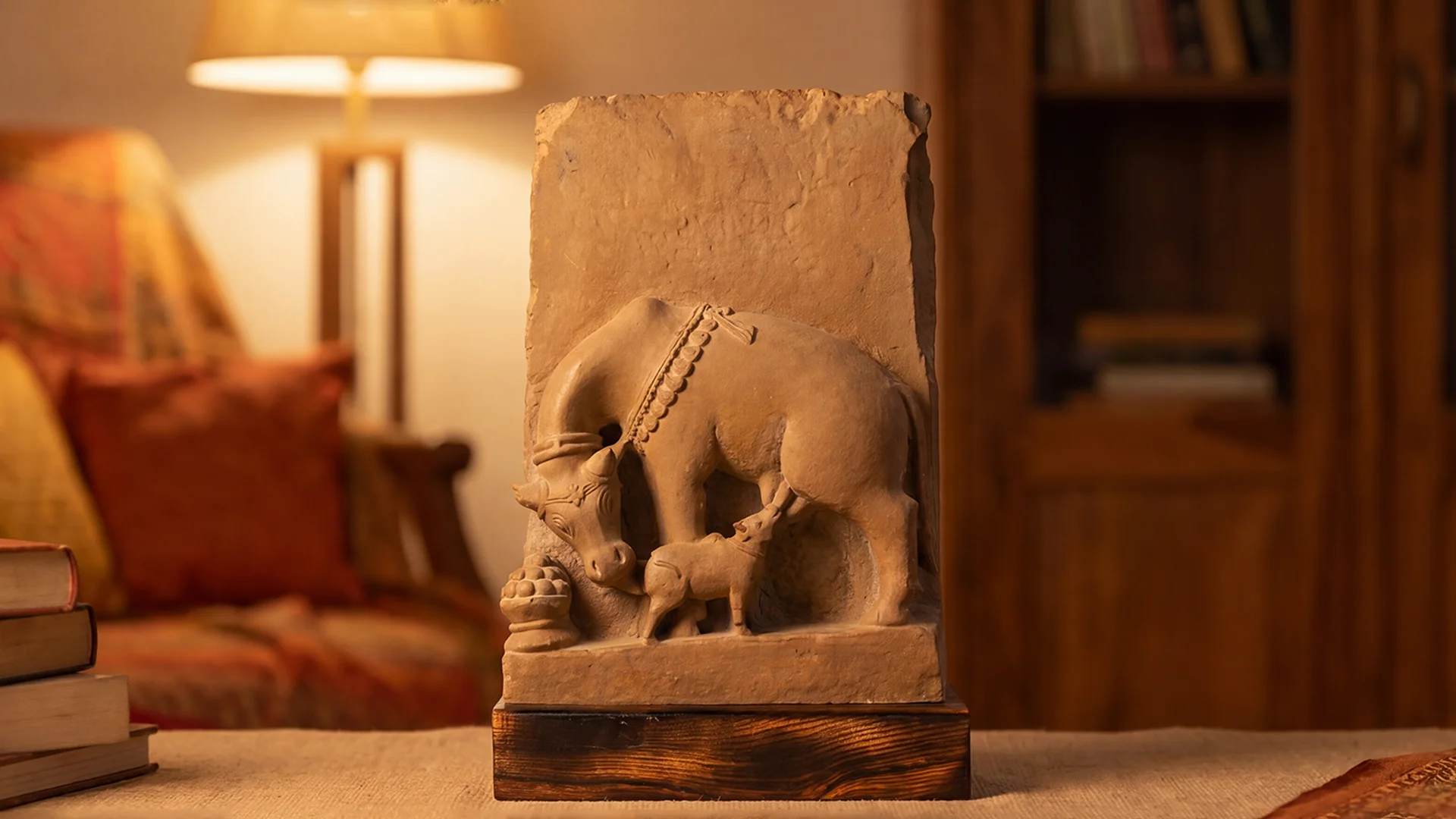
A kamdhenu idol carries a connection to Diwali that many households overlook. In Maharashtra and Gujarat, the festival actually begins a day before Dhanteras with Vasu Baras, also called Govatsa Dwadashi, when cows and their calves are worshipped as living symbols of nourishment and abundance, and the tradition returns on Govardhan Puja, the day after Diwali. Kamdhenu, the divine wish-fulfilling cow, is believed to have emerged from the Samudra Manthan, the same churning of the cosmic ocean from which Lakshmi herself arose, which is why a kamdhenu cow and calf idol sits so naturally beside Lakshmi on a Diwali altar. Where Lakshmi represents wealth, Kamdhenu represents the steady, nourishing kind of abundance that sustains a household, and common Vastu guidance places her in the South-West zone of the home, where she is believed to bring prosperity, health and positive energy.
Varaha Heritage's Kamdhenu Sculpture (available in 9 inch and 4 inch) is a Hand-Finished replica of a 12th-century Kamdhenu from Mandsaur district, now preserved at the State Museum, Bhopal. It shows the divine wish-fulfilling cow nursing her calf, a depiction long read as a symbol of motherhood and nourishment given without expecting anything in return. Like the rest of the collection, it carries a documented history rather than a generic market design, which makes it a meaningful Dhanteras or Diwali gift for families who keep the Vasu Baras tradition.
A durga idol reflects a side of Diwali that runs deeper than most guides acknowledge. On Diwali night, households across Bengal, Assam and Odisha worship Kali, the fierce form of Goddess Durga, instead of or alongside Lakshmi, and in many Gujarati and Marwari homes, chopda pujan invokes Mahakali, Mahalakshmi and Mahasaraswati together, the three forms of the Devi who protect, provide and enlighten. Lakshmi herself is described in the Devi Mahatmya as one of the Goddess's own forms, so Durga and Lakshmi on the same altar read as a single, continuous blessing rather than two separate ones. This makes a durga murti for home a fitting choice for households that want the festival's blessing to include protection of family and home, not only the arrival of new wealth, and for families who celebrate Navratri, Durga Puja and Diwali as one festive season.
Varaha Heritage's Durga Sculpture (10 inch) reproduces a 9th–10th century CE sculpture of the goddess from Naraingarh. As with the Ganesha, Lakshmi Narayan and Kamdhenu pieces, its period and site of origin are documented, which is what lets it stay meaningful on the altar long after the festive season ends.
A 12th-century Kamdhenu from Mandsaur, welcoming abundance into your home this Diwali.
Choosing a Lakshmi or Ganesh Idol for Home: Material and Size
Once the deity or pairing is chosen, a lakshmi idol or ganesh idol meant to stay in the home beyond Diwali itself needs a different material and size consideration than a festival-only clay idol.
Diwali Deity Idol Materials Compared
Clay: Best suited for festival idols, especially where immersion is customary. It is not intended for permanent home display.
Silver or brass: Best suited for traditional daily puja and Dhanteras gifting. These metals are durable, traditional and hold fine detail well. Silver idols are especially popular as a Dhanteras purchase, since buying silver or gold on that day is itself considered auspicious.
Stone composite, Hand-Finished: Best suited for documented museum-replica pieces meant for year-round display. It is a lightweight alternative to stone with the same fine detailing, suited to daily darshan.
A lakshmi murti for home that will remain on display through the year works best in a permanent material rather than clay, since the idol becomes part of the household's daily puja rather than only its Diwali night ritual. The same applies to a ganesh murti for home, where a Hand-Finished stone composite piece holds the same level of detail as the original temple artifact it is based on without the fragility of clay. For size, a compact 7 to 9 inch piece suits most home puja corners, while a 12-inch sculpture works better as the centrepiece of a dedicated mandir room.
Posture is worth considering alongside material and size. A seated Lakshmi or Ganesha generally reads as calmer and more suited to daily, quiet worship, while a standing or more dynamic pose draws more visual attention and suits a prominent entryway or living room placement. A combined lakshmi ganesh idol, rather than two separate sculptures bought individually, also tends to be easier to place correctly, since it removes the question of exact relative positioning that two independent idols would otherwise raise.
Diwali Puja Items, Samagri and Decoration for Deity Idols
A deity idol is only the centrepiece of a much larger set of diwali puja items gathered for the evening. Standard diwali pooja samagri typically includes a kalash, diyas, incense, kumkum, akshat (rice), flowers, sweets as naivedya, panchamrit for abhishek, betel leaves and nuts, a few coins or currency notes placed near Lakshmi as a symbol of the wealth being invited, and a red cloth to seat the idols on, alongside the idols of Lakshmi and Ganesha themselves. Most households also keep an account ledger or set of business documents near the altar if chopda pujan is part of their Diwali, placed so it receives the same blessing as the idols themselves.
Diwali decoration around the altar matters almost as much as the samagri, rangoli at the entrance, strings of diyas or lights, and fresh flower garlands framing the idols are the most traditional choices, kept simple enough that the deity sculptures remain the clear visual focus of the space rather than being overshadowed by the decor around them.
Vastu for Diwali Deity Idols: Direction and Placement
Vastu guidance for Diwali deity idols follows the same broad principles used for most auspicious home sculptures, with a few points specific to the Lakshmi-Ganesha pairing.
Diwali Deity Vastu: Dos and Don’ts
Do:
Place Lakshmi-Ganesha idols in the North or Northeast zone of the puja room.
Face deity idols toward the main door or west, so they appear to bless the household as they enter.
Keep Ganesha to Lakshmi’s right when placed as a pair.
Place idols at a slight height, ideally in a dedicated mandir unit.
Don’t:
Place the idols in a bedroom or facing a bathroom.
Place the idols directly on the floor without a raised platform or pedestal.
Keep a chipped or broken idol on display.
Crowd the altar with too many unrelated idols or decor pieces.
Most common Vastu guidance recommends deity idols in a home mandir face either the main entrance or west, so the household encounters their blessing while entering or leaving. The North or Northeast zone of the home is generally considered the most auspicious location for the mandir itself, consistent with how Vastu treats most benevolent deity placements, including Lakshmi and Ganesha specifically during the Diwali season.
A commonly followed convention places Ganesha to Lakshmi's left as the worshipper faces the altar, which corresponds to Lakshmi's own right, a position of honour in most Vastu and puja traditions. This is a general convention rather than a fixed rule, and households following a specific regional or family tradition should defer to that practice over a generic guideline, since Vastu guidance for deity placement has always varied somewhat by region, lineage and the specific priest or text a family follows. What stays consistent across most traditions is the underlying principle, the idols should sit elevated rather than at floor level, face outward toward the household, and avoid locations associated with impurity such as bathrooms, storage areas, or spaces directly beneath a staircase.
Varaha Heritage's Ganesha, Lakshmi Narayan, Kamdhenu and Durga Sculptures for Diwali 2026
What sets Varaha Heritage apart in a market full of mass-produced Diwali idols is simple: every piece starts as a real, documented artifact, not a generic mould. The Ganesha Sculpture, the Lakshmi Narayan Sculpture (12 inch), the Kamdhenu Sculpture and the Durga Sculpture, covered in detail above, are all Hand-Finished reproductions of specific, named sculptures, each researched for its own period, site and iconographic tradition before a single detail is reproduced. That is the difference between an idol bought because it looked right on a shelf and one bought because its history and craftsmanship can actually be explained to a guest who asks about it.
Every piece arrives in a premium presentation box with a certificate of authenticity, the same standard applied across Varaha Heritage's full catalogue, which makes any one of them work equally well as a diwali gift, for a housewarming, a wedding, or simply for a household setting up its first proper mandir, rather than as a generic festival idol discarded after the season ends. Choosing between them comes down to which form of the festival's blessing a household wants at its centre, Ganesha's wisdom alongside Lakshmi's abundance, Lakshmi and Vishnu's devotion to each other as the festival's central image, Kamdhenu's nourishing abundance, or Durga's protection of the home.
None of these pieces is built only for the five days of Diwali. Because each is Hand-Finished from stone composite rather than cast from clay, they are meant for the same kind of year-round daily darshan covered earlier in this guide, which makes the choice between them less about which one suits Diwali night specifically and more about which deity a household wants presiding over its puja space for years afterward. A documented, museum-sourced piece also tends to hold its meaning better over time than a generic festival idol, since the family buying it knows exactly which temple tradition, period and region the sculpture is drawn from, down to the specific site it was originally made for and the museum where the artifact itself is still preserved today.
Frequently Asked Questions
Which deity idol is considered auspicious for Diwali?
Lakshmi is the festival's central deity, most commonly worshipped alongside Ganesha, though Saraswati, Kubera, Vishnu-Lakshmi, Kamdhenu and Goddess Durga all have established roles depending on the household's tradition.
Why are Lakshmi and Ganesha worshipped together on Diwali?
Ganesha's wisdom and obstacle-removing role are believed to ensure the wealth Lakshmi brings is used well, which is also why Ganesha is worshipped first in the puja sequence.
Can Lakshmi Narayan be worshipped or gifted during Diwali?
Yes, Lakshmi Narayan, the combined form of Vishnu and Lakshmi, is a traditional Diwali choice for households that want to honour the divine couple together rather than the Lakshmi-Ganesha pairing.
Is a Kamdhenu idol auspicious for Diwali?
Yes, Kamdhenu is worshipped on Vasu Baras, the day before Dhanteras, and again on Govardhan Puja, and as a symbol of nourishing abundance she is considered a fitting companion to Lakshmi on the Diwali altar.
Can Goddess Durga be worshipped on Diwali?
Yes, Durga is worshipped as Kali on Diwali night in Bengal, Assam and Odisha, and as Mahakali alongside Mahalakshmi and Mahasaraswati during chopda pujan in many Gujarati and Marwari households.
Where should Lakshmi-Ganesha idols be placed for Diwali according to common Vastu guidance?
The North or Northeast zone of the puja room is generally recommended, with the idols facing the main entrance or west.
Which direction should deity idols face in a home mandir according to Vastu?
Most common Vastu guidance suggests facing deity idols toward the main entrance or west, so they appear to bless the household on entry.
Conclusion
Choosing which deity sculpture is auspicious for Diwali comes down to the blessing a household wants to centre the festival on, Lakshmi and Ganesha together for wealth matched with wisdom, Saraswati added for knowledge, Kubera for the wealth already held, Lakshmi Narayan for devotion and prosperity as one united form, Kamdhenu for nourishing abundance, or Goddess Durga for protection of the home. None of these choices are mutually exclusive, and many households build toward a fuller collection over several Diwalis rather than settling on one sculpture for life. Varaha Heritage's Hand-Finished Ganesha, Lakshmi Narayan, Kamdhenu and Durga Sculptures bring any of these starting points into the home as documented museum replicas rather than disposable festival pieces. Explore Varaha Heritage's collection to find the diwali puja idol that belongs on your altar this November.