On the outer edge of an 11th-century temple doorframe from Hinglajgarh, a lion-like beast stands poised above an elephant, with graceful celestial women stacked above them in a slim vertical strip. A sculptor spent real skill on the threshold, the one spot you walk through without stopping. Why did the doorway matter so much? And what does it have to do with the marigolds you'll hang on your own door at Diwali?
That question sits at the heart of Diwali home decor with traditional Indian sculptures. This guide covers the history behind festive decoration, how Varaha Heritage recreates museum originals, and room-by-room ideas for your entrance, living room and pooja room. It also looks at materials, styling with diyas and flowers, and six pieces from the Varaha Heritage collection.
Diwali Home Decor with Sculptures: A Quick Overview
Diwali is timed by the Hindu lunisolar calendar and falls around the new moon, so its date on the Gregorian calendar changes every year. That makes it worth planning your decoration a few weeks ahead. Most Diwali home decoration is gloriously temporary: marigolds wilt, rangoli scatters and diyas burn down. A sculpture is the opposite, because it's still in your home long after the festival ends.
That's why Diwali sculpture decor has become a quiet favourite in Indian home decor. Traditional Indian sculptures belong to the same family as the lamps and torans (decorative door garlands) around them, since each one welcomes, protects or blesses. A well-chosen piece anchors the temporary festive home decor and gives guests something to ask about.
Here's a quick map of each space and the role a sculpture plays in it. The sections after it explain why these subjects, and how to place them.
● Entrance: the sculpture welcomes guests and stands as a threshold guardian. Ganesha and temple doorway motifs suit it best, such as the Ganesha and the Dwar Shakha from Varaha Heritage.
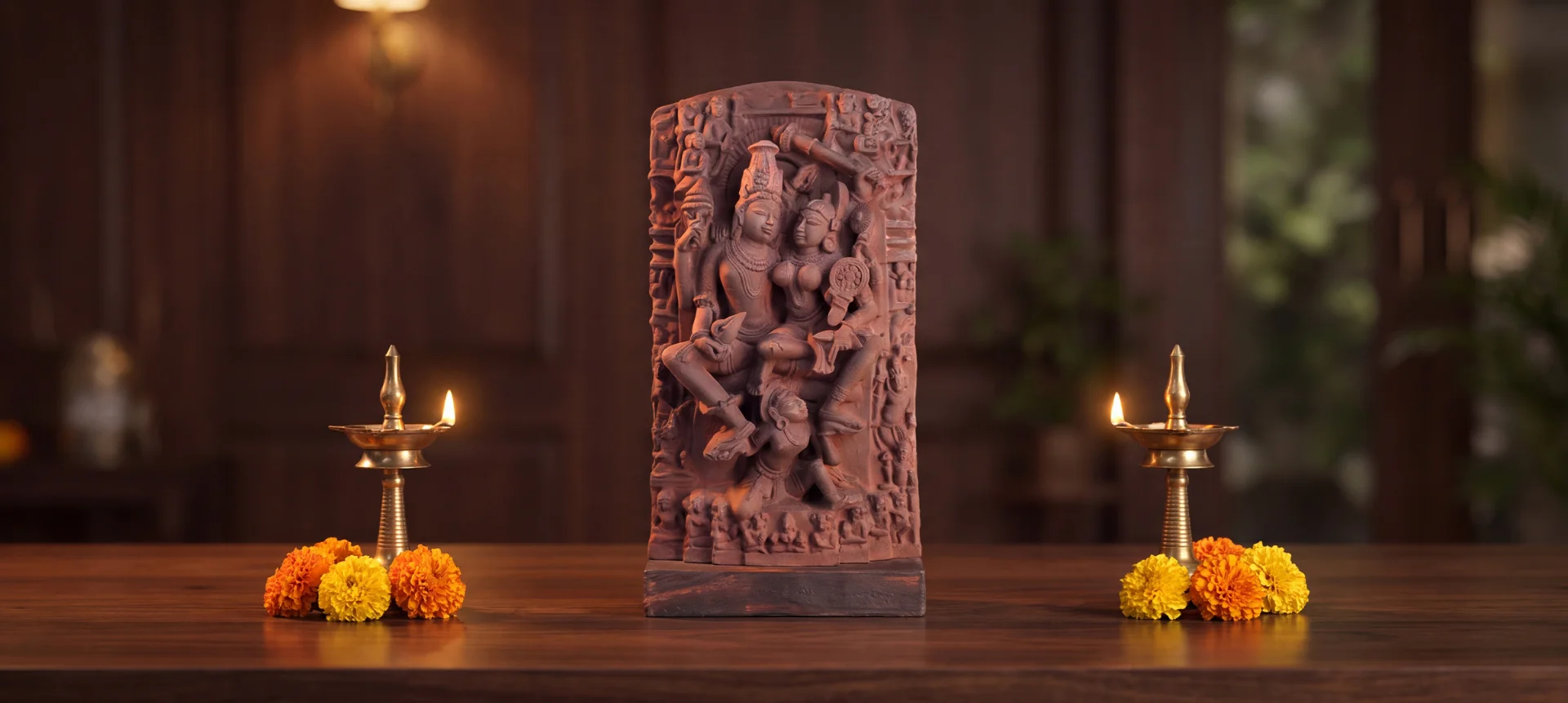
● Living room: the sculpture becomes the conversation focal point. A divine couple or an architectural landmark works well, such as the Lakshmi Narayan (12 Inch) or the Hawa Mahal Facade.
● Wall, shelf or niche: the sculpture is an accent beside lights and frames. A compact deity piece fits, such as the Lakshmi Narayan (8 Inch).
● Pooja room: the sculpture is the focus of worship. Lakshmi with Vishnu or Kamadhenu suit it, such as the Lakshmi Narayan (8 Inch) or the Kamdhenu.
The History Behind Traditional Diwali Decoration
Every element of traditional Diwali decoration has a long record. The lamp, the flower, the gateway and the goddess each appear in stone and in ritual long before any shop sold them as decoration items.
Lakshmi in Stone
Lakshmi, the goddess of prosperity, was shaped in stone long before the temples of the medieval period. Images of Gajalakshmi, Lakshmi bathed by two elephants, appear on the railing pillars and gateways of the Buddhist stupas at Sanchi in Madhya Pradesh. The American Institute of Indian Studies dates these reliefs to roughly the second and first centuries BCE. A Gajalakshmi medallion from the railing of the Bharhut stupa, now in the Indian Museum, Kolkata, is generally dated to about 125 to 100 BCE. Note where they sit: on railings and gateways, at the point of entry.
Lakshmi is also known as Shri, a word that means radiance, prosperity and good fortune together. The Lakshmi Narayan replica from Dhanauli, which you'll meet later, comes from the same long line of images. Its original was made around 900 years ago.
The Temple Doorway
Now return to Hinglajgarh, in Mandsaur district, and the temple doorframe from our opening. The sculpture is a Dwara Shakha, the "limbs" or vertical jambs of a temple doorframe. In temple architecture, these elements marked the boundary between the everyday world and the sanctum.
The 11th-century example, now at the State Museum, Bhopal, shows a Vyala, a lion-like composite creature, poised above an elephant. This pairing is read as the victory of spiritual power over worldly ignorance and ego. Beside them stand Surasundaris, celestial women who represent fertility, beauty and auspiciousness, and who welcome devotees in.
So here's the answer to the question we began with. A threshold is where a visitor changes state, from outside to inside, and sculptors treated it as a place to bless. A marigold toran across your front door carries the same idea. You are dressing the threshold for guests and for the goddess, just as medieval sculptors dressed theirs.
Where the Originals Live
India's temple sculpture mostly survives in museums today, where it's studied, labelled and kept safe. Two collections matter for this guide. The Triveni Museum in Ujjain, in a city that was once the capital of the Avanti kingdom, holds galleries devoted to Shiva, Shakti and Vaishnava traditions. The State Museum in Bhopal holds the Hinglajgarh doorjamb.
Most of us meet such objects behind glass, briefly moved, and then we walk on. That gap between seeing a masterpiece and living with its story is exactly where Varaha Heritage works.
Varaha Heritage: Museum-Authenticated Replicas for Your Home
Varaha Heritage makes museum-authenticated replicas of historic Indian sculptures, and each piece is recreated from a specific museum-held original. The company's About page says it began with a question that wouldn't let the team go: why does history feel like something that happened to someone else? Its answer is an object you can keep on a shelf, with the provenance of a museum piece attached.
The Idea Behind the Name
The name comes from the Varaha avatar of Vishnu, the boar form who, in tradition, lifts the earth out of the cosmic ocean. The company says its own work follows a similar principle: much of India's heritage isn't lost, only out of reach in storerooms and distant sanctums. Before making physical pieces, Varaha Heritage built a 3D scanning platform, heritageverse.net, so people could explore museum objects online.
The About page puts the aim plainly. Varaha objects aren't merely decorative. They're meant to be accurate, researched and museum-endorsed, made to be lived with and passed on.
What Sets a Replica Apart
On the product pages, each replica is Hand-Finished in stone composite, a material the Ganesha page describes as engineered to match the weight and texture of temple stone. Care is simple: a gentle wipe with a soft, dry cloth. Every page also names the original's era, its village of origin and the museum that holds it.
Among Indian sculptures sold for homes, that documented link between museum original and shelf is what sets a Varaha Heritage piece apart. It also gives your Diwali shelf a story to tell, which is why every room in the next section starts from a named museum piece.
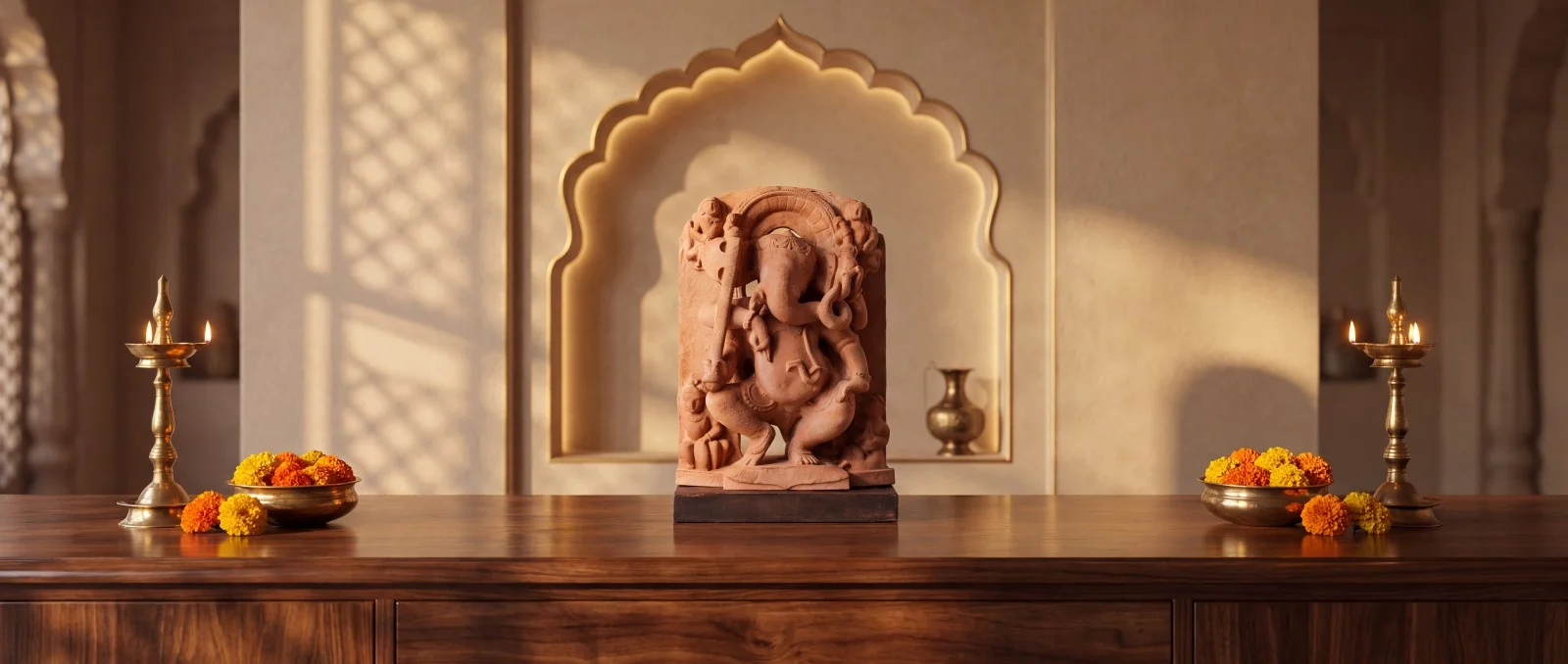
A 10th-century dancing Ganesha, Hand-Finished and museum-certified.
Diwali Decoration Ideas for Home, Room by Room
Plenty of articles list diwali decoration ideas, but most are a pile of items. Here's a quieter approach. These diwali decor ideas pair each space with one sculpture and a few supporting touches, so the house feels welcoming and not crowded. If you've been searching for diwali decoration ideas for home that last beyond the festival, start here.
How to Decorate Home During Diwali: Start with One Focal Point
The most useful rule for how to decorate home during diwali is to pick the hero first. Choose one sculpture for each zone, then build lights, flowers and fabric around it. Your diwali decoration items (diyas, torans, lanterns, rangoli colours, flowers) should support the sculpture and not compete with it.
Many people ask how to decorate house for diwali on a budget of time, not money. Do it in the order guests will experience it: entrance first, living room second, pooja room last. That sequence also mirrors how a visitor moves through a temple.
Diwali Entrance Decoration
For diwali entrance decoration, think of the Hinglajgarh doorframe. A small sculpture on a console, shoe cabinet or ledge near the door tells guests they have arrived somewhere meaningful.
The Ganesha sculpture is a natural choice. Ganesha is Vighnaharta, the remover of obstacles, and the product page suggests styling it as a decorative figurine for an entryway or office. Vastu tradition favours the Northeast zone for him, though schools of Vastu differ, so treat that as guidance and not a rule.
A Dwar Shakha sculpture adds a literal threshold motif. It's a bookend mounted on a base, so it sits well on an entry shelf beside a stack of books or a bowl of flowers. Add a marigold and mango-leaf toran above the door and a rangoli, a floor pattern of coloured powder, at the foot. If you want a Ganesh statue for home that greets visitors, this is where it belongs.
Diwali Living Room Decoration
Diwali living room decoration works best with one large statement. The Lakshmi Narayan sculpture (12 Inch) gives the Dashavatara frame, the ten incarnations of Vishnu, enough room for the small figures to read clearly across the room. A coffee table, sideboard or console is ideal.
For a different mood, the Hawa Mahal Facade sculpture brings Jaipur's palace into the room. It isn't a deity, so it suits a household that likes heritage without the ritual. Keep the palette calm. Two colours plus the warm glow of lamps look better than five.
Diwali Wall Decoration
Diwali wall decoration usually means fairy lights and paper hangings, but a wall also frames a sculpture beautifully. The Varaha Heritage product pages don't describe wall-mounting, so treat these as shelf pieces: set them on a ledge, niche or console against the wall.
Paint or drape the wall behind in a deep colour, such as maroon or indigo, and the stone tone will stand out. String lights above, not around, the piece. A compact Lakshmi Narayan (8 Inch) fits a narrow ledge neatly.
Diwali Pooja Room Decoration
Diwali pooja room decoration is the most personal of all. The room needs to be clean, bright and uncluttered before Lakshmi Puja, which is traditionally performed during Pradosh Kaal, the twilight window just after sunset. Check your local panchang (Hindu almanac) for exact timings, since they shift by city.
If you're wondering how to decorate mandir for diwali, begin with the base. Use a clean, raised platform, a fresh cloth, a kalash (water pot) and one lamp for each deity. The Lakshmi Narayan 8-inch replica suits a pooja shelf, and its product page places it in the Northeast or East zone of a room. The Northeast is called Ishanya in Vastu tradition. Advice varies between families, so follow your own custom first.
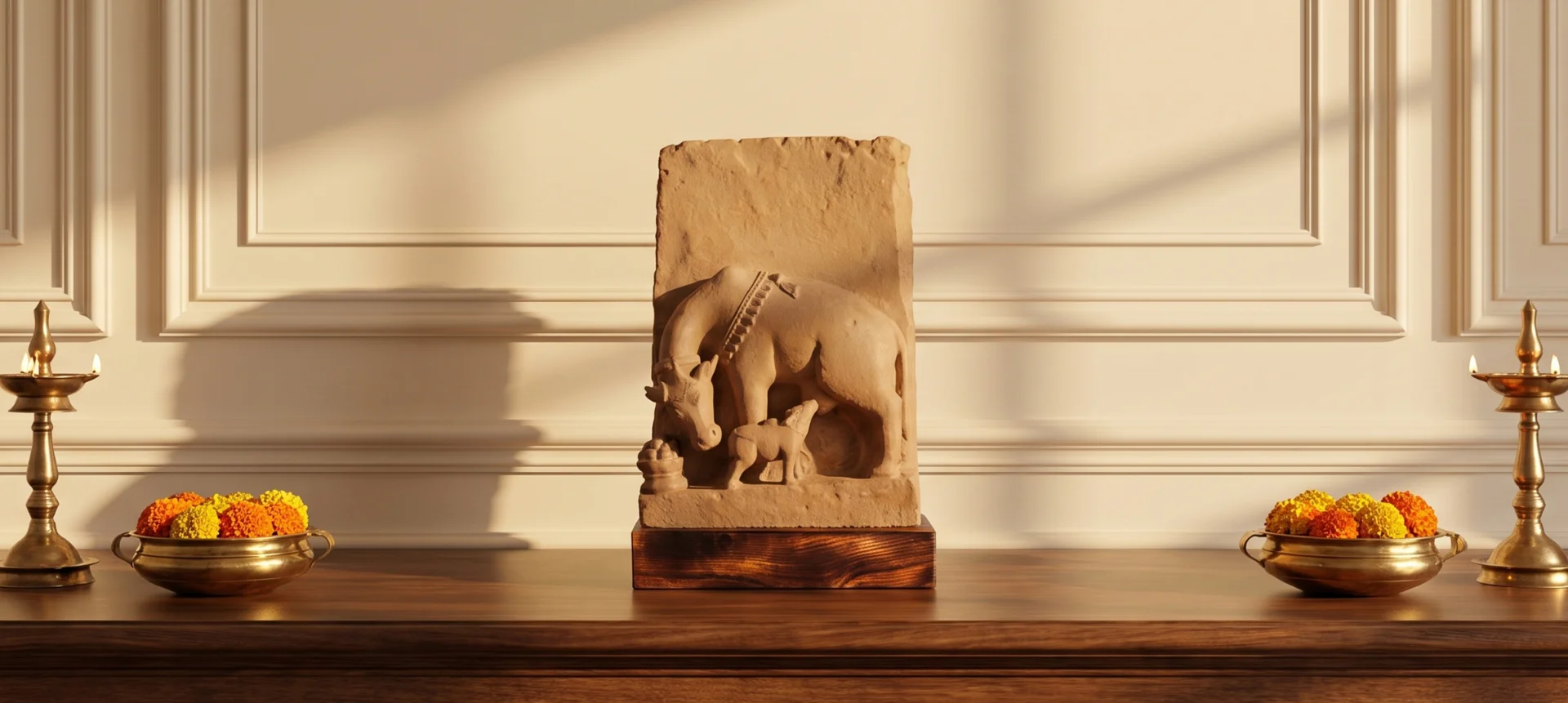
The Kamdhenu sculpture shows the wish-fulfilling cow nursing her calf. According to the product page, she rose from the churning of the ocean along with Lakshmi, which makes her a lovely companion for the goddess's evening.
Dos and Don'ts for Sculpture Decor
A few quick pairs keep the arrangement calm and the sculptures looking their best.
● Do give each sculpture breathing room, roughly a hand's width on every side. Don't line up five deity figures on one shelf with no gaps.
● Do place sculptures at eye level or on a raised surface. Don't leave worship pieces on the floor or beside shoes.
● Do keep flames a hand's breadth away from the stone. Don't set a lit diya directly against a sculpture.
● Do repeat one or two colours across flowers, cloth and lights. Don't mix every Diwali colour at once.
● Do wipe the piece gently with a soft, dry cloth. Don't scrub it with water or harsh cleaners.
Choosing Materials and Styling Sculptures for Festive Home Decor
Walk through any market before Diwali and the choices multiply. Understanding the material, and how to light and dress it, will help you build a coherent look in traditional Indian decor.
Stone Composite or Clay: Which Material Suits Your Home?
You'll find brass statues for home decor in many markets, but Varaha Heritage doesn't make brass, so this guide sticks to what the collection offers. Every piece is Hand-Finished stone composite, recreated from a museum original.
Stone and stone composite give a quieter, earthier effect. The surface is matte, and the fine detail of medieval temple work holds well. If you're choosing a Lakshmi statue for home with historical depth, the Lakshmi Narayan replicas show Lakshmi beside Vishnu on Garuda, framed by the Dashavatara.
Clay is the oldest material of all. It's what most diyas are made from, and it's best kept for lamps and festival-only items.
In short, stone composite suits heritage replicas, display pieces and pooja shelves, with only a soft, dry cloth for care. Clay suits diyas and festival items, and it's best handled gently and used seasonally.
If you mix materials, let one lead and the other support. Let the stone sculpture be the hero, then keep any metal accents, such as lamps, a bell or a small tray, few and in one matching tone. That looks planned, and nothing competes with the sculpture.
How to Decorate Diya for Diwali Around a Sculpture
Light is what makes a heritage sculpture look festive in any Diwali home decoration scheme. When planning how to decorate diya for diwali, think of diyas as a halo. Place three or five at a respectful distance in front of the sculpture, never touching it. A few tiny gold or red dots on the rim of each clay lamp are enough decoration.
Keeping lamps a hand's breadth away protects the stone surface from soot. It also means the light falls on the sculpture's face and hands, which is where the best detail sits.
Flowers That Suit Each Deity
Marigold, called genda in Hindi, is the festival's signature flower, and it's easy to weave into a toran or scatter around a base. Lotus belongs to Lakshmi, who is shown seated on it or holding it. Many families offer durva, a fine grass, to Ganesha. Fresh petals around the base of a sculpture soften the stone, but keep them clear of the flame.
If you're thinking about how to decorate mandir for diwali with flowers, use fewer than you think you need. A single garland and a small bowl of petals leave the deity as the focus. A crowded altar can hide the very detail that makes a replica worth owning.
Heritage Sculptures for Your Diwali Home
Here are six pieces from the Varaha Heritage collection that fit the rooms above. Each is Hand-Finished in stone composite, and each product page names its source. Five are replicas of museum-held originals, and the sixth, the Hawa Mahal, is a tribute to a landmark. At a glance:
● Ganesha: 10th century CE, Ashapuri, Raisen; original at the Triveni Museum, Ujjain. A dancing Ganesha with cymbal-playing attendants, for an entryway or office desk.
● Lakshmi Narayan (8 Inch): 12th century CE, Dhanauli, Mandla; original at the Triveni Museum, Ujjain. Vishnu and Lakshmi on Garuda, framed by the Dashavatars, for a pooja shelf, study desk or ledge.
● Lakshmi Narayan (12 Inch): the same composition at a larger scale, for a living room console or larger mandir.
● Kamdhenu: 12th century CE, Mandsaur district; original at the State Museum, Bhopal. The wish-fulfilling cow nursing her calf, for a pooja room, kitchen or office desk.
● Dwar Shakha: 11th century CE, Hinglajgarh, Mandsaur; original at the State Museum, Bhopal. A temple threshold with Vyala, elephant and Surasundaris, for an entry shelf or bookshelf.
● Hawa Mahal Facade: the 1799 facade in Jaipur, Rajasthan, for a living room or reception table.
Ganesha Sculpture
The Ganesha sculpture recreates a 10th-century original from Ashapuri in Raisen district, now at the Triveni Museum, Ujjain. It shows Ganesha in a dancing posture, with attendants playing cymbals in time with the dance. The product page places it in the transitional phase of Pratihara-Parmara art and notes that the earliest dancing Ganesha images date back to the 6th century. For anyone looking for a Ganesh statue for home that feels joyful and not solemn, it's a lively choice.
Lakshmi Narayan Sculpture (8 Inch and 12 Inch)
The Lakshmi Narayan replicas come from a 12th-century original from Dhanauli in Mandla district, now at the Triveni Museum in Ujjain. Vishnu and Lakshmi sit in Lalitasana, the relaxed pose with one leg folded and one lowered. Beneath them, Garuda, Vishnu's vahana (divine mount), holds Vishnu's right leg in one palm and Lakshmi's left in the other. The Dashavatars frame the scene.
The 8-inch size suits a pooja shelf, study desk or ledge. The 12-inch size gives the frame more presence in a living room. For a household that wants a Lakshmi statue for home with a documented past, these are the closest match in the collection, since they show the goddess with Vishnu and not alone.
Kamdhenu Sculpture
The Kamdhenu sculpture recreates a 12th-century original from Mandsaur district, now at the State Museum, Bhopal. It shows Kamadhenu, the divine wish-fulfilling cow, nursing her calf. The product page describes her as a symbol of abundance and maternal divinity, and suggests an office desk, kitchen or puja room.
Dwar Shakha Sculpture
The Dwar Shakha sculpture takes the temple doorjamb from the history section and turns it into a bookend. The original comes from Hinglajgarh in Mandsaur and is preserved at the State Museum, Bhopal. The product page dates it to the 11th century CE. It makes an unusual accent for an entry shelf or library.
Hawa Mahal Facade Sculpture
The Hawa Mahal Facade sculpture is a tribute to the 1799 facade in Jaipur, built by Maharaja Sawai Pratap Singh and designed by the architect Lal Chand Ustad. The five-storey original is pierced by 953 small latticed windows called jharokhas, and it was conceived in the shape of Krishna's crown. It's a landmark tribute and not a replica of a museum object. It suits a living room console or reception table.
Frequently Asked Questions
Which traditional Indian sculptures work well for Diwali home decor?
Lakshmi and Ganesha are the most familiar choices, with Lakshmi Narayan, Kamadhenu and architectural pieces such as a temple doorjamb (Dwara Shakha) also fitting the festival. Choose by space: a deity piece for the pooja room, and a landmark or doorway motif for a living area or entrance.
How can I decorate a home with sculptures without overcrowding the space?
Pick one sculpture for each zone and let lights, flowers and fabric support it. Leave clear space of roughly a hand's width around each piece, and keep to two or three colours.
Which sculptures suit an entryway during Diwali?
Ganesha, the remover of obstacles, is a natural fit, and a Dwara Shakha bookend echoes the temple threshold. Both work on a console or entry shelf beside a toran and rangoli.
Can brass and stone sculptures be mixed in festive decor?
Yes, as long as one material leads. Let the stone sculpture be the focus and keep any metal accents, such as lamps, a bell or a tray, few and in one tone so the look stays coordinated.
How can heritage sculptures be styled with diyas and flowers?
Place diyas a hand's breadth in front of the sculpture and never against it, so the flame lights the piece without touching it. Add a small ring of fresh marigold petals or a single garland at the base, keeping flowers clear of the flame.
Conclusion: Diwali Home Decor That Outlasts the Festival
A sculptor in Hinglajgarh once gave a doorway a Vyala, an elephant and a row of celestial women, because the threshold was worth blessing. Your Diwali home decor does the same thing every year, with marigolds, lamps and a goddess invited in. A sculpture from a documented museum original keeps that idea in the house long after the lamps are packed away.
That is the idea Varaha Heritage was built on: heritage you can live with, not only look at behind glass. Start at the entrance with Ganesha or the Dwar Shakha, give the living room one strong piece, and keep the pooja room simple. Explore the full Varaha Heritage collection of museum replicas, or begin with the Lakshmi Narayan sculpture to bring the goddess home.