The ocean of milk had been churning for what felt like an age. Gods pulled one end of the great serpent while demons hauled the other, and a mountain spun between them. Then the water turned black with a poison that could have ended all three worlds, and only after Shiva swallowed it did the waves start to glow again. Out of that light stepped a goddess holding a lotus, and she was about to make a choice. It's the choice every Lakshmi Narayan sculpture remembers.
For centuries, stories like this have lived not only in scriptures, but also in the sculptures carved by Indian artists. Varaha Heritage works to bring these stories closer to the present through museum-authenticated replicas of historic Indian sculptures. Each piece is recreated from a specific museum-held artefact, preserving its historical form, iconography, and connection to its original place and period. The aim is simple: to make India's heritage something that can be understood, lived with, and passed on not something experienced only from behind museum glass.
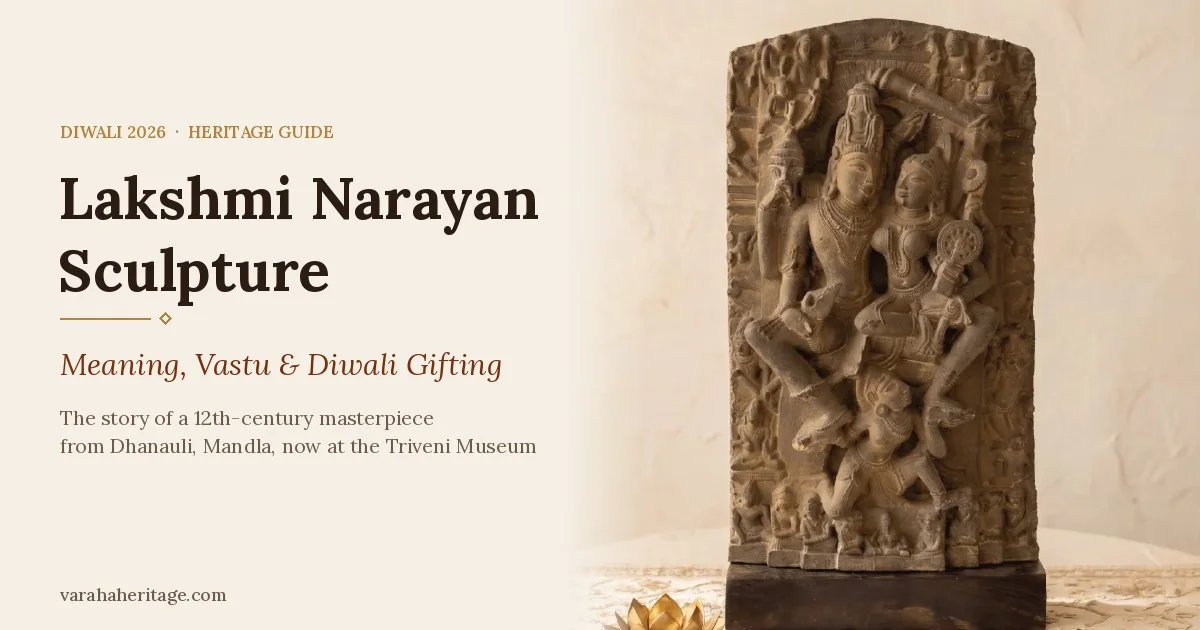
One such piece is the Lakshmi Narayan sculpture, a recreation of a 12th-century artwork from Dhanauli, Mandla, now preserved at the Triveni Museum in Ujjain. It depicts Vishnu and Lakshmi seated together on Garuda, surrounded by an intricate Dashavatara frame. Every detail from their posture to the figures carved around them offers a glimpse into the religious art and craftsmanship of medieval India.
In this, you'll discover the Lakshmi Narayan meaning and the story behind the divine couple, learn how to read the sculpture's iconography, explore commonly followed Vastu guidance, and understand why this museum replica has become a meaningful choice for Diwali gifting. But first, who did Lakshmi choose, and why him?
Lakshmi Narayan Meaning: The Story Behind the Divine Couple
A Garland, a Curse and a Bargain
The trouble began with a gift. The sage Durvasa, famous for his temper, handed Indra a garland of flowers, and Indra placed it on his elephant, Airavata, who tossed it to the ground. Durvasa didn't take it well, and he cursed the gods to lose their Shri, a word that means radiance, prosperity and good fortune all at once.
Without Shri, the gods grew weak, and their rivals, the asuras, pressed the advantage. So the gods went to Vishnu, whose advice surprised them: make peace with your enemies and churn the Kshira Sagara, the ocean of milk, together. The prize would be amrita, the nectar of immortality.
It was an uneasy deal. Mount Mandara became the churning rod and Vasuki, king of serpents, became the rope. When the mountain began sinking, Vishnu took the form of Kurma, a giant tortoise, and held it up on his back. Keep that tortoise in mind. He'll show up again.
What Rose from the Ocean
The Samudra Manthan, or churning of the ocean, first produced halahala, a poison so deadly that everyone fled. Shiva drank it and held it in his throat, which is why he's called Neelakantha, the blue-throated one. Then came the treasures: a wish-granting cow, a white horse, a radiant gem and a celestial tree.
And then Lakshmi. She rose seated on a lotus, holding another in her hand, and gods, sages and asuras all wanted her on their side.
The Choice
Here's the detail most people miss. In the Bhagavata Purana's telling, Lakshmi isn't handed to anyone; she looks over every candidate herself. One is wise but quick to anger. Another is powerful but can't let go of desire. Another is generous but lacks real insight. Finally she walks to Vishnu, who wasn't even asking, and places a garland of lotuses around his neck.
Vishnu gave her a permanent home on his chest, marked by the Shrivatsa, a curl-shaped sign said to be her dwelling place. From that moment, tradition says, they were never apart.
That's the heart of what the pair stands for. Lakshmi's name is traced to the Sanskrit root laks, to perceive or observe, so she's the one who sees clearly and helps devotees reach their goals. Narayana is often explained as nara, the waters, and ayana, a resting place, the one whose home is the primordial ocean. Together, they stand for prosperity that has chosen to rest beside order and protection. Wealth that knows where it belongs.
Why the Divine Couple Belongs to Diwali
Diwali 2026 falls on Sunday, November 8, on the night of Kartik Amavasya, the new moon and the darkest night of the month. Families light lamps because Lakshmi is believed to visit homes that are clean, bright and welcoming.
Many families also hold that Lakshmi rose from the ocean around this time of year, and some regional traditions say she wed Vishnu on Diwali night. These beliefs vary by community, but they share one idea: Lakshmi rarely travels alone.
That's why a Lakshmi Narayan puja feels so natural at Diwali. You aren't only inviting prosperity in; you're inviting it alongside the one she chose, which, in traditional thinking, helps it stay. The puja usually happens during Pradosh Kaal, the window just after sunset, and since exact timings shift by city, it's worth checking your local panchang, or Hindu almanac.
Want something to chant? The most familiar Lakshmi Narayan mantra builds on Vishnu's Ashtakshara, the eight-syllable Om Namo Narayanaya. Many families pair it with Om Lakshmi Narayanaya Namah, and either way, sincerity counts for more than perfect pronunciation.
You'll feel this at any big Lakshmi Narayan temple during Diwali week. Delhi's Laxminarayan Temple, built by the Birla family and inaugurated by Mahatma Gandhi in 1939, still draws huge festival crowds.
How to Read the Iconography

Here's what to look for in a carved idol of the pair, and while a good Lakshmi Narayan photo can show some of it, a carved piece reveals far more.
Lalitasana: The Posture of Ease
Lalitasana means the posture of graceful ease, with one leg folded on the seat while the other hangs down, relaxed. You'll notice that medieval sculptors often gave both deities this pose, so they mirror each other. It's the way rulers sit at rest, which suits a couple enthroned in Vaikuntha, Vishnu's heavenly abode.
Garuda, the Divine Vahana
Look beneath the couple. Garuda, the eagle-like vahana, or divine mount, of Vishnu, often appears supporting them. In some carvings he holds their feet in his open palms. It's a tender touch: the mightiest bird in Hindu tradition, gently bearing the two he serves.
The Four Attributes of Vishnu
Vishnu usually carries four objects. The shankha, or conch, called Panchajanya, stands for the first sound of creation, while the chakra, or discus, called Sudarshana, cuts through ignorance. The gada, or mace, called Kaumodaki, represents strength, and the padma, or lotus, signals purity. Which hand holds which varies by region, so don't worry if a carving differs from a print you've seen.
The Dashavatara Frame
Some of the finest sculptures surround the couple with the Dashavatara, the ten incarnations of Vishnu. Most lists include Matsya the fish, Varaha the boar, Narasimha, Rama and Krishna. And remember that tortoise from the churning? Kurma usually has a place in the frame too, so the story you've just read is quite literally carved into the border.
Lakshmi's Lotus and Embrace
Lakshmi typically holds a lotus, the flower she rose on. Her free arm often rests around Vishnu or on his shoulder, and that small gesture tells you this is a bond of affection rather than a formal pairing.
Lakshmi Narayan Murti Vastu: Placement and Direction

Vastu Shastra, the traditional science of space, has plenty to say here. It's belief-based and practitioners don't always agree, so think of what follows as widely shared suggestions rather than strict rules.
The Northeast and East Zones
Most advice on Lakshmi Narayan murti Vastu points to the northeast, known as Ishanya or the Ishan corner. It's considered the most sacred zone of a home, linked with clarity and divine energy. The east, which greets the rising sun, is the usual second choice.
Which Way Should It Face?
Here's where advice splits. Many Vastu guides suggest the idol face west, so you face east while praying, while others prefer the idol itself facing east. Both are widely followed, and most guides also advise against a south-facing placement for worship. Keep the idol off the floor, ideally at about chest height when you're seated in front of it.
In a Home Mandir
A Lakshmi Narayan idol for home sits beautifully in a home mandir. Give it a clean, raised platform, a small lamp and a little breathing room from other idols. If you already keep a separate Lakshmi idol for home and a Vishnu idol for home, the combined form can either join them or replace them as a single focal point.
In the Living Room
A living room works well if you place the piece in its northeast or east part, away from shoes and clutter. Guests will ask about it, and you'll get to tell the story of the churning.
On a Study Desk or Bedroom Shelf
A smaller sculpture can sit on a study desk or a bedroom shelf. Some Vastu followers prefer to keep worship idols out of bedrooms, while others are comfortable with a heritage piece that's displayed rather than worshipped. If you're unsure, a desk or quiet shelf in the northeast is a good middle ground.
Choosing the Right Material and Form
Walk into any market before Diwali and you'll find rows of Lakshmi Vishnu idol options. They aren't all alike, and the material changes how you'll live with the piece. Whether you call it a Vishnu Lakshmi idol, a Vishnu Lakshmi statue or a Lakshmi Narayan statue, the same three choices usually come up.
Brass
A Lakshmi Narayan brass idol is the classic pick for daily ritual. Brass can handle abhishekam, the ritual bathing with water or milk, and it glows warmly in lamplight. Mass-produced brass pieces tend to follow a familiar calendar-art look, though.
Marble
Marble suits a permanent mandir, since it's bright and calm to look at but heavy and harder to move. Most marble figures today follow modern devotional styles rather than medieval temple forms.
Stone and Stone Composite
Stone carries the look of real temple art, with deep carving and an earthy surface. Hand-finished stone composite gives you that texture at a weight that's easier to place on a shelf or send as a gift. Many museum replicas use it because it holds fine detail.
The Dhanauli Sculpture: A 900-Year-Old Story to Bring Home

Every detail from the story above is there in one remarkable 12th-century carving, made around 900 years ago at Dhanauli in Mandla, a district along the Narmada in Madhya Pradesh. Today the original is preserved at the Triveni Museum in Ujjain.
The couple sit together in Lalitasana. Beneath them, Garuda holds Vishnu's right leg in one palm and Lakshmi's left leg in the other. A frame of the Dashavatara runs all around them, so the tortoise from the churning keeps watch from the border. Look closely at the jewellery too, because sculptors of this period could make heavy stone seem light, almost like folds of fabric.
Indian art has two words for this. Kala is skill, the craft of the hand, and bhava is feeling, the emotion a piece carries. This sculpture has both, which is why it rewards a slow, second look.
Varaha Heritage has recreated it as a hand-finished stone composite museum replica in two sizes. Both arrive with a certificate of authenticity and a brochure on the original's history.
The 8-Inch Size
The 8-inch Lakshmi Narayan Sculpture suits a puja shelf, a study desk or a compact home mandir. It's the easier size to gift, since it fits on almost any surface and comes in a black display box that's ready to hand over.
The 12-Inch Size
The 12-inch Lakshmi Narayan Sculpture gives the Dashavatara frame more room, so the smaller figures read clearly even from a distance. It's the better pick for a living room focal point or a larger mandir, and it includes a greeting card for gifting.
Why It Works Among Diwali Gifts

Most Diwali gifts are forgotten by the new year, but this one carries a story the receiver can retell for decades. It suits couples and newlyweds especially, since the whole tale is about a deliberate, lasting choice. Tradition holds that Lakshmi with Narayan blesses a home with prosperity that stays balanced, though that's a matter of faith. If you want a Diwali gift idol that won't look like every other box on the table, a museum replica stands apart.
Frequently Asked Questions
What does a Lakshmi Narayan sculpture symbolize?
It symbolizes prosperity joined with protection and order. Lakshmi stands for material and spiritual wealth, while Narayan, or Vishnu, stands for the preservation of the world. Shown together, they suggest that abundance stays where dharma, or right living, is kept. Many devotees also see the pair as a model of a loving, lasting partnership, rooted in the story of Lakshmi choosing Vishnu.
Is a Lakshmi Narayan idol suitable for Diwali gifting?
Yes, it's one of the more meaningful choices. Diwali centres on welcoming Lakshmi, and pairing her with Vishnu adds the idea of stability. It suits families, couples and anyone setting up a new home. A heritage replica with a known origin also feels more personal than sweets or hampers.
What is the difference between Lakshmi Narayan and Lakshmi Ganesha idols?
Lakshmi Ganesha idols pair the goddess with Ganesha, who's traditionally worshipped first as the remover of obstacles. They're the usual choice for the Diwali puja itself in many homes. Images of Lakshmi with Narayan show her beside her consort Vishnu, which emphasises union, devotion and lasting prosperity. Plenty of families keep both, using Lakshmi Ganesha for the puja and the divine couple as a year-round presence.
Which material is best for a Lakshmi Narayan sculpture?
It depends on how you'll use it. Brass is best if you plan daily abhishekam, and marble suits a fixed, permanent mandir. Stone or hand-finished stone composite works well if you want medieval temple detail in a piece that's easy to display and gift.
Which direction should a Lakshmi Narayan sculpture face according to Vastu?
Common Vastu guidance places the sculpture in the northeast or east of a room. Many guides suggest it face west, so you face east while praying, though others prefer it facing east, and both are widely accepted. Most also advise against a south-facing placement. Since Vastu is a belief system, follow your family's practice.
Conclusion
The story starts with a curse and an unlikely alliance, and it ends with a goddess making a choice no one could make for her. That's what a Lakshmi Narayan sculpture holds: wealth that chose to stay beside protection. You now know how to read its Lalitasana, Garuda and Dashavatara frame, and where Vastu tradition places it.
This Diwali, on November 8, you could bring that story into your own home, or into someone else's. Explore the Lakshmi Narayan Sculpture in 8 inches or 12 inches, or browse Varaha Heritage's gifting collection.