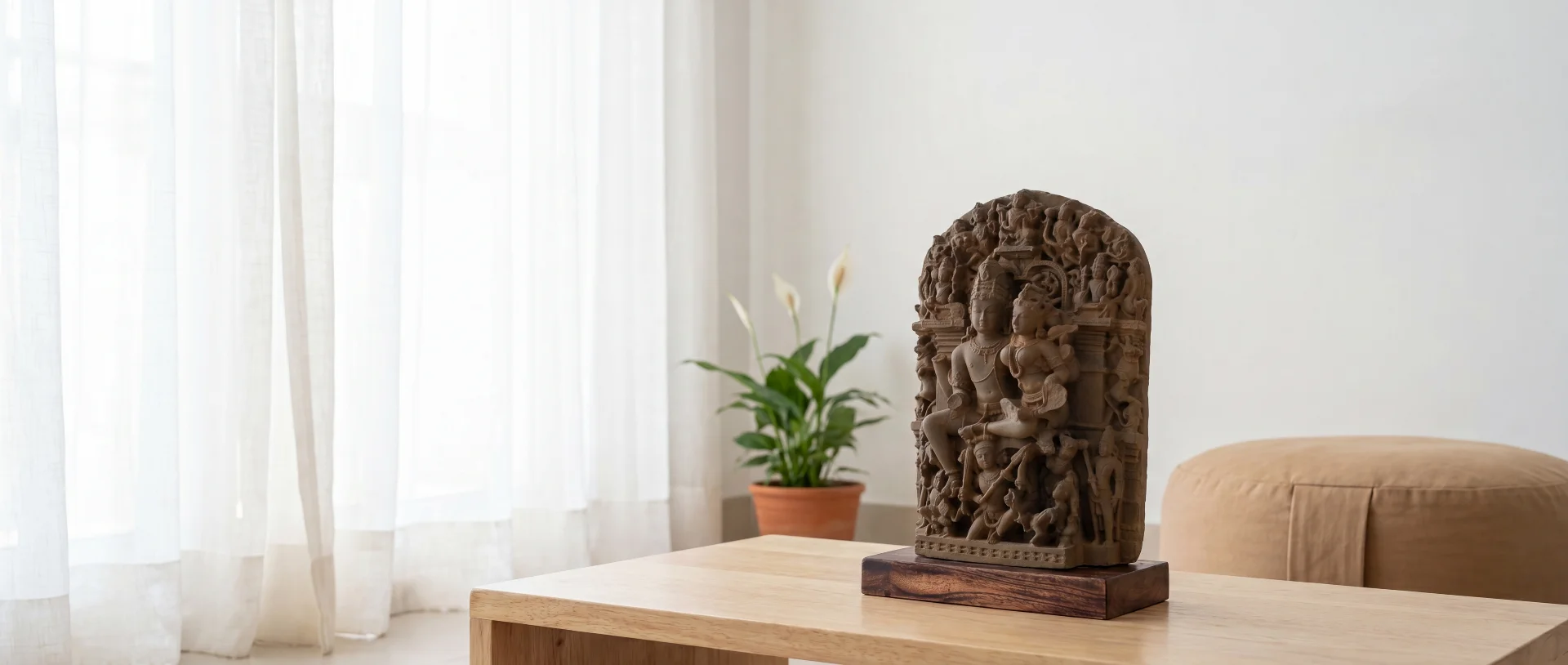
Few episodes from Indian mythology appear on temple walls as often as the moment Ravana tried to shake Mount Kailash and was pressed to the ground by a single toe of Shiva. Known in temple sculpture as Ravananugraha, this scene turns up from Elephanta to Ellora to the courts of central India, and it is one of the most recognisable examples of Indian temple sculpture built around Ravana. This guide covers what Ravananugraha actually means, the full story of Shiva, Parvati and Ravana at Kailash, why Ravana is shown lifting or shaking the mountain, where these sculptures survive in Indian temples today, and what the scene symbolises in Hindu mythology and temple art.
What Does Ravananugraha Mean in Indian Art?
Ravananugraha literally combines "Ravana" with "anugraha," meaning grace or blessing, and it names the specific sculptural scene of Shiva granting his blessing to Ravana after crushing his arrogance beneath Mount Kailash. It is one of Shiva's Anugrahamurti forms, sculptures that depict him showing benevolence toward a devotee, and it stands apart from a Ravana statue showing him fighting Rama, since ravananugraha murti sculptures are entirely about his relationship with Shiva, not with Rama or Sita.
Ravananugraha at a Glance
Aspect | Detail |
Meaning | Shiva's grace or blessing (anugraha) granted to Ravana |
Category of sculpture | Anugrahamurti, one of Shiva's benevolent forms |
Core episode | Ravana tries to shake Mount Kailash; Shiva presses it down with his toe |
Earliest known depictions | From around the 7th to 8th century CE |
Key textual sources | Ramayana, Mahabharata, and the Tamil Tevaram |
Famous surviving panels | Elephanta Caves, Ellora Caves, Pattadakal, Mahabalipuram, Kanchipuram |
The Story of Shiva, Parvati and Ravana at Mount Kailash
The story behind every Ravananugraha murti begins with Ravana's own overreaching pride. Flying over Mount Kailash in his Pushpak Viman, the mighty king of Lanka found that he could not cross it. When he questioned why, Nandi, Shiva's own attendant, told him that no one could pass over the abode of Shiva and Parvati. Rather than accept the answer, Ravana grew agitated and tried to lift the mountain itself, shaking the ground beneath the resting deities.
To stop him, Shiva simply pressed his toe down on Kailash, pinning Ravana beneath its weight and crushing his arms in the process. The act did more than trap him physically, it crushed his ego along with it, and for the first time Ravana understood the true scale of Shiva's power. In response, he turned to rigorous penance, composing and singing the Shiva Tandava Stotram in praise of Shiva for years. Moved by his devotion, Shiva eventually released him and granted his blessing, the moment that gives Ravananugraha its name.
This narrative is documented across some of the oldest texts in Indian literature, appearing in both the Ramayana and the Mahabharata. The Pushpak Viman itself matters to the story, it was not an ordinary chariot but a divine flying vehicle Ravana had taken from his half-brother Kubera, and its inability to simply pass over Kailash is what first exposes the limit of his power. Nandi's warning is equally central: as Shiva's own gatekeeper and attendant, Nandi is traditionally shown as a figure Ravana openly mocked for his appearance, which some tellings suggest sharpened Ravana's fury when he was told he could not proceed, and made his attempt to shake the mountain as much an act of wounded pride as brute strength.
The Tamil devotional work Tevaram adds a striking detail to the story: in his devotion, Ravana is said to have cut off one of his own heads to fashion a veena, using his own tendons as its strings, so that he could keep singing the Shiva Tandava Stotram. The hymn itself is composed in a distinctive, rapid Sanskrit metre meant to be chanted rather than read quietly, and it remains recited in temples and classical dance performances today, independent of the sculpture tradition it is tied to. Versions of this full narrative, from Ravana's arrogance to his eventual redemption, are etched into the walls of some of India's oldest surviving rock-cut cave temples.
Ravana in Hindu Mythology: The Devotee Behind Ravananugraha
Ravana's role in this particular scene only makes sense against the wider picture of Ravana in Hindu mythology, where he is remembered as far more than the antagonist of the Ramayana. Tradition holds him as a scholar-king, a Shiva devotee from birth, and the author of several Sanskrit hymns, the Shiva Tandava Stotram foremost among them. He is also credited in tradition as the originator of the Ravanahatha, an early bowed instrument still played by folk musicians in parts of India and Sri Lanka today, a detail that gives his self-sacrifice in the Tevaram version of the Ravananugraha story its full weight, since it is not an isolated act of desperation but consistent with how he is remembered as a musician and devotee throughout Hindu mythology.
This context matters for reading Ravananugraha correctly. The scene is not a contradiction of Ravana's later villainy in the Ramayana, it is a separate episode entirely, set earlier in his life, that Hindu temple sculpture chose to preserve precisely because it captures something the Ramayana narrative does not: a powerful figure whose devotion to Shiva was genuine, even as his pride repeatedly worked against him. Sculptors and temple patrons across centuries returned to this scene because it offered a complete moral arc, arrogance, humbling, penance and grace, in a single tableau, independent of how Ravana's story concluded elsewhere.
Why Is Ravana Shown Lifting or Shaking Mount Kailash?
The pose of Ravana shaking Mount Kailash is the single most consistent visual signature of this scene across Indian temple sculpture, and it is deliberately dramatic. Ravana is typically shown multi-armed, straining beneath the mountain with a doubled-over or kneeling posture that conveys real physical struggle, while Shiva above remains almost entirely still, seated with Parvati, his foot alone enough to hold the mountain, and by extension Ravana, in place.
That contrast is the entire point of the composition. Ravana's shaking of the mountain represents unchecked physical strength and arrogance, while Shiva's single toe represents effortless, absolute power that needs no visible strain to overcome it. Parvati is often shown reacting to the tremor, sometimes clinging to Shiva in alarm, which heightens the sense of disruption Ravana's arrogance causes even in Shiva's own household, right before that disruption is undone without any real effort on Shiva's part.
Ravana's own iconography varies from panel to panel. He is generally shown multi-armed, though the exact number of arms differs by region and period, and at Ellora's Kailasanatha temple he is rendered fully in the round rather than in flat relief, an unusual treatment reserved for very few figures in early Indian temple sculpture and one that underlines how important this particular scene was considered there. Attendant figures, celestial onlookers, or Kailash's own guardians are frequently included around the central group, sometimes reacting with alarm, sometimes actively resisting Ravana, which adds a sense of chaos around the mountain's base that throws Shiva's stillness at its summit into even sharper relief.
How the Ravananugraha Panel Evolved Across Dynasties and Centuries
The way this scene was rendered changed considerably between its earliest appearances and the period Varaha Heritage's own piece belongs to. At Elephanta in the seventh century and at Ellora through the eighth century, Ravananugraha appears as a large, densely populated narrative relief, filled with attendant figures, visible motion, and a sense of real physical strain, closer to a frozen moment from a much longer story than a self-contained devotional image. Parvati clinging in fear, Ravana doubled over under the mountain's weight, and Shiva's attendants reacting around him all appear together in a single crowded composition.
By the time the scene reaches the Gurjara-Pratihara and Kalachuri sculptural traditions of central India, the eighth through eleventh centuries, the composition had generally become more contained and iconic, closer to a standalone image of Shiva's grace than a sprawling narrative scene. This is the tradition the Hinglajgarh Fort sculpture belongs to, and it reflects a broader shift across Indian temple sculpture of this period, away from large narrative wall reliefs and toward more self-contained, portable icons meant for focused devotion rather than storytelling across an entire wall. That shift is also part of why a piece like this translates naturally into a home sculpture today, it was already moving in that direction a thousand years ago.
Ravananugraha in Ancient Temples: Where the Sculptures Survive
Ravananugraha murti sculptures appear in the historical record from around the seventh and eighth centuries CE onward, most often in Shiva temples built under royal patronage, including the Pallava dynasty of Kanchipuram, the Chalukyas, Rashtrakutas and Hoysalas of the Deccan, and the Kalachuri and Gurjara-Pratihara dynasties of central India. Several art historians read these panels as carrying a political message as much as a religious one: a king commissioning the scene of Shiva's effortless victory, and his mercy afterward, could be read as a statement about the patron's own strength and magnanimity toward defeated rivals.
Site | Region | Approximate Period | Notable Detail |
Elephanta Caves | Maharashtra | 7th century CE | A large, though damaged, panel at the cave's east entrance; Shiva holds his attendants by their hair as the mountain shakes |
Ellora Caves (Dashavatara, Kailasanatha and Dhumar Lena caves) | Maharashtra | 8th century CE | Naturalistic panels showing Parvati clinging in fear and Ravana doubled over or kneeling beneath the mountain |
Virupaksha Temple, Pattadakal | Karnataka | 8th century CE | Kailash's other inhabitants are shown shooting arrows and throwing stones at Ravana |
Pallava temples, Mahabalipuram and Kanchipuram | Tamil Nadu | 8th century CE | Among the earliest South Indian Ravananugraha reliefs |
Gurjara-Pratihara sites | Jodhpur, Jaipur, and multiple sites across Madhya Pradesh | 8th to 11th century CE | The regional tradition to which Varaha Heritage's own Hinglajgarh Fort sculpture belongs |
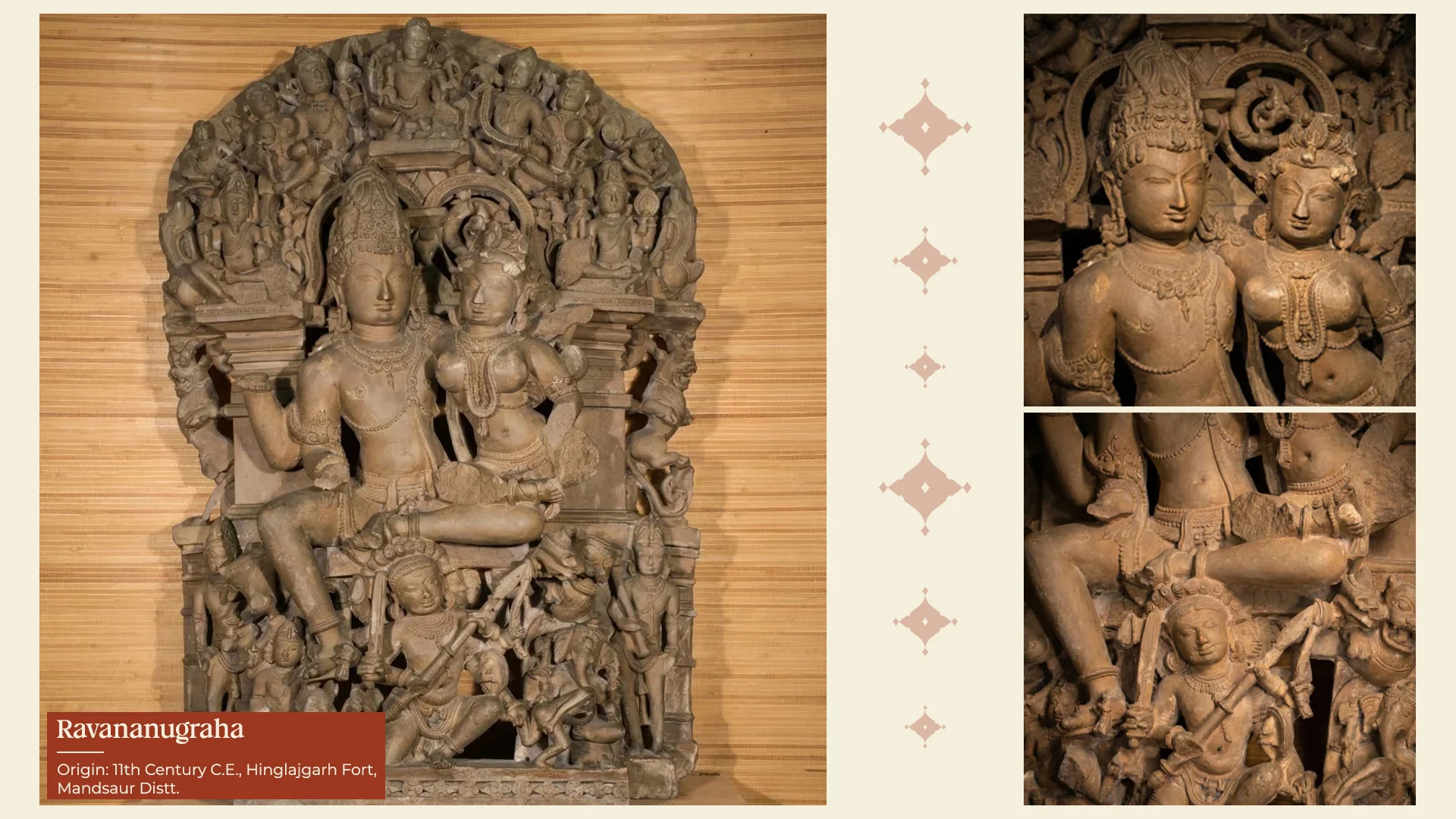
This last group is the tradition Varaha Heritage's own piece comes from. Hinglajgarh Fort in Mandsaur district, Madhya Pradesh, sits within exactly this Gurjara-Pratihara sculptural world, which is why the museum-documented Ravananugraha sculpture now preserved at the State Museum, Bhopal, and Varaha Heritage's replica of it, both belong to the same broader story told at Elephanta and Ellora centuries earlier.
What Does Ravana Symbolize in Temple Sculpture, and Why Is Shiva So Calm?
Ravana's symbolism in this specific scene is different from his role in the Ramayana. Here, he is not simply a villain, he is a powerful devotee whose arrogance briefly overtakes his devotion, and whose eventual penance and redemption are the actual subject of the sculpture. Shiva's calm, seated posture above him is what makes that meaning legible at a glance: real power in Hindu temple sculpture is consistently shown as restrained rather than showy, a single toe achieving what Ravana's full strength, and all twenty of his arms, could not undo.
Common Misreading vs Accurate Meaning
Common Misreading | Accurate Meaning |
Ravananugraha shows Shiva punishing Ravana | It shows Shiva humbling Ravana's pride, then blessing his devotion, anugraha means grace, not punishment |
The scene is part of the Ramayana's Rama-Ravana conflict | It is a separate Shiva-Ravana episode, rooted in Ravana's own devotion to Shiva, not his conflict with Rama |
Ravana is shown as purely evil in these panels | He is shown as a flawed but genuinely devoted figure, whose penance and the Shiva Tandava Stotram are central to the story |
Shiva's stillness suggests passivity | His stillness represents effortless mastery over a threat that visibly overwhelms everyone else in the scene |
Varaha Heritage's Ravananugraha: An 11th-Century Masterpiece from Hinglajgarh Fort
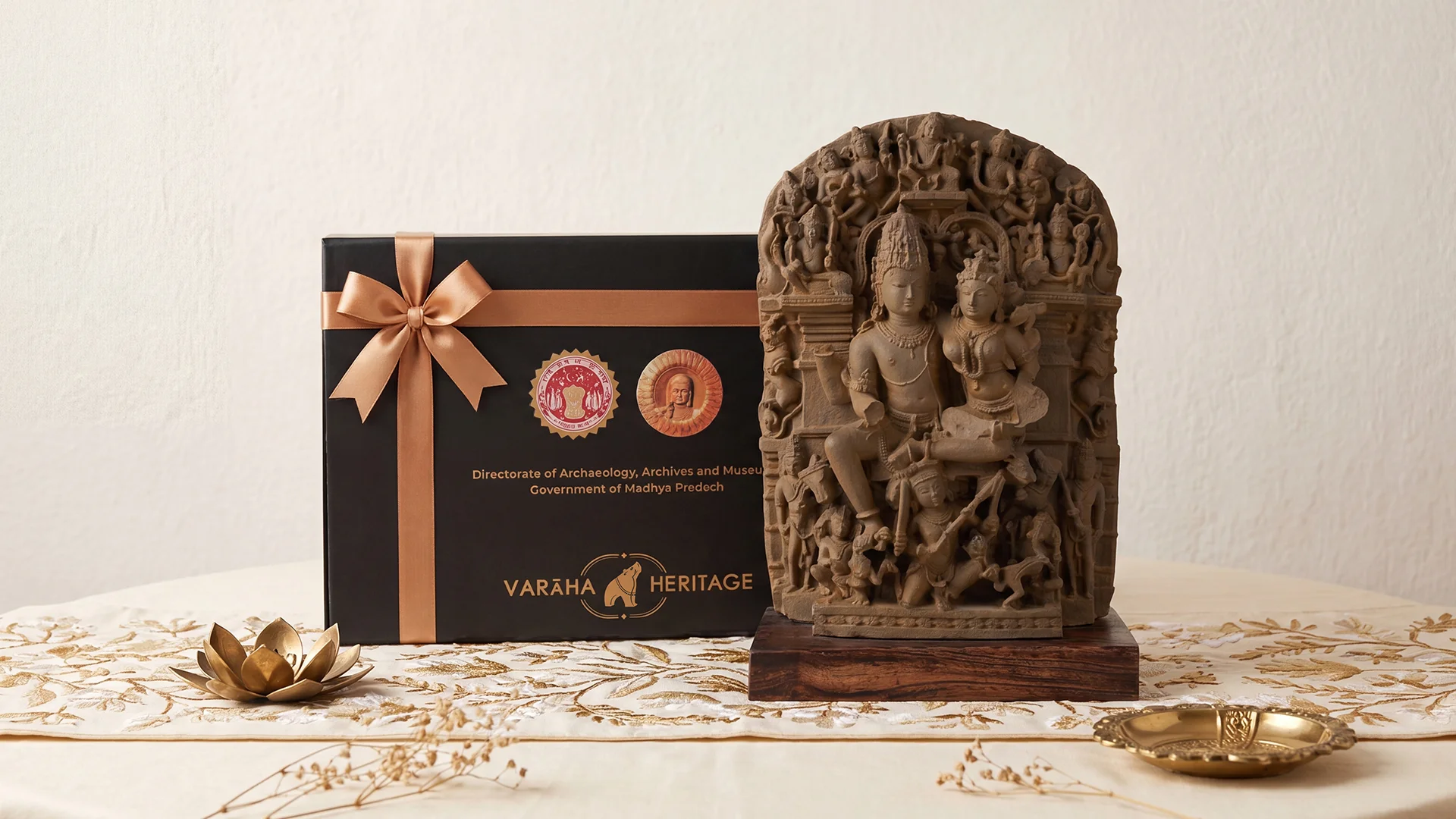
Varaha Heritage's Ravananugraha Sculpture is a Hand-Finished replica of an 11th-century CE artifact from Hinglajgarh Fort, Mandsaur district, Madhya Pradesh, now preserved at the State Museum, Bhopal. It reproduces the same composition found at Elephanta and Ellora centuries earlier: Shiva calmly granting his blessing to a humbled Ravana, rendered here in stone composite and mounted on a teak wood finished base to honour the detail of the original, roughly 1000-year-old sculpture.
As a piece of indian temple sculpture built for a home rather than a cave wall, this ravananugraha murti works as a commanding statement piece for a living room, study, or puja room, and its scale and the more contained, iconic composition typical of the Gurjara-Pratihara tradition it belongs to is exactly what makes it work as a standalone home sculpture rather than a fragment pulled from a larger narrative wall. In Vastu, placing this depiction of Shiva's grace in the North or East zone of a study or puja room is considered to channel higher wisdom and protective harmony, which makes it a natural fit for Mahashivratri and Diwali gifting, and a meaningful piece for a housewarming as well. For anyone drawn to a shiva sculpture with real documented history rather than generic mythological decor, this is a Ravana idol built on the same tradition studied at Elephanta, Ellora, Pattadakal and Mahabalipuram, brought into a form meant to stay in a home for generations.
Frequently Asked Questions
What does Ravananugraha mean in Indian art?
Ravananugraha means Shiva's grace, and in art it refers to the sculptural scene of Shiva blessing Ravana after crushing his arrogance beneath Mount Kailash.
Why is Ravana shown lifting or shaking Mount Kailash?
The scene depicts Ravana's failed attempt to force his way past Kailash, punished and ultimately redeemed after he tried to lift the mountain in anger.
What is the story of Shiva, Parvati and Ravana at Kailash?
Ravana could not cross Kailash, tried to shake it in frustration, was pinned beneath it by Shiva's toe, and after years of penance and singing the Shiva Tandava Stotram, was granted Shiva's blessing.
Where can Ravananugraha sculptures be seen in Indian temples?
Notable examples survive at the Elephanta Caves and the Ellora Caves in Maharashtra, the Virupaksha Temple at Pattadakal in Karnataka, and Pallava and Gurjara-Pratihara sites across Tamil Nadu and Madhya Pradesh.
What does Ravana symbolize in temple sculpture?
In this scene, Ravana represents unchecked strength and pride that is humbled, followed by genuine devotion and redemption, rather than pure villainy.
Why is Shiva often shown calmly seated above Ravana?
His stillness represents effortless, absolute power, a single toe is enough to contain a threat that visibly strains and overwhelms everyone else in the scene, including Ravana himself.
Conclusion
Ravananugraha endures across Indian temple art because it tells a complete story in a single frozen moment: arrogance, humbling, penance and grace, held in stone from Elephanta to Ellora to the courts of central India. Varaha Heritage's Hand-Finished replica of the 11th-century Hinglajgarh Fort sculpture carries that same story into a home-ready form, a documented piece of Ravana in Indian mythology rather than a generic showpiece. Explore Varaha Heritage's Ravananugraha Sculpture to bring this centuries-old scene of Shiva's grace into your own space.