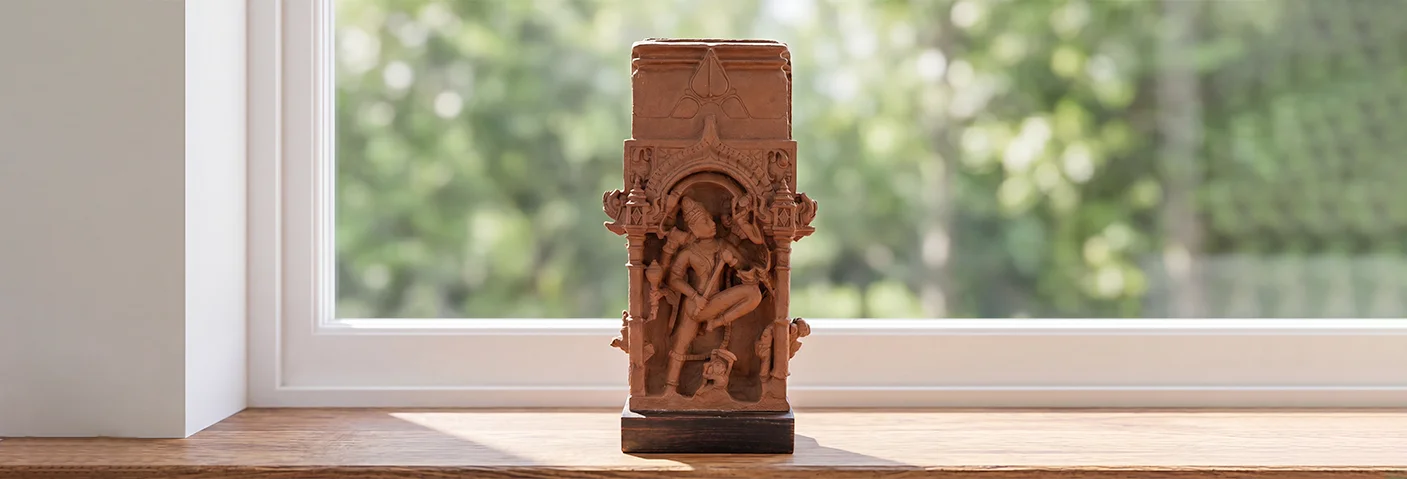
Walk into the Kailasa temple at Ellora and the stone grows quieter as you go deeper. On the outer walls, Shiva appears as a warrior, a dancer and a giver of boons. Further in, the crowd thins, and in the sanctum there's only a linga, the emblem of Shiva, in darkness. That sequence was a pattern, not an accident, and every relief sculpture along it had its place. You can borrow the idea with museum replicas of Indian temple sculpture as wall decor. This guide explains what a relief sculpture is, the types of relief sculpture, where temple panels come from, how to display them, and which State Museum Bhopal panels suit which room. But first, once a panel leaves its temple, where should it go on your wall?
Before you hang anything: Display suitability depends on the individual sculpture's design, weight and mounting provisions. Confirm these details before fixing any piece to a wall.
What Is a Relief Sculpture, and Why Does It Suit a Wall?
A relief sculpture is a work whose figures stay attached to a background of the same material. Two forms matter most when you're planning a wall.
Low relief (bas-relief): the design projects only slightly from the background. It suits slim walls, corridors and landings where depth is limited, and because its shadows are shallow, a side light matters.
High relief: more than half the depth of the figures projects from the background. It suits a plain wall with room to step back, and even soft light casts deep shadows across it.
Wikipedia's article on relief traces the word to the Latin relevare, "to raise," and puts the line between the two forms at about half the depth: in high relief, more than half the mass of the figure projects. Britannica's entry on relief sculpture describes low relief, or bas-relief, as a design that projects only slightly from the ground.
That's why a relief sculpture behaves like a picture. It's made to be met from the front, at a viewing distance, in a particular light. A wall sculpture or piece of stone wall decor like this doesn't need a pedestal. It needs a good wall, a sensible height and a lamp placed with care.
Where Temple Panels Came From and the Stories They Tell
Ellora, in Maharashtra, is a UNESCO World Heritage Site. Sahapedia's survey of the Kailasa temple describes 34 rock-cut caves there, dated 600 to 1000 CE. Cave 16, the Kailasa temple, also known as the Kailash temple of Ellora, is a monolithic shrine to Shiva built by the Rashtrakutas. Its date is debated. Sahapedia reports that James Burgess linked it to the reign of Dantidurga, while M. K. Dhavalikar, citing a Baroda copper plate, argues for the king Krishna I (757 to 772 CE) as its patron.
The same survey explains the plan. A vimana (the superstructure) rises over the garbhagriha, the sanctum, and halls such as the gudhamandapa (closed hall) lead towards it. Sahapedia sorts Shiva's forms into groups, including Samharamurti, the aggressive forms, and Anugrahamurti, the boon-giving forms. It notes that in the outer areas Shiva appears as warrior, supreme god, giver of boons and dancer, accompanied by gods, demons and devotees. The interior is reserved for his family and attendants, and the sanctum holds only the linga. A visitor therefore meets the scenes in order, from busy outer panels towards stillness.
Central India produced its own temple sculpture panels in the centuries that followed. The four replicas below date from the 10th to the 12th century. According to their product pages, all four originals come from Mandsaur district, and each is now preserved at the State Museum Bhopal.
Gajasura Vadha: The Elephant Demon Slain
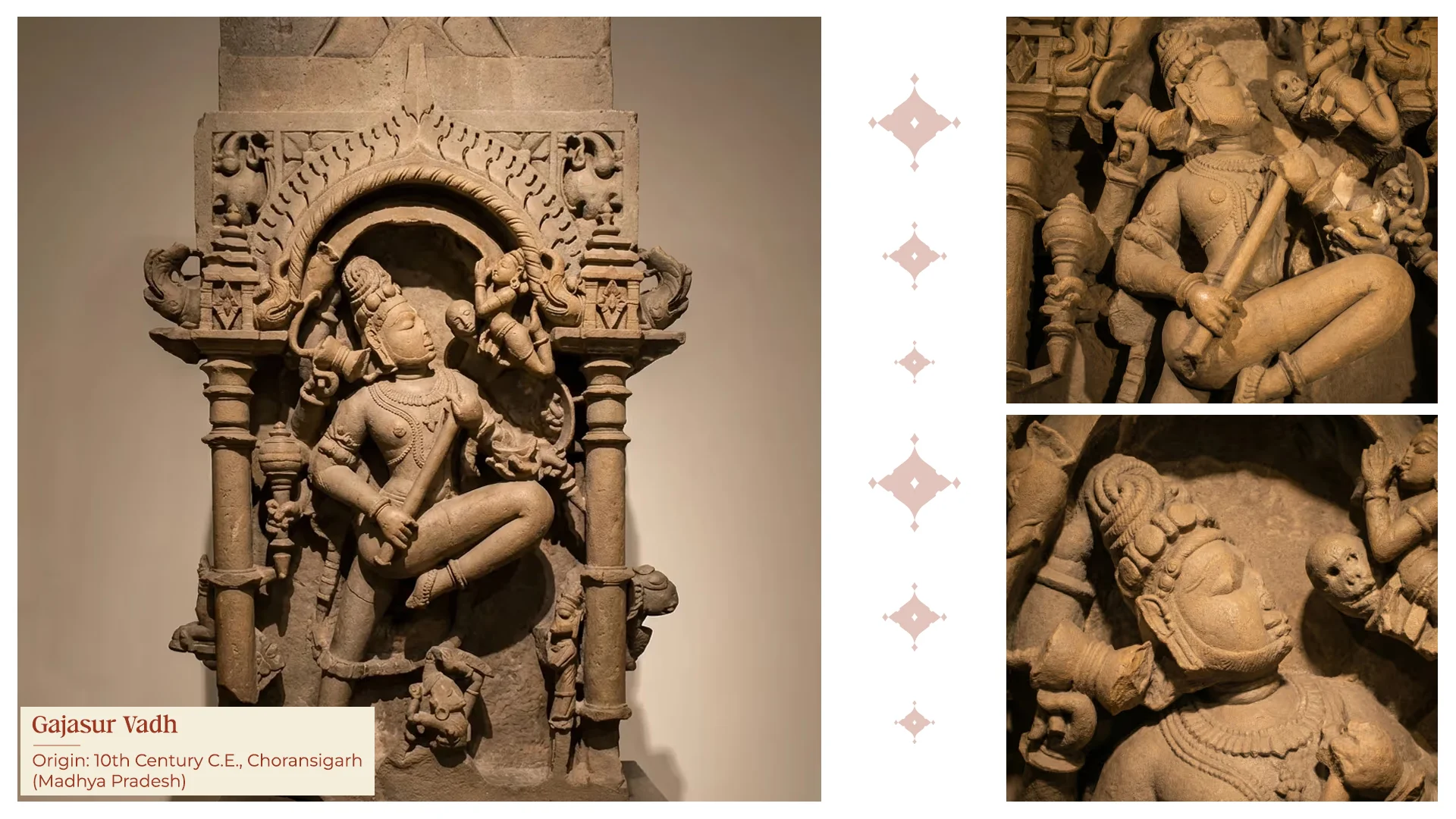
Vadha is Sanskrit for slaying. The Gajasura Vadha product page describes Shiva in his fierce Rudra form vanquishing the elephant demon Gajasura, a son of Mahishasura. In the page's telling, Gajasura won a boon of invincibility from Brahma, terrorised the people of Varanasi, and met Shiva when the god stepped in.
The tale ends in surrender. The product page says Gajasura gave up his arrogance and asked Shiva to wear his hide. Sahapedia gives the same sequence from the Shiva Mahapurana: the defeated demon asked that Shiva be known as Krittivasa, the one clad in elephant hide.
At Ellora, Sahapedia lists Gajantaka, the slayer of the elephant demon, as one of five aggressive forms of Shiva at the temple, out of twelve it enumerates. On the east wall of the nandimandapa (the pavilion for Shiva's bull), it describes a ten-armed Shiva who holds the elephant's tusk in his front right hand, with the hide held in the hands behind. Sahapedia reads that panel as joining the Andhakasura and Gajasura stories.
The product page, not the scholarship, offers the reading of the elephant as tamas, the heaviest quality of nature, made of delusion and ignorance. In its interpretation, the thick hide is the material world, and removing it lets light through.
The page gives the original as a 10th-century temple relief from Choransigarh in Mandsaur. The replica is hand-finished in stone composite.
Ravananugraha: Pride Humbled, Grace Given
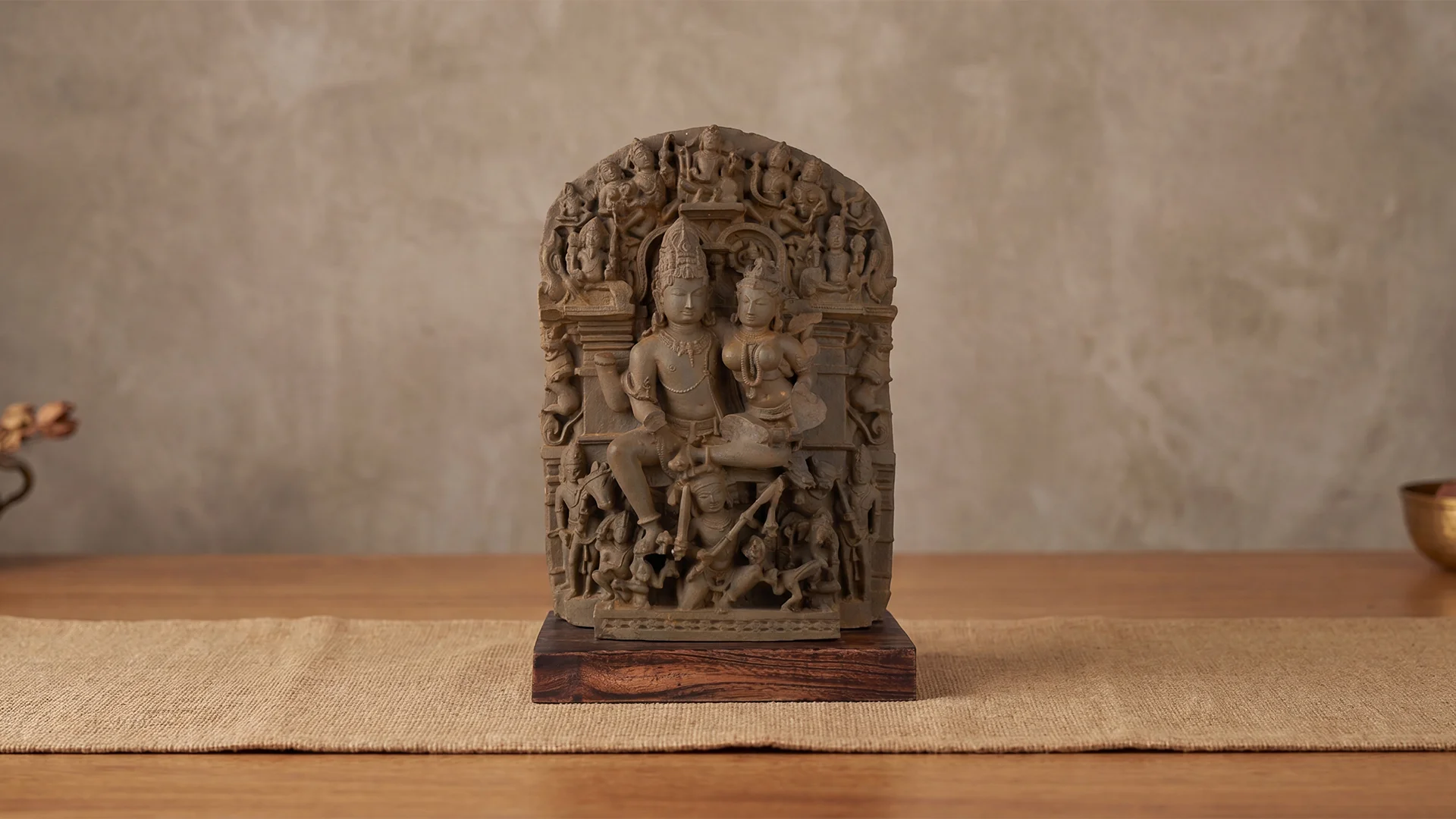
Anugraha means grace or favour. Sahapedia calls the Ravananugraha one of the most famous and refined Lord Shiva sculptures of the Kailasa temple, and the most prominent of its boon-giving forms. The Ellora panel is set deep in high relief on the south face of the lower storey of the gudhamandapa. Below, Ravana kneels with many arms, his back to the viewer, heaving at a mountain. Above, Shiva and Parvati sit on Mount Kailasa with their attendants, and Parvati is alarmed. Dvarapalas, the door guardians, stand in high relief on either side.
The Ravananugraha product page tells the story this way. Ravana tries to cross Kailasa in his flying chariot, Pushpak Viman, is stopped, and then tries to lift the mountain. Shiva presses down with a toe, pinning the demon king's arms and his ego. Ravana then sings the Shiva Tandava Stotram for years, and Shiva grants him his blessing.
The page gives the original as an 11th-century work from Hinglajgarh Fort. The replica is stone composite, mounted on a teak wood finished base.
Nar Varaha: The Earth Lifted
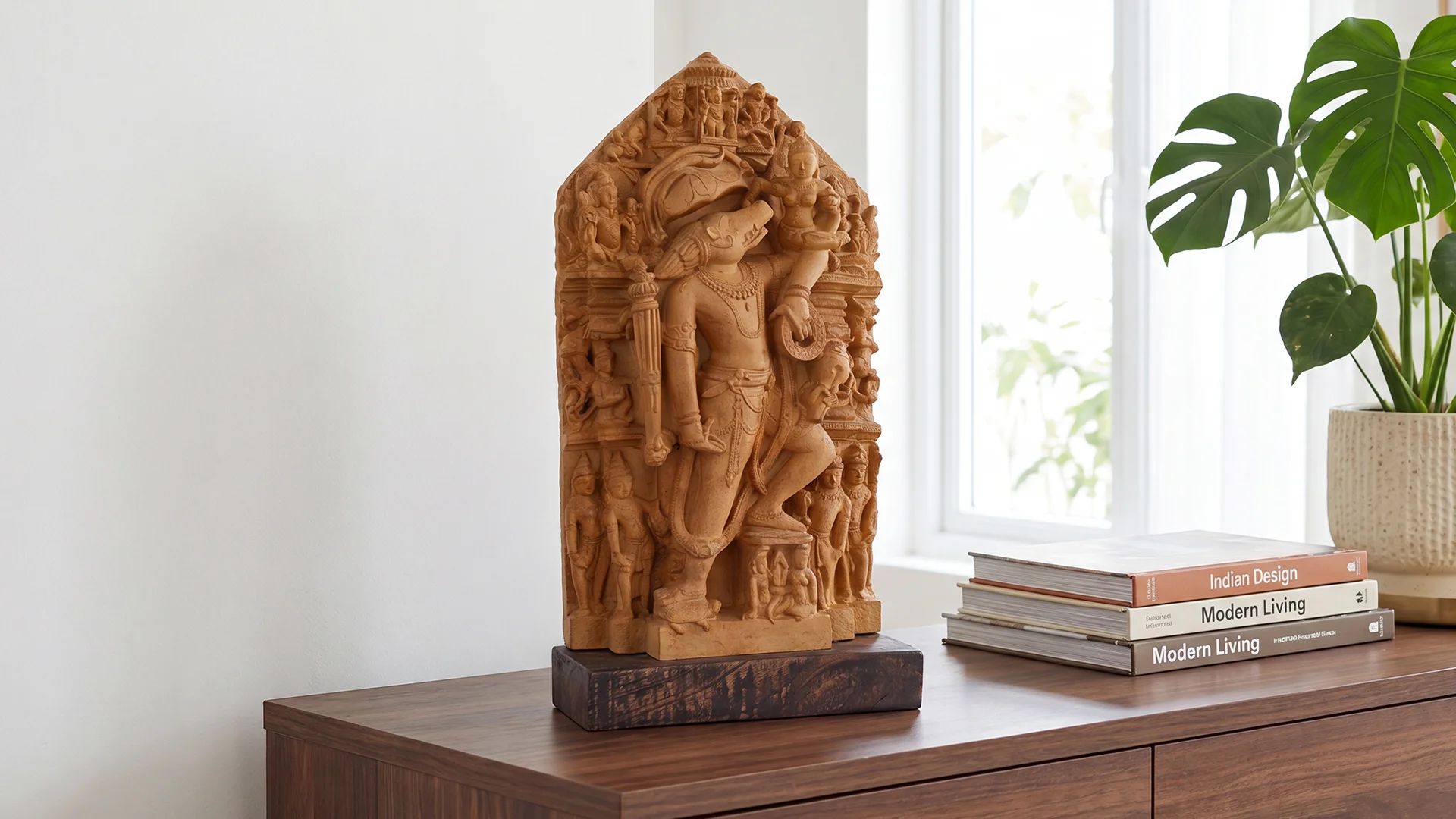
Varaha is the boar avatara, or incarnation, of Vishnu (the Varaha avatar of Vishnu). Britannica's entry on the Venkateswara temple retells how Varaha saves Bhudevi, the goddess of the earth. The Nar Varaha product page describes the man-boar form as four-armed and cradling Bhudevi on his elbow.
Why did medieval kings favour this subject? Only the product page offers an answer, and it is the brand's reading rather than an independent finding. It says rulers faced upheaval after the Gupta period and compared themselves to Varaha, the saviour who restores dharma (right order). The page adds that the Pratihara king Mihir Bhoja used the symbol on his coins.
The page gives the original as a 10th-century work from Kanwal in Mandsaur district. The replica is hand-finished in stone composite.
Kamdhenu: The Wish-Fulfilling Cow
Kamadhenu, also called Surabhi, is the wish-fulfilling cow. Britannica's article on the churning of the ocean of milk lists her among the treasures of that story. The Kamdhenu Cow product page describes a quiet scene of abundance and maternal care, with the cow nursing her calf.
The page gives the original as a 12th-century work from Mandsaur district. The replica is hand-finished in stone composite, and the page suggests an office desk, a kitchen or a puja room for it.
How the Originals Are Documented and Recreated
Every replica starts with a specific museum-held original, not a general style. Each product page names the piece, its origin site, its period and the museum that holds it today. All four list the State Museum Bhopal.
MP Tourism says the museum traces its origins to 1909, when it was the Edward Museum, and was re-established on 2 November 2005. It lists 17 galleries, covering sculpture, inscriptions, prehistory, coins, manuscripts and more. Because the originals sit in a public collection, a replica can say exactly where its form came from.
Varaha Heritage recreates each stone sculpture in hand-finished stone composite. The aim is to follow the original's form and iconography as closely as a replica can.
How to Display Relief Sculptures on a Wall
How do you display a relief sculpture on a wall so that it looks intentional? Work through five decisions in order: the wall, the height, the spacing, the light and the fixing.
Choose the Wall and Its Colour
Pick a plain wall with clear space around it. Panels with several figures need calm surroundings, so avoid walls crowded with switches, vents or busy wallpaper. MFA Boston's shop guide also advises keeping art out of bathrooms because of humidity and away from heat sources such as radiators.
Warm off-white, sand and soft grey generally let stone tones read gently. Deeper shades such as charcoal, indigo or forest green make pale stone stand out, and terracotta looks lovely against cooler or lighter walls. Matte paint is kinder than gloss, which bounces light and flattens shadows.
Set the Height
The MFA Boston shop's hanging guide gives the gallery rule as a centre about 57 to 60 inches (145 to 150 cm) from the floor. Cobelio's guide to hanging height points out that this isn't average eye level. It's closer to the midpoint of a comfortable band for seated and standing viewers, so treat it as a window, not a target. Over a sofa or sideboard, the same guide suggests 15 to 20 cm of wall between furniture and the bottom edge.
Cobelio adds a point that matters for reliefs. The lower you hang a relief, the longer every shadow on it becomes, so if you move the height, re-aim the light.
Space and Group the Panels
Give a single panel generous empty wall on either side. For a group, give the panels a shared centre line, which Cobelio calls the default for works of different shapes. Cobelio also notes that gaps of 5 to 10 cm make a group read as one object, while about 20 cm reads as two. Group by story. Gajasura Vadha and Ravananugraha, for instance, both belong to Shiva's world.
Light the Relief
Relief depends on shadow. Wikipedia's article on raking light defines it as illumination from a source at an oblique angle, almost parallel to the surface, which brings out surface topography. Conservation Wiki lists bas-reliefs among the objects it suits, and recommends a narrow, point-like source, because diffused light gives lower contrast. At home, a small adjustable spotlight or picture light placed above or to one side does the job. Light from straight in front flattens the figures.
For art in general, MFA Boston's guide recommends warm white bulbs of 2700K to 3000K and diffused natural light over direct sun.
Hang, Lean or Rest
Wall hanging decor is a safety question before it's a style question. A fixing rated above the sculpture's weight isn't enough on its own. The wall material, the type of anchor, the mounting points and the piece's centre of gravity all matter, and MFA Boston's guide itself says to double-check weight limits and wall compatibility before hanging. None of the four product pages gives a weight, mounting points or hanging fittings, so ask Varaha Heritage for the manufacturer's mounting instructions before you drill. For a heavy or irregularly shaped piece, use a professional installer. There are three common ways to show a panel:
Fixed to the wall. This suits only pieces designed and confirmed for wall mounting. You'll need the maker's mounting instructions, anchors matched to the wall material and, for heavy or irregular pieces, a professional installer. Watch for hollow or thin walls and a high centre of gravity.
Resting on a ledge or picture shelf. This suits pieces with a stable, flat underside. You'll need a deep, level ledge with a lip or a non-slip pad, and you should keep it clear of edges within reach of children and pets.
On a console with the wall behind. This suits pieces that come with a base, such as Ravananugraha. You'll need a stable surface and room for a lamp, and you should watch for knocks in busy corridors.
Wall Decoration Ideas by Room
Once the wall is ready, the question is which panel belongs where. These wall decoration ideas follow the story each piece tells.
Living Room Wall Decor
Living room wall decor can carry the boldest panel in the house. The Ravananugraha page lists a living room among its suggested spaces, and the Nar Varaha page calls its piece a centrepiece. Because Ravananugraha is described as mounted on a teak wood finished base, it's likely to suit a sideboard with the wall behind it better than a wall fixing. Confirm that with Varaha Heritage. Either panel gives guests a story to ask about before they sit down.
Entryway
Temples put guardians at doors, and Sahapedia's description of the Ellora Ravananugraha panel includes dvarapalas, the door guardians. The Gajasura Vadha page recommends its piece for an entryway. In Vastu tradition, the page adds, a piece resting in the South acts as a protective shield. Treat that as belief rather than rule, since Vastu schools differ on direction.
Study or Office
Ravananugraha is a natural study panel, since its subject is arrogance turned into grace. According to its page, Vastu tradition favours the North or East of a study. That's a suggestion and it varies by school.
Puja Room and Kitchen
Kamdhenu belongs where nourishment and prayer meet. Its page names the office desk, the kitchen and the puja room, and Vastu tradition, as the page puts it, favours the South-West. Both the room and the direction are belief-based suggestions, so follow your family's custom first.
State Museum Bhopal Replicas for Your Walls
Browsing wall decoration ideas is easy. Choosing a piece of wall art with a documented origin is harder, and this is where a museum replica helps. Here are the four relief sculpture panels. All the originals are at the State Museum Bhopal, and all replicas are hand-finished stone composite. Click a photograph or a name to open the product page. Suggested displays follow each product page's own wording.
Origin: 10th century CE, Choransigarh, Mandsaur
The story: Shiva vanquishes the elephant demon
Suggested display: entryway
Wall mounting stated on the page: not stated
Origin: 11th century CE, Hinglajgarh Fort, Mandsaur
The story: Shiva grants grace to Ravana
Suggested display: living room, study or puja room
Wall mounting stated on the page: not stated; supplied on a teak wood finished base
Origin: 10th century CE, Kanwal, Mandsaur
The story: Vishnu as the boar lifts Bhudevi
Suggested display: study or living room
Wall mounting stated on the page: not stated
Origin: 12th century CE, Mandsaur
The story: a quiet scene of abundance and maternal care
Suggested display: office desk, kitchen or puja room
Wall mounting stated on the page: not stated
If you're choosing one, start with the story. Pick Gajasura Vadha for a fierce, protective presence at a threshold and Ravananugraha for a room where conversation matters. Choose Nar Varaha for a calm, commanding figure and Kamdhenu for a gentler scene.
None of the four pages gives dimensions or weight as text. Each page carries a Dimension and Care panel as an image, so check it, and ask Varaha Heritage for exact measurements, weight and mounting instructions before you plan a wall.
Frequently Asked Questions
How do I display a relief sculpture on a wall?
Choose a plain wall and fix the piece only as the maker's mounting instructions allow, or rest it on a ledge against the wall. Light it from one side so the shadows show its modelling, and use a professional installer for heavy pieces.
What wall colours suit stone and terracotta reliefs?
Warm off-white, sand and soft grey let stone and terracotta tones read gently, while charcoal, indigo or forest green make pale stone stand out. Matte paint works better than gloss.
How high should wall sculptures be hung?
The usual gallery rule places the centre of a piece about 57 to 60 inches (145 to 150 cm) from the floor. Above furniture, leave about 15 to 20 cm below the bottom edge.
Which temple panels work best in a living room?
Panels with a clear central figure and a bold story, such as Ravananugraha and Nar Varaha, read well from across a room as living room wall decor. Smaller scenes such as Kamdhenu suit a quieter wall.
Can relief sculptures be placed on a shelf instead of hung?
Yes, provided the base is fully supported and the surface is stable. Setting the piece slightly back against the wall keeps it steady.
Conclusion: A Relief Sculpture Is a Story You Meet
At Ellora, the scenes were placed so that you'd meet each story on your way in: a warrior, a dancer, a giver of boons, and finally the dark. A relief sculpture from the State Museum Bhopal carries that same habit of storytelling into traditional Indian wall decor, whether it's an elephant demon's surrender, a king's pride humbled, a boar lifting the earth or a cow feeding her calf. Choose the story you'd like to meet every day, and explore the State Museum Bhopal collection at Varaha Heritage.