Everyone knows who gets worshipped first. Ganesha, before every wedding, every journey, every new ledger. So the scene on a hilltop at Bhedaghat, above the Narmada near Jabalpur, stops visitors cold. In a circular cloister of 81 niches, goddesses sit above lions, bulls and peacocks. One has an elephant's head. At her feet, another elephant-headed figure, presumably Ganesha, takes the weight of her bent leg. Her label reads Sri Aingini, but scholars know her as Vinayaki. Why would the god honoured first be the one holding her up?
Here's what you'll learn: who she is, whether she's truly a female Ganesha, which texts name her, where her images survive, and what an 11th-century sculpture from Morena shows. You'll also see how Varaha Heritage recreates it.
Who Is Vinayaki in Hindu Tradition?
Try finding her in a standard list of Hindu deities. You probably won't, and that's the first clue. Vinayaki (Vināyakī) is an elephant-headed goddess of Hindu tradition, usually understood as the feminine counterpart of Ganesha. She's rare. Few texts describe her, very few images of her survive, and she has no single fixed name. In 1975 the art historian Balaji Mundkur titled his study of her "The Enigma of Vaināyakī" in the journal Artibus Asiae, and the word still fits.
Here's Vinayaki at a glance:
Names: Vinayaki, Vainayaki, Ganeshani, Gajanana (elephant-faced) and Vighneshvari.
Appearance: an elephant head on a goddess's body, with weapons and ornaments.
Relation to Ganesha: generally, read as his shakti (divine power), not his consort.
Earliest text: the Matsya Purana, compiled around 550 CE, names her among the Matrikas (mother goddesses).
Earliest image: a terracotta plaque from Rairh, Rajasthan, generally dated to around the turn of the Common Era.
Most surviving images: from the 10th century CE onwards.
Group links: the Matrikas and the yoginis (a circle of sixty-four or eighty-one tantric goddesses).
Ask a hundred devotees to describe Ganesha and you'll hear the same details every time. Ask about the Vinayaki goddess and most will pause. That's because she never became a mainstream figure of worship. She lives instead in temple niches, in lists of mothers, and in a handful of museum pieces.
The names tell part of the story. Vinayaka is a familiar name of Ganesha, and Vinayaki is simply its feminine form. Gajanana means "elephant-faced," and Vighneshvara means "lord of obstacles," so Vighneshvari is the same title for a goddess. Every one of her names is borrowed from her male counterpart. Here's the detail worth holding on to: that borrowing is exactly why scholars still debate how independent she ever was.
Is Vinayaki the Female Form of Ganesha?
She has his face, his weapons and his gift for removing obstacles. So, is she his wife, his sister, or something else entirely? Is Vinayaki the female form of Ganesha? Broadly, yes, but the careful answer has layers. The shakti idea explains most of it.
Shakti, Not Consort
In Hindu image-making, a god's shakti is his energy given a form. The Matrikas show the pattern clearly: sculptors armed each mother with the weapons of her male counterpart and gave her his ornaments and his vahana, or mount. Vinayaki follows the same logic. She isn't Ganesha's wife. She's his own power, standing beside him with his elephant face.
The Devi Purana, an upapurana (a "lesser" Purana), states this directly. It names Gananayika or Vinayaki as the shakti of Ganesha, marked by her elephant head and by the same ability to remove obstacles.
Ganeshani, Lady Ganesha and Other Names
Anyone searching for a Ganesha female form will meet a crowd of labels. Stri Ganesha means "female Ganesha." Ganeshani is the feminine of Ganesha, and some writers say lady Ganesha, which isn't a traditional title but points to the same goddess. Don't be thrown by the variety, because the texts themselves never settled on one name.
There's also a caution. The Matsya Purana calls her Vainayaki ("belonging to Vinayaka") without explicitly tying her to Ganesha, so only her name suggests the link. The Agni Purana, compiled around the 10th century, lists Ganesha's shaktis without naming her at all. A careful reader should treat the Devi Purana as the clearest early statement.
Matrika, Yogini or Goddess in Her Own Right?
The scholar Yuvraj Krishan argued that three figures are easily confused: the early elephant-headed Matrika, the Brahmanical shakti of Ganesha, and the tantric yogini. Many writers merge them, while Krishan kept them apart. You can see why the confusion arises. At Bhedaghat she stands among yoginis, in the texts she's a Matrika, and in later descriptions she's Ganesha's power. A single sculpture can sit inside all three traditions at once.
The Matrikas, Andhaka and Vinayaki in the Texts
Her best-known appearance comes in a battle where a single drop of blood could decide everything.
The Demon Whose Blood Became an Army
According to the account in the Matsya Purana, the demon Andhaka had a boon: every drop of his blood that touched the ground produced another Andhaka. Varaha Heritage's research notes add that he had set his desire on Parvati, which is why Shiva fought him.
Shiva's blows only multiplied the demon. Every wound made more enemies, not fewer. So the shaktis of the gods were called in, among them Vaishnavi, Indrani and Brahmani. Their task was simple and fierce: drink the blood before it reached the earth. In one telling, Ganesha's shakti rose with them. The demon had no army left to grow, and Shiva ended him.
Why Vinayaki Isn't Among the Seven
The classical group is the Saptamatrika, the seven mothers: Brahmani, Maheshvari, Kaumari, Vaishnavi, Varahi, Indrani and Chamunda. In sculpture they usually stand in a row, flanked by Shiva on one side and Ganesha on the other. Notice where that leaves Ganesha. He's already in the panel as the male guardian, so a female Ganesha had no empty place in the line.
That's one reading of why Vinayaki missed the list of seven. The Matsya Purana does name her in a very long roll of goddesses, according to the research notes behind the Varaha Heritage replica, and other lists add her later.
The Nine Mothers
Eastern India favoured a longer list, the Navamatrikas, or nine mothers. The Devi Purana gives Gananayika or Vinayaki as the ninth. In some lists of nine, Mahalakshmi or Yogeshvari and Ganeshani appear as the eighth and ninth. So the goddess who couldn't find a seat among seven did find one among nine.
Where Are Vinayaki Sculptures Found in India?
Here's the odd part: there are far fewer images than you'd expect, and the earliest one might not even be her. Where are Vinayaki sculptures found in India? Scattered widely, and thinly. Mundkur and later scholars have traced images from Rajasthan and Madhya Pradesh to Bihar, Odisha and Karnataka. Here are the best known:
Rairh, Rajasthan (around the turn of the Common Era): a worn terracotta plaque of an elephant-faced goddess with two hands, with emblems too eroded for firm identification.
Bhedaghat, Madhya Pradesh (generally dated to the 10th century): a figure labelled Sri Aingini among the yoginis, with an elephant-headed male at her feet.
Giryek, Bihar (Pala period): a four-armed goddess holding a mace, a pot, an axe and possibly a radish.
Chitrapur Math, Shirali, Karnataka (probably 10th century, from north-western India): a metal image with the sacred thread, a sword and a noose, and two hands in blessing gestures.
Morena, Madhya Pradesh (11th century): the Kachchhapaghata-period sculpture now at the Triveni Museum, Ujjain.

The Oldest Image: Rairh
The plaque from Rairh in Rajasthan is the earliest known elephant-headed goddess. She has two hands and her trunk turns to the right. Because her emblems have worn away, nobody can say for certain that she is Vinayaki, and the date is given as a range, from the first century BCE to the first century CE. Then comes a long silence. Most other images appear only from the 10th century onwards.
The Yogini Circle at Bhedaghat
Back to the hilltop from the opening. The Bhedaghat temple is generally dated to the 10th century and associated with the Kalachuri dynasty. It was planned for yoginis, from the Sanskrit chausath, "sixty-four," though its cloister actually holds 81 niches. Here Vinayaki has company, and her place among the yoginis explains why some writers file her under tantric goddesses rather than Puranic ones.
Pala, Pratihara and Karnataka Images
The Pala-period image from Giryek in Bihar is slender and four-armed, not pot-bellied like Ganesha. A Pratihara-period image, by contrast, shows a pot-bellied goddess with a plate of modaks, the sweet dumplings Ganesha loves, which her trunk reaches for. The metal Vinayaki at Shirali shows abhaya mudra (the fear-not gesture) and varada mudra (the boon-giving gesture) in her two front hands. Further images, many of them incomplete, turn up in Odisha, Gujarat and Rajasthan, and at Satna she appears as one of five animal-headed goddesses gathered around a cow-headed yogini who holds the infant Ganesha.
What Does the 11th-Century Vinayaki Iconography Show?
Most Vinayaki images show her as one face in a crowd of mothers or yoginis. The Morena sculpture does something rarer. What does the 11th-century Vinayaki iconography show? It's one of the few pieces dedicated to her alone, so it's the best place to find out.
The Kachchhapaghata World
The Kachchhapaghatas ruled from Gwalior from about 950 to 1196 CE, and their territory took in what is now Morena district. They patronised Shaivism and Vaishnavism, and they're remembered for the Sas-Bahu temple at Gwalior, built under Mahipala around 1093. In Morena itself stands the circular Chausath Yogini temple at Mitaoli, which an inscription of 1323 CE says was built by King Devapala (reigned about 1055 to 1075). So a sculpture of a mother goddess in 11th-century Morena wasn't an oddity. The region already honoured the Matrikas and yoginis.
Reading the Figure
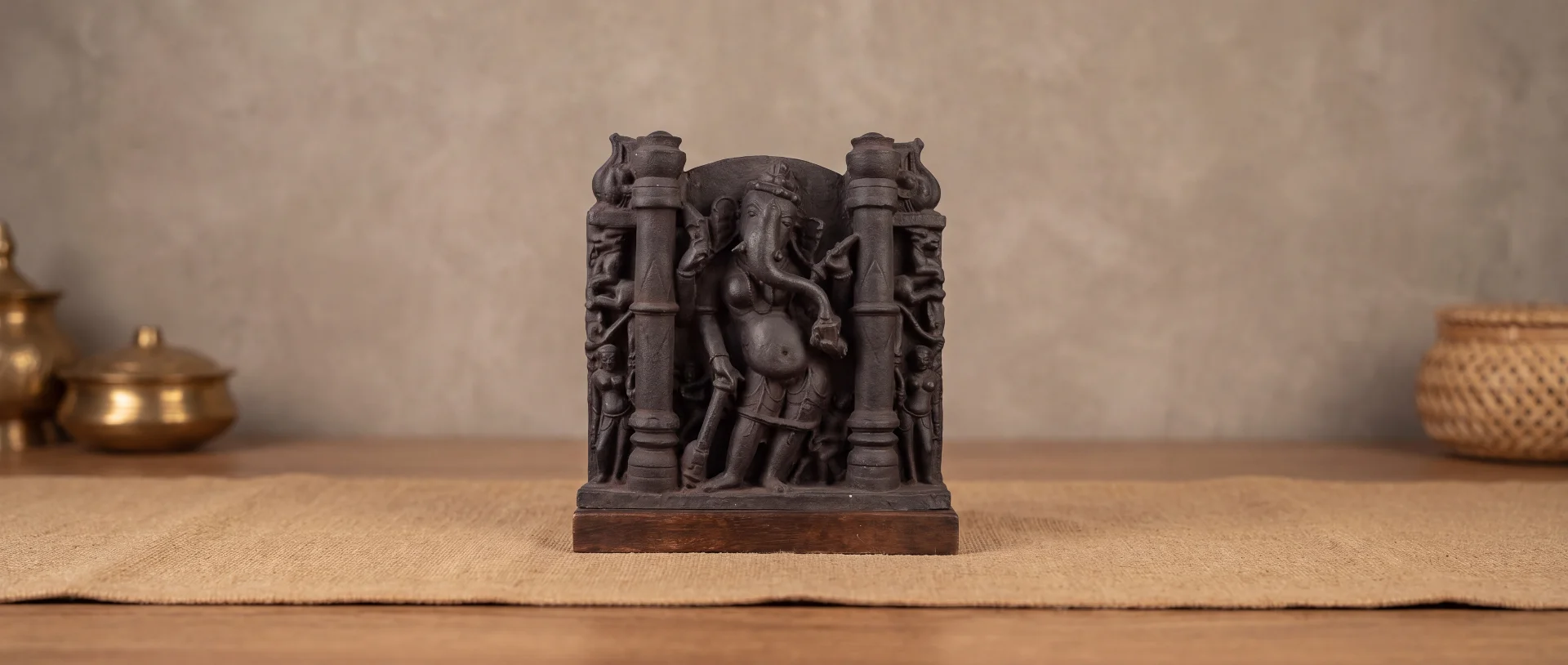
According to the research on the original, the sculpture shows a hybrid goddess with an elephant head, carrying weapons and the usual ornaments laid down by the Shastras, the traditional texts on image-making. That is the Matrika pattern at work: a shakti wears the signs of her god. It helps to compare the Rupamandana, a medieval text on images, which describes Ganesha with a dant (tusk), parashu (axe), padma (lotus) and modak. Look for those same attributes in her hands on any Vinayaki image, but remember that artists varied them from region to region.
How Vinayaki Differs from Ganesha
Put a Ganesha and a Vinayaki side by side and the borrowed signs are plain, but so are the changes. In the images scholars have studied, she often wears the yajnopavita (sacred thread) across her chest, as Ganesha does, yet her body follows a goddess's proportions. The Shirali metal image is described as slender and full-breasted, unlike Ganesha. Her trunk turns left in some images and right in others. Even her weapons shift, from a mace and axe in one region to a sword and noose in another. She's recognisably his equal, never a copy.
The Triveni Museum, Ujjain
The original is preserved at the Triveni Museum in Ujjain, Madhya Pradesh, a museum whose galleries are devoted to Shiva, Shakti and Krishna. Pieces dedicated to Vinayaki alone are uncommon, since most images show her as one figure in a larger group. Varaha Heritage's Vinayaki sculpture is recreated from this specific museum-held piece. Another Triveni original, the 10th-century dancing Ganesha from Ashapuri, is recreated as the Ganesha sculpture, so the goddess and the god she mirrors both trace back to one museum.
The Varaha Heritage Vinayaki Sculpture
So what happens when a goddess most people have never met comes home to a shelf of your own?
About Varaha Heritage and How the Replica Is Recreated
Varaha Heritage starts from a simple belief: India's sculptural heritage shouldn't be something you meet only behind museum glass. The brand recreates historic Indian sculptures as museum-authenticated replicas, and each piece is based on one specific museum-held original. That way its historical form, its iconography and its connection to a particular place and period stay intact. Every product page names the original, its origin and the museum that holds it, so you can follow a piece from your shelf back to its source.
The Vinayaki sculpture follows the 11th-century Kachchhapaghata piece from Morena described above. It's hand-finished in stone composite, a cast blend that holds fine detail, so the goddess you've just read about can be studied up close, at home, rather than glimpsed in a gallery. The product page doesn't state dimensions in text, so check the size panel before you plan a shelf.
Vinayaki Idol or Vinayaki Statue?
People use both words, and they overlap. A Vinayaki idol suggests a murti (sacred image) for worship in a puja room. A Vinayaki statue suggests something you display and talk about. This piece suits either, since the page presents it for a puja room or a display cabinet. If you want an object for daily abhishekam, the ritual bathing of an image, a metal murti is the usual choice. Stone composite suits a piece you'd like to study and show.
Where to Place It, According to Tradition
Vastu Shastra, the traditional science of space, is belief-based, and its schools don't always agree. The product page notes that the Northeast, known as Ishanya, is the traditionally favoured zone for a remover of obstacles. Many families follow that for Ganesha, and you could extend it to this figure. If your family has its own custom, follow that first.
Is Vinayaki Suitable as a Gift?
Is Vinayaki suitable as a gift? It's an unusual choice, which is much of its appeal. Most people expect another Ganesha, so a piece with a documented museum original from the 11th century gives the recipient something to explain and enjoy. Ganesh Chaturthi, also called Vinayaka Chaturthi, falls on Monday, 14 September 2026, and the product page also suggests Diwali. Traditionally, both are occasions when families welcome images of Ganesha, so a Vinayaki sculpture would sit alongside the usual one rather than replace it. As ever, a gift of this kind is a matter of the recipient's own faith and taste.
If you'd like both goddess and god on one shelf, the Ganesha sculpture is another Varaha Heritage replica from the Triveni Museum. Its original is a 10th-century Pratihara-Parmara piece from Ashapuri in Raisen district, shown in a dancing posture with attendants playing cymbals, and it's also hand-finished in stone composite.
Frequently Asked Questions
Who is Vinayaki in Hindu tradition?
Vinayaki is an elephant-headed goddess, generally understood as the shakti, or divine feminine energy, of Ganesha. The Puranas name her among the Matrikas, the mother goddesses, and very few images of her survive.
Is Vinayaki the female form of Ganesha?
Generally, yes, though scholars describe her as his shakti rather than his consort. The Devi Purana states this directly, while the earlier Matsya Purana names her Vinayaki without clearly linking her to him.
Where are Vinayaki sculptures found in India?
Surviving images include a terracotta plaque from Rairh in Rajasthan, a figure among the yoginis at Bhedaghat in Madhya Pradesh, a Pala-period image from Giryek in Bihar and a metal image at Shirali in Karnataka. The 11th-century piece from Morena is now at the Triveni Museum, Ujjain.
What does the 11th-century Vinayaki iconography show?
It shows a hybrid goddess with an elephant head, carrying weapons and ornaments prescribed by the Shastric tradition. It belongs to the Kachchhapaghata period and is preserved at the Triveni Museum in Ujjain.
Is Vinayaki suitable as a gift?
Yes, as a heritage piece it's a good fit. The Varaha Heritage replica follows a documented 11th-century original held at the Triveni Museum in Ujjain and is hand-finished in stone composite.
Conclusion
Remember the hilltop at Bhedaghat, and the god honoured first kneeling beneath a goddess with his own face? One reading is that the sculptors were showing a power and its source holding each other up. That's what Vinayaki offers: a goddess of few words and fewer images, found in a plaque from Rairh, in a circle of yoginis, in lists of the nine mothers, and in the quiet 11th-century piece from Morena. Once you know to look for the elephant head, the weapons and the shakti behind them, you'll start to see her in the corners of Indian art. She's the female Ganesha tradition kept half-hidden for centuries.
Varaha Heritage exists to put pieces like this within reach. If you'd like to bring the Vinayaki goddess into your own home, explore the Vinayaki sculpture, a museum replica of the original at the Triveni Museum. A Vinayaki idol or Vinayaki statue like this is a way to live with the part of the story most people never meet. You can also browse the wider Varaha Heritage collection of museum replicas.