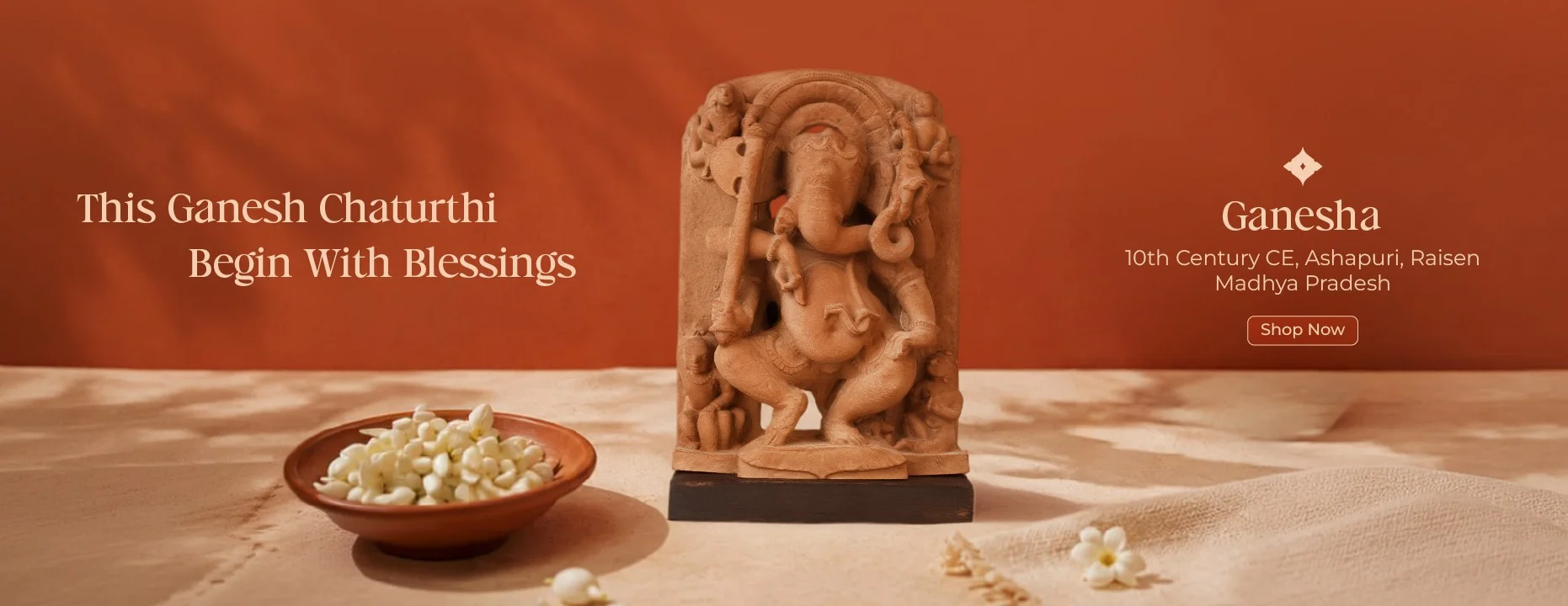
Somewhere in a stack of ancient temple carvings, there's a version of Ganesha that isn't sitting cross-legged with folded hands. He's mid-step, one foot lifted clean off the ground, arms swinging with real rhythm, while two small attendants keep the beat on cymbals just below him. It's not the pose most people picture when they think of Ganesha. So why did a temple artist, working stone by hand a thousand years ago, choose to freeze the god of new beginnings mid-dance instead of mid-meditation?
Why Does a God of new beginnings Dance?
The dancing form has a name of its own: Nritya Ganapati, roughly "the happy dancer," one of thirty-two traditional forms of Ganesha recognized across Indian temple art. The Shiva Purana describes him dancing to the rhythm of the cosmos itself, which is really just a poetic way of saying something simple: joy, in this tradition, isn't separate from the divine. It's one of the ways the divine shows up.
That idea shaped who actually worshipped this form. Dancers, musicians, and other performing artists have long turned to Nritya Ganapati specifically, believing the pose itself carries some of that skill and grace into anyone who honors it. Curious why a pot-bellied, elephant-headed god became the patron of rhythm and movement? Maybe because removing obstacles was never meant to be a grim job. Ganesha does it dancing.
Nritya Ganapati is also tied to a specific lunar association, Makha Nakshatra, in traditional Vedic astrology one small, layered detail among the 32 recognized forms of Ganesha, each built around its own mood or story. Some forms sit in deep meditation. Some hold weapons for protection. This one, alone among them, is built entirely around motion.
More Than Just a Date
Ganesh Chaturthi 2026 falls on Monday, September 14 the day Ganesha is welcomed into homes and pandals across India for ten days of celebration. Ganesh Chaturthi marks his birth, and the Ganesh Chaturthi date changes every year, tied to the Chaturthi tithi of Shukla Paksha in the month of Bhadrapada rather than a fixed date on the regular calendar. "When is Ganesh Chaturthi" is one of the most common questions asked about the festival, precisely because that lunar calculation shifts annually.
The Ganesh Chaturthi festival itself has become one of the biggest devotional events in the country. Streets fill with pandals, idols travel through cities on decorated floats, and by the tenth day, families send Ganesha off with visarjan, or immersion, and a promise to welcome him back next year. Long before anyone sends a "Happy Ganesh Chaturthi" message or searches for Ganesh Chaturthi wishes to share with family, this is the quiet rhythm the entire festival is built around.
Ganesh Chaturthi decoration at home usually starts simple: a clean, elevated spot for the murti, fresh flowers, and a rangoli at the door to welcome him in. Bigger celebrations add pandals, lights, and elaborate backdrops, but the basic idea stays the same across almost every Ganesh Chaturthi decoration ideas list you'll find clear a space, make it beautiful, and put Ganesha at the center of it.
The public version of this festival is fairly recent, in the context of Ganesha's much older worship. In the late 19th century, the independence-era leader Bal Gangadhar Tilak turned what had largely been a private, household observance into a shared community festival, encouraging public pandals and processions as a way to bring people together under British rule. That's part of why Ganesh Chaturthi today feels less like a quiet home ritual and more like a citywide event, especially in Maharashtra, complete with drumbeats, dancing crowds, and the chant of "Ganpati Bappa Morya" echoing through the streets.
The Temple Town That Vanished
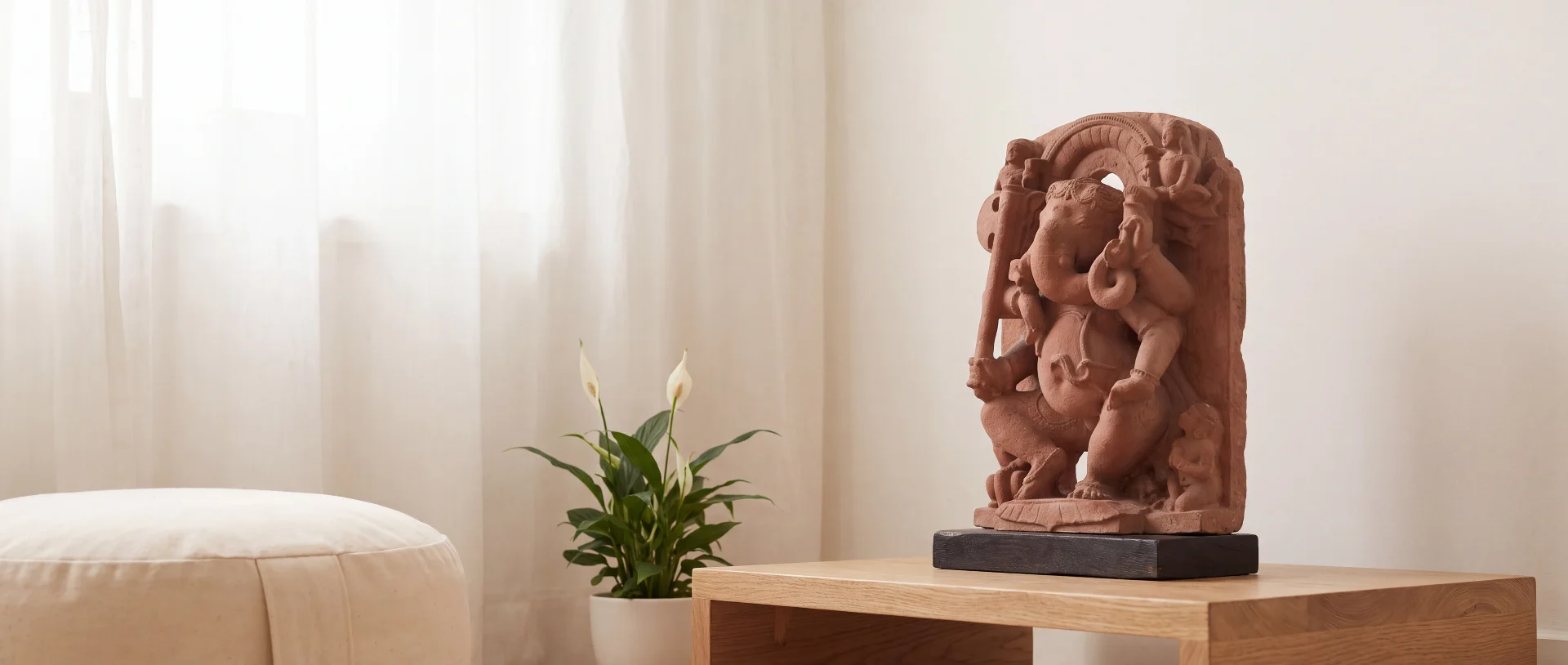
Long before this particular Ganesha reached a museum shelf, he was one of hundreds of figures carved across a hilltop temple town called Ashapuri, in the Raisen district of Madhya Pradesh, roughly 35 kilometers from Bhopal. Between the 9th and 12th centuries, under the Pratihara and Parmara dynasties, an estimated twenty-six temples rose here over two hundred years of continuous construction and royal patronage.
Then, slowly, it all came down. Invasions and natural disasters did what centuries of devotion couldn't undo: temple after temple collapsed, and the entire site disappeared under earth and forest, forgotten by almost everyone except the people living nearby. It stayed that way for centuries.
In 2010, Madhya Pradesh's archaeology department began a serious excavation at Ashapuri, and what came up out of the ground surprised even the researchers involved: more than 400 sculptures and architectural fragments, stacked and scattered across the hillside, evidence of an entire artistic tradition that had simply been waiting underground. This particular Dancing Ganesha, dated to the 10th century, was one of the pieces that survived that long burial well enough to be studied properly, cymbal-playing attendants and all.
Reading the Carving
Once you know the tradition, a dancing Ganesha carving rewards a slow look. Classical texts like the Rupamandana, an old manual for sculptors, actually spell out exactly how he should appear: riding his mouse, or mushika, holding his own broken tusk, or dant, a parshu, or axe, a padma, or lotus, and a modak, the sweet he's famous for craving. Not every dancing Ganesha follows this exact list plenty of later sculptures give him an elephant goad and a rope instead of the axe and lotus which makes each version a small window into which century, and which artist's workshop, actually made it.
Look closely, too, at what's happening around him. In many versions, including this one, small attendants stand just below the god, playing cymbals to keep time. It's an easy detail to miss, but it's the one that turns a static figure into an actual performance proof that the sculptor wasn't just carving a pose, he was carving a moment, mid-song, caught mid-air.
The earliest dancing Ganesha figures date back to roughly the 6th century. By the 10th, when this particular carving was made, he'd become common enough to appear on the exterior walls of temples across central India public, visible, dancing in daylight for anyone walking past to see.
The Pratihara and Parmara dynasties who ruled this part of central India between the 8th and 13th centuries left behind a distinctive sculptural style: dense ornamentation, deeply undercut relief, and real attention paid to smaller supporting figures rather than just the central deity. A dancing Ganesha carved during this transitional window tends to show both influences at once the more restrained, geometric composition typical of earlier Pratihara work, alongside the busier, more theatrical detailing that later Parmara sculptors preferred.
Where to Place Him
Vastu tradition has fairly specific advice for a dancing Ganesha too. The Northeast zone of a home or office is considered the most auspicious spot, associated with wealth, mental clarity, and protective harmony which is why you'll often see him placed there, whether at an entryway, a reception desk, or a living room console.
A few placements are worth avoiding, by most accounts: directly facing the main door, inside a bathroom, or tucked under a staircase, all considered draining rather than auspicious spots. Beyond that, most practitioners agree the details matter less than the intention a clean, respected spot, kept at eye level or slightly above, works for almost any home. As always, treat this as tradition and personal belief rather than a strict rule.
Sitting Ganesha or Dancing Ganesha? What to Look For
Not every Ganesha sculpture is meant to be the same thing. The seated, cross-legged form is the one most households keep for daily puja calm, symmetrical, built for quiet worship. The dancing form is different. It's meant to be seen more than prayed to in the traditional sense, which is exactly why it works so well as a centerpiece for a living room, office, or gifting occasion rather than a strict pooja shelf.
When you're choosing a dancing Ganesha statue, a few things separate a real heritage piece from a generic showpiece. Look for a sculpture tied to a specific, verifiable original rather than a vague "traditional design." Check whether the attributes match a real iconographic tradition the tusk, axe, lotus, and modak combination described in classical texts, rather than a random assortment. And look for documentation: a certificate or keeper's card that tells you exactly which artifact the replica is based on, not just a label.
Material is worth a close look too. Hand-finished stone composite holds the fine detail of a dance pose, like a raised heel or a curled trunk, far better than other material. Cheaper pieces tend to round off exactly the details that make this form recognizable in the first place, which rather defeats the point of choosing a dancing Ganesha over a simpler seated one.
The Piece Behind This Story: Ganesha
By now, the sculpture behind all of this should feel familiar. This Ganesha, from Varaha Heritage, is a museum-authenticated replica of the exact 10th-century carving recovered from Ashapuri, now preserved at the Triveni Museum in Ujjain, Madhya Pradesh. Every detail described above is there: the raised leg mid-step, the broken tusk in hand, and the small attendants keeping time on cymbals, carved in the transitional Pratihara-Parmara style of the region.
Ganesha from Varaha Heritage is a compact piece, about 7 inches, hand-finished in stone composite, made to sit comfortably on an entryway console, an office desk, or that Northeast corner Vastu points to. Many people choose it specifically for spaces meant to be seen rather than strictly worshipped a reception area, a study, a gifting occasion like a housewarming. It brings a sense of movement and joy that a seated murti, however beautiful, simply isn't designed to carry.
There's something fitting about a sculpture built entirely around joy showing up during Ganesh Chaturthi, of all festivals ten days built on welcoming exactly that kind of energy into a home.
Simple Ganesh Chaturthi Decoration Ideas Around It
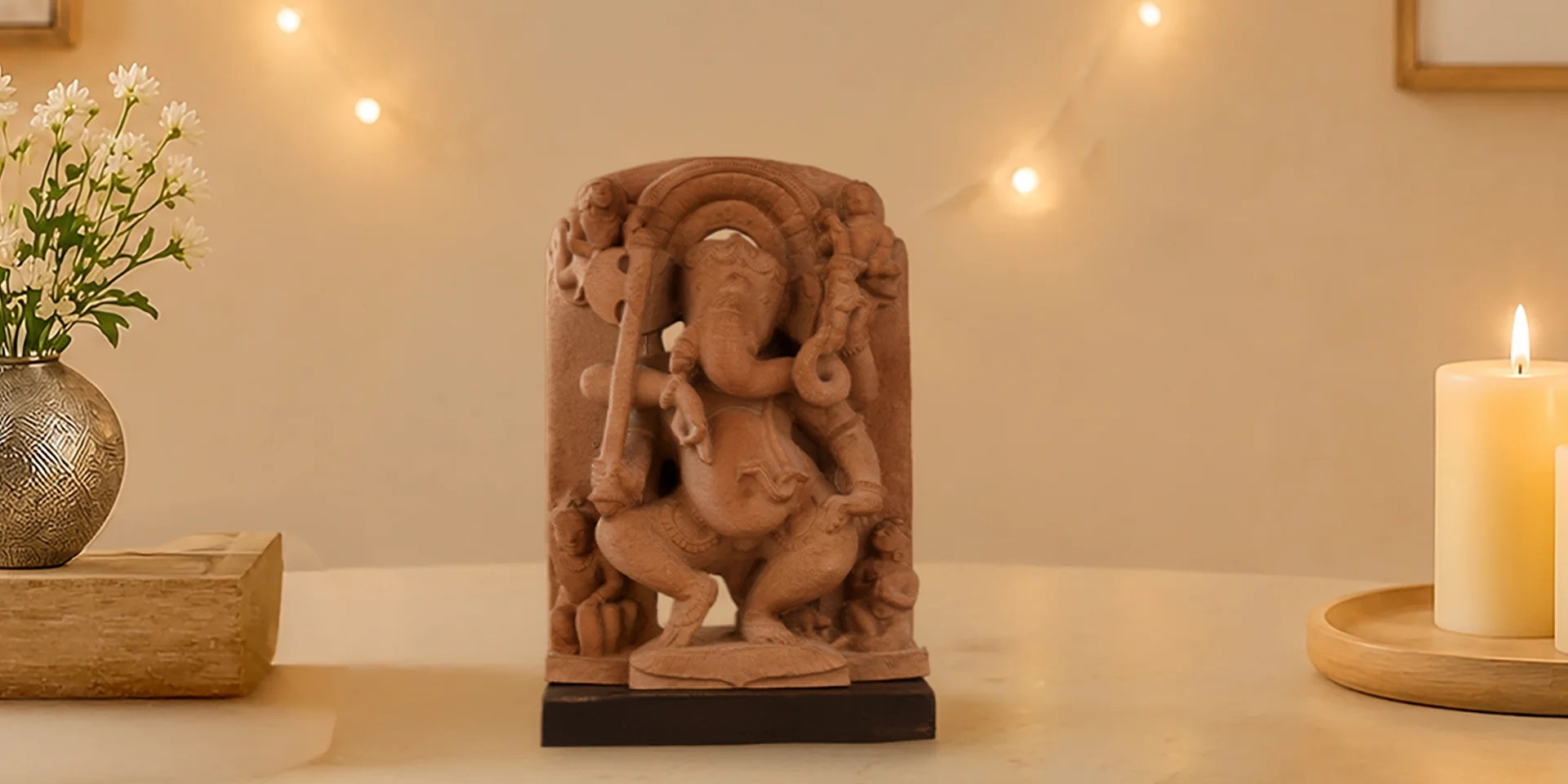
You don't need an elaborate setup to make a dancing Ganesha the centerpiece of your Ganesh Chaturthi decoration. A backdrop of marigold and mango leaves, a small rangoli underneath, and a ring of diyas are usually enough to turn any console table into a proper festive corner.
For bigger celebrations an office reception, a housewarming, or a Ganesh Chaturthi decoration at home that the whole family gets involved in keep the sculpture as the visual anchor and build outward: fairy lights, fresh flowers changed daily, maybe a small cluster of modaks placed as an offering. Simple, repeated elements photograph well too, useful if you're planning to send Ganesh Chaturthi wishes to family with a picture of this year's setup.
Keeping It Looking Its Best
Caring for a heritage piece like this is simple. Dust it gently with a soft, dry cloth once a week, and if you want extra shine before Ganesh Chaturthi, a barely damp cloth works better than any polish or chemical cleaner. Keep it out of direct sunlight and away from spots where diya flames sit too close, and it'll hold its detail and color for years, long after this year's decorations come down.
FAQs
What does a dancing Ganesha sculpture symbolize?
A Dancing Ganesha, or Nritya Ganapati, symbolizes joy, celebration, and the idea that removing obstacles doesn't have to be a solemn task. It's associated with the performing arts and is traditionally worshipped by dancers and musicians seeking skill, grace, and creative success.
What does Ganesha's dancing posture represent in Hindu art?
The raised leg and rhythmic pose represent movement, celebration, and the rhythm of the cosmos itself, as described in texts like the Shiva Purana. Sculptors often add attendants playing cymbals beside him, turning a static carving into a captured moment of music and motion.
Is a dancing Ganesha sculpture different from a regular Ganesha idol?
Yes. The common seated form is used for daily puja, while the dancing form, Nritya Ganapati, is one of Ganesha's thirty-two traditional forms and is meant to be displayed and admired as much as worshipped, making it a popular choice for living rooms and office spaces.
How do I choose an authentic traditional dancing Ganesha sculpture?
Look for a piece tied to a specific, verifiable artifact rather than a generic design, with attributes like the tusk, axe, lotus, and modak matching real iconographic tradition. Documentation such as a certificate or keeper's card confirming the original source is a strong sign of authenticity.
Where should a dancing Ganesha sculpture be placed in the home?
Vastu tradition considers the Northeast zone the most auspicious spot for a dancing Ganesha, whether at an entryway, office desk, or living room console. Avoid placing it directly facing the main door, in a bathroom, or under a staircase. This is guided by belief and tradition, not a strict rule.