It happened right in the middle of the wedding no warning, no build-up, just a voice with no one attached to it, cutting straight through the music and the noise. What it said was bad enough that Kansa, the bride's own brother, pulled his sword on her on the spot, in front of every guest in the hall.
The voice named no one you could see, and it said only one thing: that this bride's eighth child would grow up to kill the king standing beside was her own brother, Kansa. That's the bhavishvani, the prophecy, that sets this entire story in motion. Kansa didn't wait to find out if it was true. He grabbed Devaki by the hair, blade raised, ready to end the danger before it had even been born.
It was Vasudeva, the groom, who talked him down not with force, but with a bargain no father should ever have to offer: hand over every child the moment it's born, and let Kansa decide what happens next. Kansa agreed, and kept the terrible end of that promise with total precision. Six children were taken from Devaki's arms in the years that followed, one after another, never given the chance to grow past a few minutes old.
Devaki’s seventh child did not remain in her womb. By divine intervention, the child was transferred from Devaki’s womb to that of Rohini, another wife of Vasudeva, who was living safely away from Kansa. When the news reached Kansa, he believed Devaki had simply lost the child. But the child had survived and was later known as Balarama, Krishna’s elder brother. His birth was a quiet miracle, hidden from the very king who had spent years trying to prevent the prophecy from coming true.
By the time the eighth pregnancy came, Devaki and Vasudeva were locked deep inside Kansa's prison, watched day and night. And still, on the one night it mattered most, everything the king had planned for quietly fell apart. Outside, the sky split open rain hammering Mathura in sheets, thunder loud enough to swallow the cry of a newborn. Inside the cell, Devaki held her eighth child for the first time, and somehow, impossibly, the chains around Vasudeva's wrists simply gave way.
The guards at the door, swords drawn, slipped into a sleep too sudden to be natural. A door bolted for nine months creaked open on its own. Vasudeva wrapped the baby against the storm and walked straight into a flooded Yamuna, holding his son above the water with both arms, until he reached the far bank in a quiet village called Gokul and handed him to a woman named Yashoda, before turning back toward the prison before anyone woke.
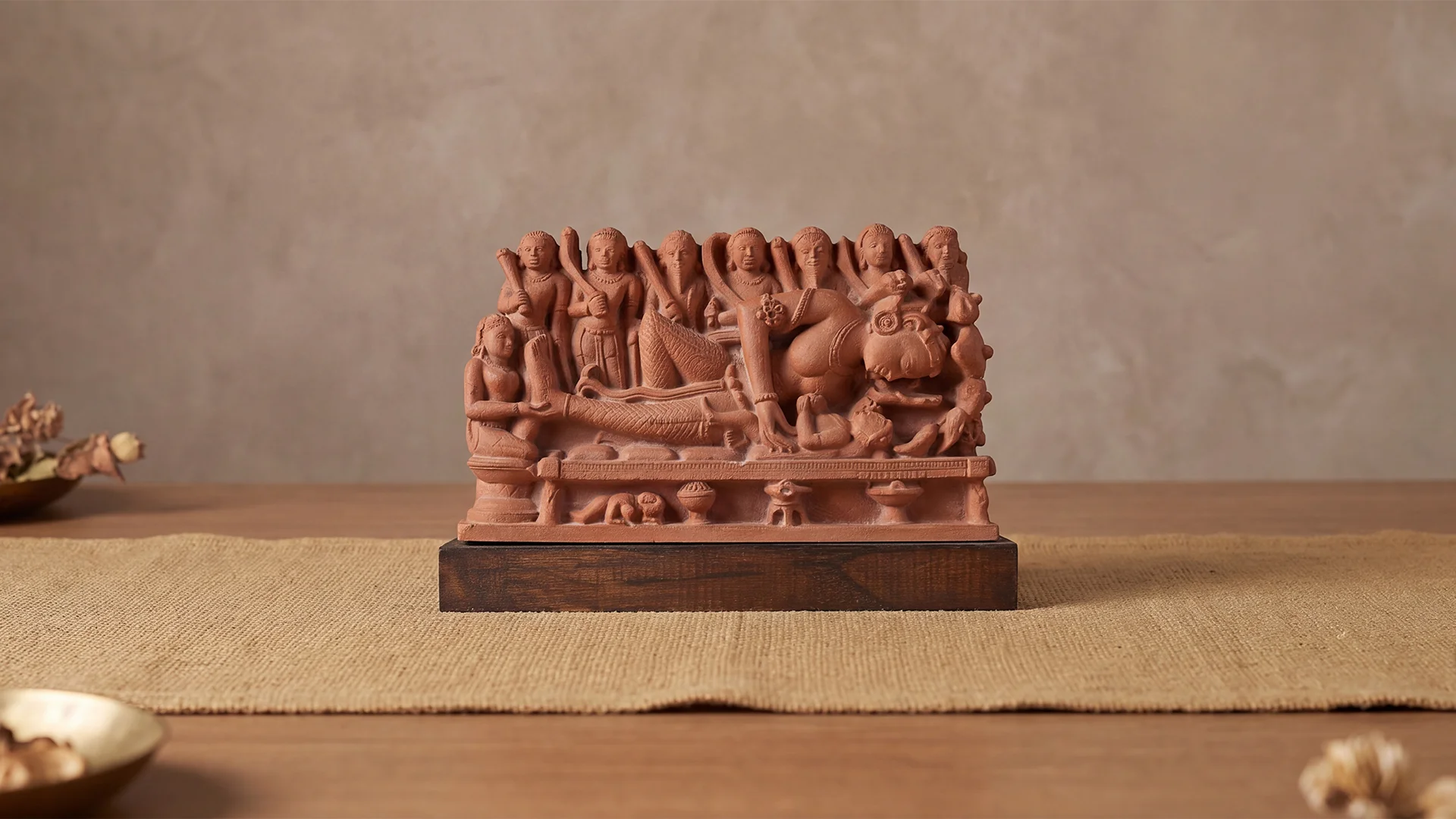
That entire sequence the prophecy, the sword, the six children lost, the storm, the escape is the whole reason an entire festival exists, thousands of years later. And it's also, in astonishing detail, the exact moment a sculptor once chose to freeze in stone. Not the prophecy. Not the sword. Just the one quiet second after all of it: a mother, a newborn, and the danger still standing guard around them.
More Than a Festival Date
Krishna Janmashtami 2026 falls on Friday, September 4 the night households everywhere re-enact some quiet version of that same story, with fasting, singing, and a small cradle set up for the newborn. The exact Janmashtami date shifts every year because it's tied to the Ashtami tithi and Rohini nakshatra lining up at midnight, which is why "when is Janmashtami" gets searched fresh every August. It's strange, in a way something this precise, an exact date and an exact hour, traced back to a night that was pure chaos. But maybe that's the point. Chaos, distilled generations later into something as calm as a lit diya and a folded pair of hands.
What doesn't change year to year is the shape of the celebration itself: fasting through the day, singing late into the night, and at the stroke of midnight, welcoming Krishna into the home. Long before anyone types out a "Happy Janmashtami" message to family, this is what's quietly happening behind it.
How people mark the day varies by region. Most part of India is famous for Dahi Handi, where teams form human towers to break a pot of curd hung high above the street. Mathura and Vrindavan lean into Raslila performances reenacting scenes from Krishna's life. Across every region, phones fill up with "Happy Janmashtami" messages sent to family who couldn't make the trip home, often with a photo of exactly the kind of sculpture or altar this piece is about.
A Temple That Almost Vanished
Long before this scene reached a museum shelf, it was part of something much bigger: a temple and monastery complex at Gurgi, a village near Rewa in Madhya Pradesh, built under the patronage of the Kalachuri dynasty. A stone inscription from King Kokalladeva II records grants made to support a monastery and temple raised here, around the 9th or 10th century CE. Gurgi wasn't a minor outpost. for a few centuries, it was a genuine center of worship, learning, and craft.
Krishna's Birth is one of the pieces that came out of that slow rediscovery. It's easy to forget, reading a short museum label, that a panel like this survived roughly a thousand years of change before anyone thought to study it closely a mother, a storm, and a love fierce enough to outlast a kingdom.
Reading the Carving, Stone by Stone
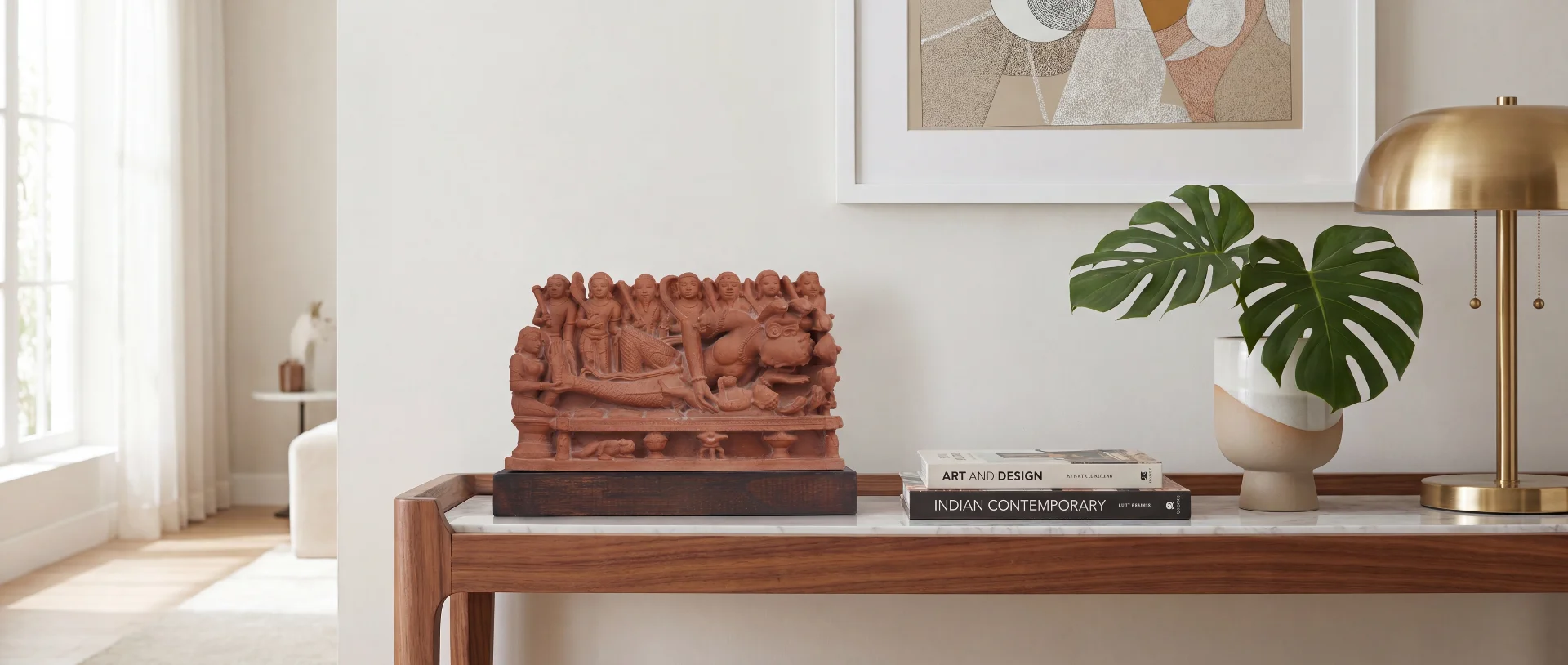
Once you know what to look for, a Krishna’s birth sculpture is packed with detail. Above the newborn, you'll often see Shesha, a great multi-headed serpent, spreading his hoods like a canopy a sign, in this tradition, that Krishna was never just an ordinary child but a form of Vishnu himself. Around the edges, seven carved soldiers stand watch, spears and shields in hand, faces set and alert.
Here's the detail that's easy to miss: in the story, those guards had already fallen asleep by the time Vasudeva slipped out. Yet the sculptor carved them wide awake, weapons ready, as if the danger hadn't passed yet at all. Maybe that was deliberate showing the fear still hanging in the room, rather than the miracle that had already happened, so the mother and child at the center feel even more fragile, even more human, surrounded by all that carved tension.
Look closely at how the sculptor arranged the whole scene, too: the guards don't crowd the center, they frame it, almost like a border standing watch around one still, soft moment. Sculptors cut the background stone away in layers, deep enough that Devaki and her child sit forward, catching the light, while the guards recede into shadow. It's a simple trick with real emotional weight, your eye lands on the mother and newborn first, every time, no matter how many armed men are carved around them.
The festival carries its own vocabulary too. Devotees fast until Nishita Kaal, the deepest part of midnight, then break the fast after aarti. Many households keep a small jhula, or cradle, for baby Krishna and celebrate devotion through bhajans. Curious why Janmashtami sculptures rarely show Krishna older, playing his flute or stealing butter? Those images belong to a later chapter of his life. A birth sculpture stays fixed on this one night, the night the story actually begins.
It helps to know the difference, since Krishna shows up in Indian art in so many forms. As a toddler reaching for makhan, butter, he earns the nickname Makhan Chor. A little older, he wears a peacock-feather mukut, or crown, and plays his bansuri, the flute, surrounded by cows and gopis in the fields of Vrindavan. A birth sculpture is quieter than all of that no flute, no crown, no cows, just a mother, a newborn, and a serpent standing guard, which is exactly why it fits Janmashtami night rather than any other Krishna festival.
Where to Place Him
Vastu, the traditional Indian approach to space and direction, has fairly specific advice for a Krishna sculpture. The Northeast corner of a room, sometimes called the Ishaan zone, is considered the most auspicious spot it's associated with clarity, peace, and spiritual energy, which is why you'll often see a Krishna murti placed there in a living room or pooja room.
That said, plenty of homes don't have a free Northeast corner, and most Vastu practitioners agree a few other spots work well too: a clean shelf in the pooja room, a console table in the living room facing the main door, or a quiet corner of the bedroom, as long as it isn't directly facing the bed. One placement worth avoiding is the bathroom or anywhere near the shoe rack. Think of this as tradition and personal belief rather than a strict rule.
What Separates a Real Heritage Piece from a Showpiece
Krishna sculptures are everywhere during Janmashtami season, from roadside stalls to big-box stores, and most are decorative rather than meaningful. If you want something worth keeping for years, look for a piece tied to a specific, real artifact rather than a generic mold a sculpture that references an actual museum piece or temple carving carries a story you can verify, like a sculpture of Krishan’s Birth from Varaha Heritage
Material matters too. Hand-finished stone composite hold detail far better than other materials, especially in smaller carvings like Shesha's hoods or the guards' expressions. Genuinely authenticated pieces also come with documentation a certificate, a keeper's card, something that tells you exactly which original the replica is based on. That's easy to overlook in a hurry, but it's really the difference between owning art and owning a shape.
Size is worth thinking through too. A large, elaborate sculpture can dominate a small apartment shelf, while a piece that's too small gets lost on a big mandir altar. Most Krishna birth sculptures size is 6 inches, which works for both a compact pooja corner and a spacious living room console.
The Piece Behind This Story: Krishna's Birth
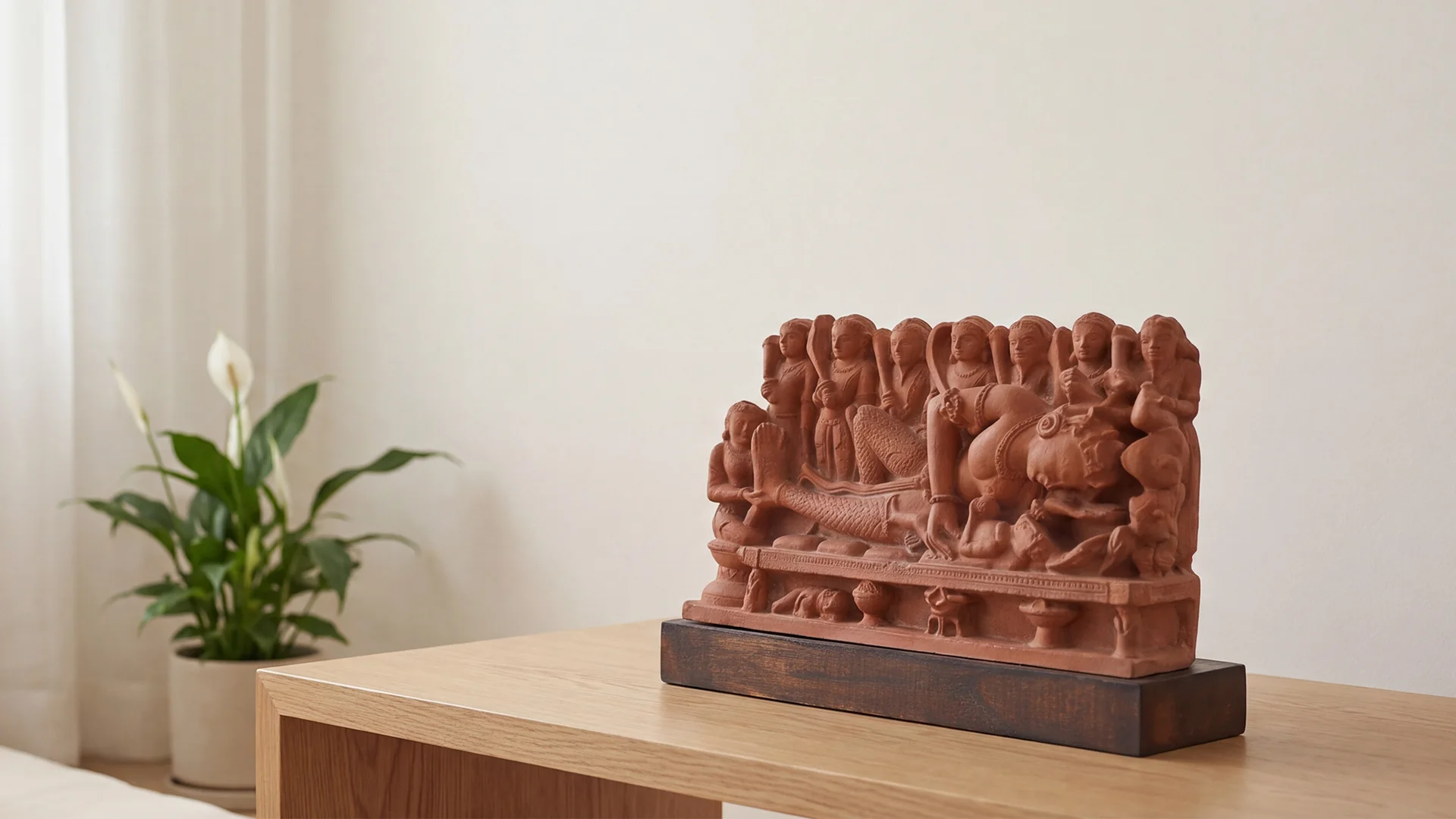
By now, the sculpture behind all of this should feel familiar. Krishna's Birth, from Varaha Heritage, is a museum-authenticated replica of the exact 10th-century Kalachuri carving that survived Gurgi's long silence, now preserved at the Triveni Museum in Madhya Pradesh. Every detail from the story above is there in miniature: Devaki holding her newborn close, the multi-hooded Shesha spread like a canopy above them, and seven watchful soldiers framing the scene, carved just as tense as that stormy night must have felt.
It's compact, about 6 inches, small enough to sit on a living room console without asking for too much space. Families often choose it for weddings and housewarmings too a scene about protecting something fragile is a fitting thing to hand someone at the start of their own new chapter.
There's something fitting about gifting a birth scene. A wedding, a housewarming, a baby shower they're all beginnings too, in their own way. A carving that has already outlasted a thousand years of its own beginning carries a little of that quiet, stubborn hope into every new beginning it is gifted for.
Simple Ways to Decorate Around It
You don't need an elaborate setup to make a Krishna sculpture the centerpiece of your Janmashtami decoration. A small jhula or swing nearby, strung with fresh flowers, keeps the birth theme going. Marigold garlands, a ring of diyas, and a rangoli pattern in front of the shelf are usually enough to turn an ordinary console table into a proper festive corner.
If you're planning Janmashtami decoration ideas for a bigger celebration, an office reception, a school event, or a housewarming keep the sculpture as the visual anchor and build outward: fairy lights, a cluster of small brass diyas, maybe a peacock feather tucked into the flowers. Simple, repeated elements photograph well too, useful if you're sending a happy Janmashtami message to family who couldn't make it home this year.
Keeping It Looking Its Best
Caring for a heritage piece like this is simple. Dust it gently with a soft, dry cloth once a week, and if you want extra shine before Janmashtami, a barely damp cloth works better than any polish or chemical cleaner. Keep it out of direct sunlight and away from spots where diya flames sit too close, and it'll hold its detail and colour for years, long after this year's decorations come down.
FAQs
Which Krishna sculpture is best for Janmashtami at home?
A birth-scene sculpture, like Krishna's Birth, works especially well for Janmashtami since it reflects the exact night being celebrated. Look for a piece tied to a real museum artifact rather than a generic showpiece it gives the celebration a genuine sense of history alongside the usual diyas and decorations.
Where should a Krishna sculpture be placed at home according to Vastu?
Vastu tradition considers the Northeast corner, or Ishaan zone, the most auspicious spot for a Krishna sculpture, especially in a living room or near pooja room. If that corner isn't available, a clean shelf facing the main door works well too. This is guided by belief and tradition, not a strict rule.
What does a Krishna sculpture symbolize during Janmashtami?
A Krishna sculpture, especially a birth scene, symbolizes protection, new beginnings, and good overcoming harm. Figures like Devaki, the guarding soldiers, and the serpent Shesha each carry their own meaning, together turning a vulnerable moment into something sacred and lasting.
Can I keep a Krishna sculpture in the living room, bedroom, or pooja room?
Yes, all three work well. The living room and pooja room are the most common choices, especially near the Northeast corner, while a bedroom placement is fine too, as long as the sculpture isn't directly facing the bed. Many households simply pick whichever space gets calm, respectful daily attention.
What should I look for when choosing an authentic Krishna sculpture for my home?
Look for a sculpture tied to a specific, real artifact, with documentation like a certificate or keeper's card explaining its origin. Hand-finished materials such as stone composite hold fine detail better than other materials, and a piece with a verifiable history feels far more meaningful than a purely decorative one.