
The image of the Preaching Buddha stands as a beacon of clarity in a world often clouded by noise and distraction. With his hands poised in the Vyakhyana Mudra / Dharmachakra Mudra, this iconic figure represents more than just a historical event – it encapsulates the essence of the human journey from ignorance to enlightenment. When we look upon the Preaching Buddha, we are invited to revisit the teachings of Buddha, a body of wisdom that has guided millions for over two and a half millennia.
A note on the two mudras:
Dharmachakra Mudra – Specifically symbolizes the First Sermon and the Turning of the Wheel of Dharma. This is the standard identification for Buddha images from Sarnath.
Vyakhyāna Mudra – A general teaching or exposition gesture that can be used for various teachers, deities, or even the Buddha in contexts other than the First Sermon
To understand the statue, we must first understand the Buddha. The Gautam Buddha teachings are not abstract theories; they are the distilled results of a life dedicated to finding the end of suffering. In this blog, I will take you on the journey of Gautama Buddha from a prince to a monk, and ultimately to the Enlightened One. We will explore his early life, the Great Departure, his enlightenment, and the profound philosophy that became the foundation of Buddhism and continues to inspire millions around the world.
The Prince Who Searched for Truth: The Early Life of Siddhartha
Long before he was known as the Buddha, he was Siddhartha Gautama, born into the royal Shakya clan. He was born in Lumbini, in present-day Nepal, and spent his early years in Kapilavastu, the capital of the Shakya kingdom. His life began in luxury as the son of Queen Maya and King Suddhodana, who ensured he was surrounded by comfort and protected from the hardships of the outside world. Legend tells us that at his birth, sages prophesied he would become either a great universal monarch or a world-renouncing spiritual leader. Determined to keep his son on the path of kingship, the King surrounded Siddhartha with every pleasure and comfort imaginable.
The Shielded Life and the Great Awakening
For the first 29 years of his life, Siddhartha lived within the palace walls. He married the beautiful Yashodhara and fathered a son, Rahul. Yet, the human spirit is often restless in the face of superficial comfort. Siddhartha’s curiosity led him to venture beyond the palace gates. It was during these trips that he encountered the "Four Sights":
An elderly man: Representing the fragility of the body.
A sick man: Representing the inevitability of disease.
A corpse: Representing the finality of death.
A wandering ascetic: Representing the search for truth.
These sights struck him with the gravity of human existence. He realised that the palace lifestyle was a veil, hiding the reality of life that everyone – regardless of rank – is subject to ageing, illness, and death.
The Great Departure
At age twenty-nine, in a moment of monumental sacrifice, Siddhartha left his kingdom, his wife, and his young son. This act of "The Great Departure"(Great renunciation) was not born of coldness, but of deep compassion. He realized that if he remained a prince, he could help only his subjects; if he became an enlightened being, he could potentially help all of humanity escape the cycle of suffering.
Image of Siddhartha leaving his family and kingdom
Buddhist art has immortalized this defining moment in a deeply symbolic scene. Prince Siddhartha is shown leaving the palace at night on his faithful horse, Kanthaka, accompanied by his loyal charioteer, Channa. According to Buddhist tradition, celestial beings gently lifted Kanthaka's hooves so that they made no sound, allowing the prince to depart without disturbing the sleeping city. The silent journey marks the moment Siddhartha turned away from worldly power and comfort, choosing instead a life devoted to seeking the truth and the end of human suffering.
The Path to Enlightenment: From Asceticism to the Middle Way
After the Great Departure, Siddhartha cut off his long hair, exchanged his royal garments for the robes of a wandering ascetic, and began searching for the truth about suffering.
His goal was simple but profound:
Why do people suffer, and is there a way to end suffering forever?
Siddhartha spent years studying under the greatest spiritual teachers of his time, yet he found their methods incomplete. He then turned to extreme asceticism, practising fasting and physical austerity near Bodh Gaya (then the region of Uruvela). For nearly six years, he pushed his body to its limits. He was reduced to skin and bone. Many sculptures from Gandhara portray this "Fasting Buddha" with remarkable realism. He realized that extreme self-mortification only clouded the mind and weakened the body, making spiritual insight impossible.
He understood that:
A weak body cannot support a clear and focused mind.
Images of Gandhara art portraying the Fasting Buddha
The Discovery of the Middle Way
The six years of penance were not a failure – they were an essential part of Siddhartha's journey. They convinced him through direct experience that neither royal luxury nor extreme asceticism could free a person from suffering. This insight gave rise to the Middle Way. The Middle Way is a path that avoids the extremes of self-indulgence and self-denial. It is the path of moderation, which allows the body to be healthy and the mind to be clear. Embracing this, he accepted a bowl of milk rice (Kheer) from a village girl named Sujata. He regained his strength after that, he took a bath in the Niranjana River. He then walked to the Mahabodhi Tree (the Bodhi Tree) and made a solemn vow:
He would not rise from meditation until he had discovered the truth.
The Night of Awakening
As he sat in meditation, he faced the temptations of Mara, a demon representing desire, fear, and ego. Siddhartha remained unmoved. By dawn, the veil of ignorance was lifted. He saw the interconnectedness of all things and the mechanics of suffering. At that moment, Siddhartha Gautama became the Buddha, the "Awakened One."
The First Preaching of Lord Buddha: Turning the Wheel
After attaining enlightenment, the Buddha travelled to Mṛgadāva / Migadāya (the ancient Deer Park) at Sarnath. There, he met his five former companions who had previously abandoned him for his abandonment of extreme asceticism. The Preaching of Gautam Buddha began here with his first sermon, Dhammacakkappavattana Sutta, or "Setting the Wheel of Dharma in Motion"
The Significance of the Dharmachakra Mudra
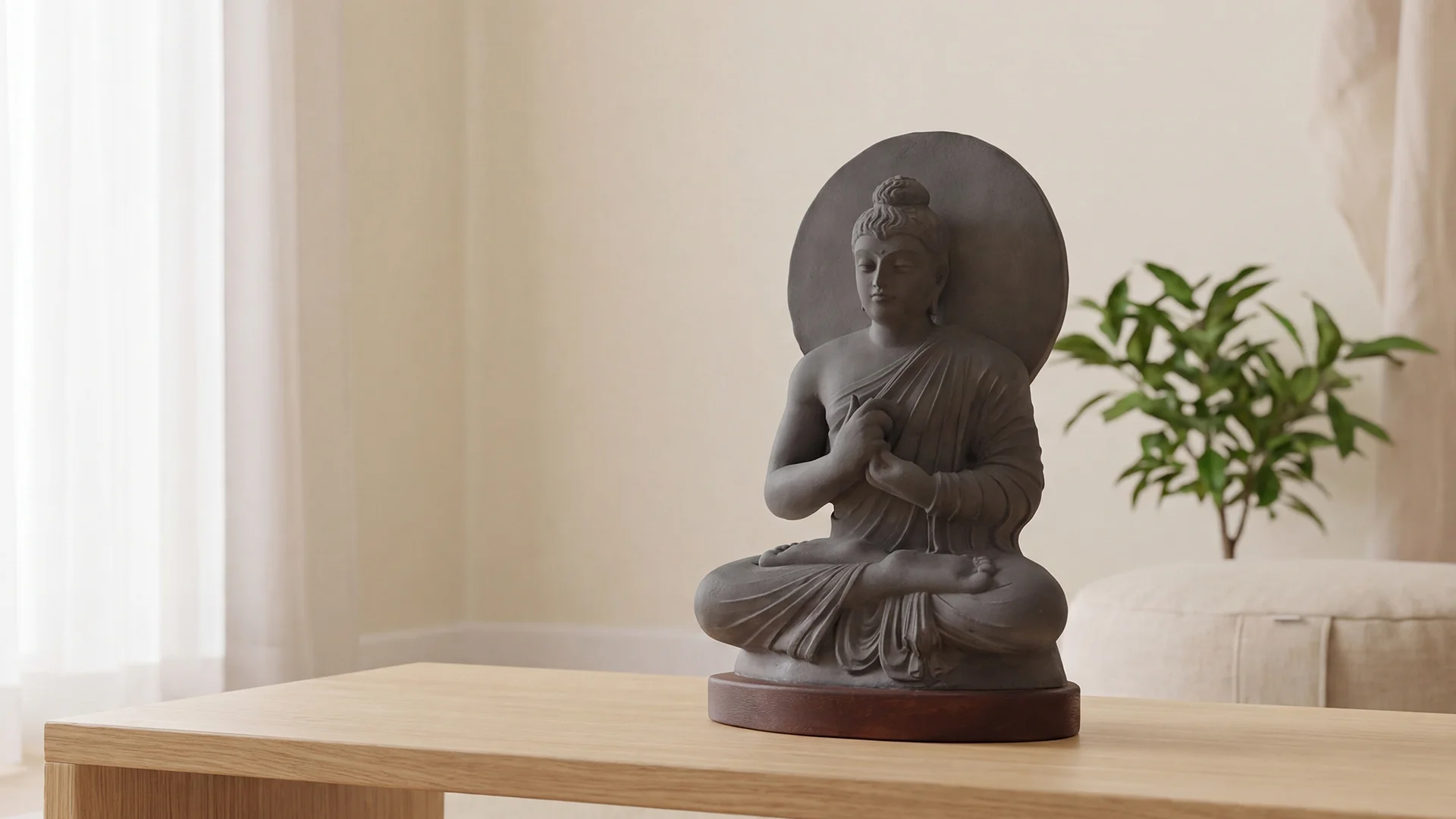
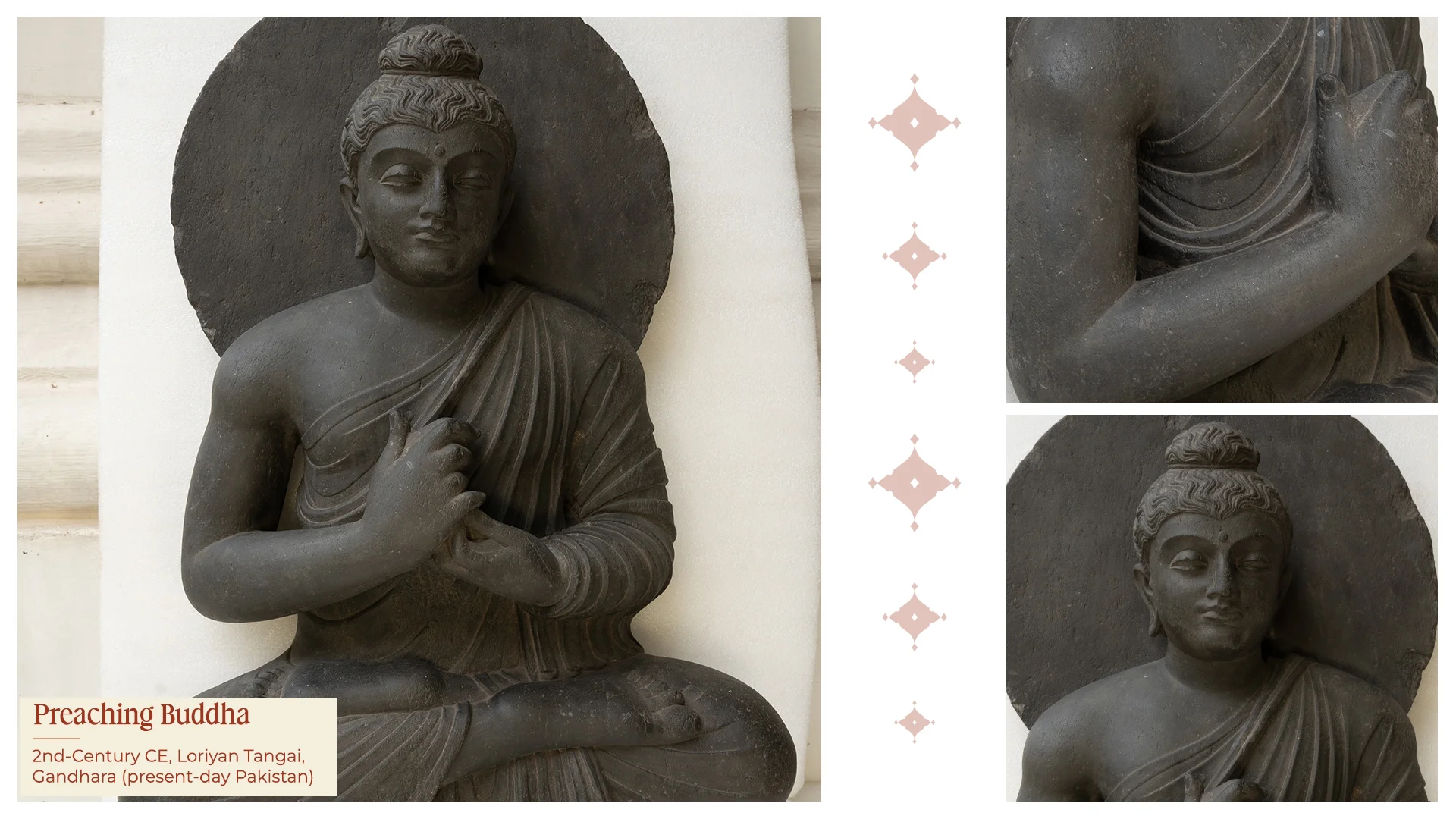
When we see the Preaching Buddha statue, the hands are in the Dharmachakra Mudra. The index fingers and thumbs touch to form circles, representing the Wheel of the Law. This posture is not just a pose; it symbolizes the continuity of his message. The Lord Buddha preaching gesture reminds us that his wisdom was not intended for a select few, but was meant to be set in motion for the benefit of all living beings.
Decoding the Teaching of Buddha: Core Philosophy
The Buddha's teachings are rooted in the practical application of wisdom to daily life. He did not ask his followers to worship him as a god; he asked them to test his words as a goldsmith tests gold.
The Four Noble Truths: The Medical Diagnosis
The Four Noble Truths are the foundation of the teachings that Gautama Buddha first expounded in his sermon at Sarnath. They explain the nature of human suffering and the path to liberation. Gautam Buddha's philosophy is often compared to a physician’s approach:
The Truth of Suffering (Diagnosis): Life inevitably involves suffering, dissatisfaction, and impermanence. Birth, ageing, illness, death, separation from loved ones, and unfulfilled desires are all forms of dukkha (suffering/unsatisfactoriness).
The Truth of the Cause of Suffering (Samudaya – Etiology): Suffering arises from craving (tanhā), attachment, and ignorance. We suffer because we cling to pleasures, possessions, relationships, and even our own identities, expecting them to be permanent.
The Truth of the End of Suffering (Nirodha – Prognosis): Suffering can come to an end. By letting go of craving and attachment, one can attain Nirvana (Nibbāna) – a state of complete liberation, peace, and freedom from the cycle of birth and death.
The Truth of the Path Leading to the End of Suffering (Magga – Prescription): The way to end suffering is by following the Noble Eightfold Path, which cultivates wisdom, ethical conduct, and mental discipline.
The Eightfold Path: A Roadmap for Modern Living
The Eightfold Path in Buddhism is the comprehensive guide to ethical life:
Wisdom (Prajñā)
Right View (Sammā-diṭṭhi): Seeing the world as it is, not as we want it to be.
Right Resolve (Sammā-saṅkappa): Cultivating the intention of renunciation and non-harming.
Ethical Conduct (Śīla)
Right Speech (Sammā-vācā): Refraining from lying, gossiping, and divisive speech.
Right Action (Sammā-kammanta): Practicing non-violence, integrity, and generosity.
Right Livelihood (Sammā-ājīva): Choosing a profession that does not harm others.
Mental Discipline (Samādhi)
Right Effort (Sammā-vāyāma): Consciously choosing wholesome states of mind over unwholesome ones.
Right Mindfulness (Sammā-sati): Being fully present in the current moment.
Right Concentration (Sammā-samādhi): Developing deep, meditative focus.
The 10 Teachings of Buddha for Everyday Life
While there are many facets to the teaching of Buddha, ten core principles serve as a powerful foundation for a balanced life:
Compassion for All: Cultivate a heart that wishes happiness for everyone.
Impermanence (Anicca): Accept that change is the only constant.
Self-Responsibility: You are the author of your own happiness and suffering.
Practice Mindfulness: Live in the "now" rather than the past or future.
Letting Go of Attachment: Attachment is the root of pain; learn to hold things lightly.
Kindness in Speech: Words have power; use them to heal and build.
Humility: Recognize that pride is a barrier to wisdom.
Generosity (Dana): Giving is a practice that breaks the hold of ego.
Patience: True transformation takes time; do not rush the process.
Wisdom (Panna): Always question and investigate; do not accept blind dogma.
Why are the Teachings of Buddha Still Relevant Today?
In an age dominated by digital noise, Buddha and his teachings offer a sanctuary of silence. We are constantly pressured to produce, to consume, and to compare. The preaching of Lord Buddha serves as a vital counterbalance to this high-speed lifestyle.
Mental Health and Mindfulness
Modern psychology has largely embraced the Buddhist practice of mindfulness. By focusing on the breath and observing thoughts without judgment, we can break the cycle of anxiety. The Buddha's teaching reminds us that we are not our thoughts; we are the observers of our thoughts. This realization alone can drastically improve one’s mental health.
Ethical Living in a Complex World
The Gautam Buddha teachings provide a moral compass that isn't tied to rigid dogma. It is based on the principle of Ahimsa (non-violence) and Karuna (compassion). When applied to modern debates – from environmental stewardship to corporate ethics – the Buddha’s focus on the interconnectedness of all beings provides a sustainable way forward for humanity.
A Masterpiece of History: The Loriyan Tangai Preaching Buddha
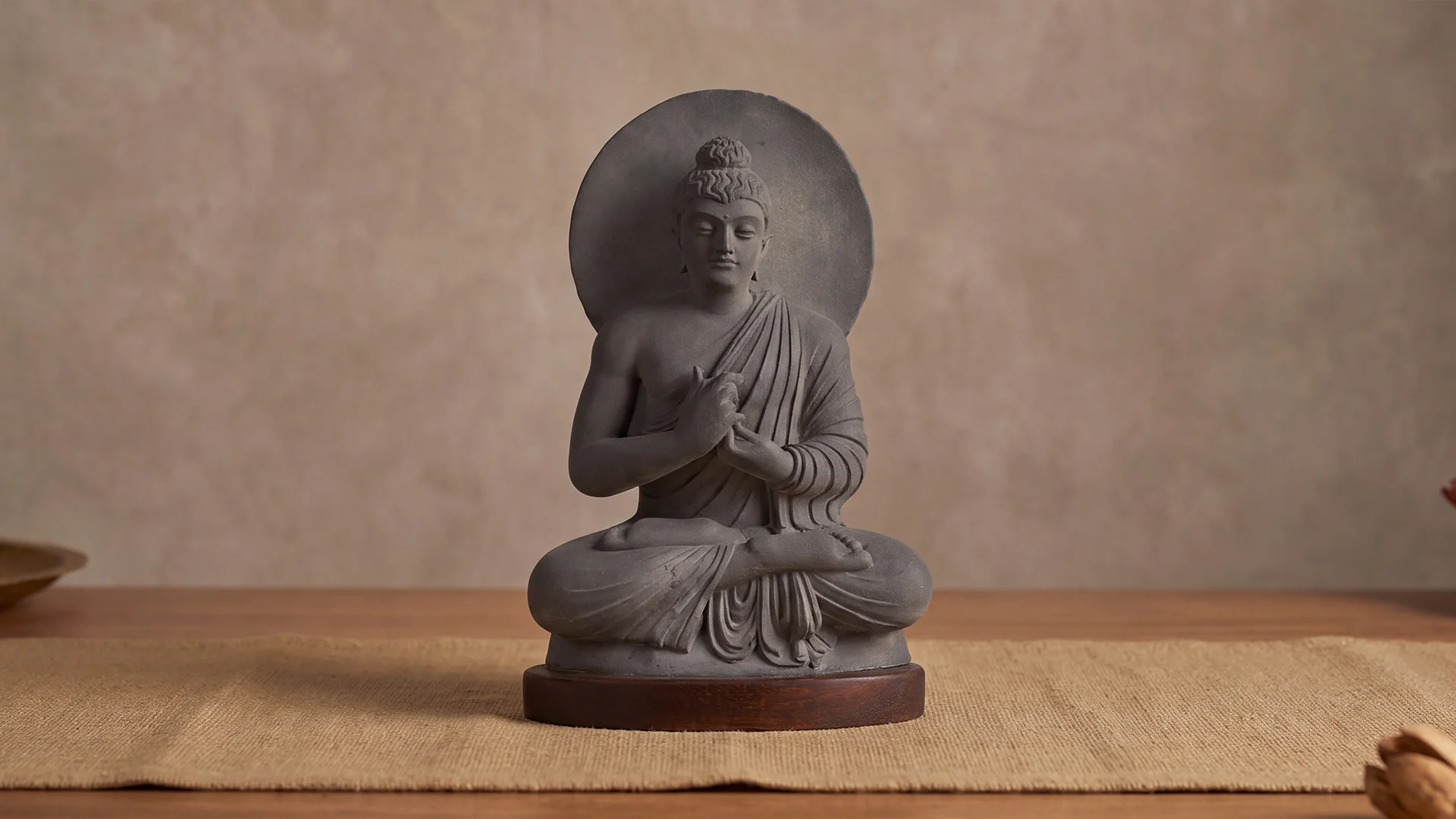
At Varaha Heritage, we are deeply honoured to bring into focus a rare and exquisite artifact: a Preaching Buddha sculpture dating back to the 2nd century CE. Originally unearthed in Loriyan Tangai, Gandhara – located in present-day Pakistan – this sculpture is a profound testament to the Gandharan school of art, which famously blended Eastern spirituality with Hellenistic artistic influences. This ancient piece perfectly captures the serenity and instructional grace of the Lord Buddha preaching, serving as a bridge to a bygone era where the foundations of Buddhist art and philosophy were solidified. Holding such a relic allows us to physically connect with the roots of the preaching of Gautam Buddha, preserving the legacy of an enlightenment that has travelled through centuries to reach us today.
Conclusion: Embodying the Preacher Within
The Preaching Buddha statue is more than just a piece of art; it is a mirror reflecting our own potential for enlightenment. When we study the Gautam Buddha teachings, we aren't just learning history – we are acquiring the tools to become our own teachers.
Whether through the practice of meditation, the cultivation of daily mindfulness, or the simple act of speaking with kindness, each of us has the capacity to "turn the wheel" in our own lives. As you look at the serene face of the Preaching Buddha, remember that the enlightenment he attained is the same potential that resides within you. The journey to wisdom starts with a single step – or a single, mindful breath.
Explore the Collection: At Varaha Heritage, each Preaching Buddha is more than décor — it is a piece of living history, echoing masterpieces such as our 2nd-century Loriyan Tangai sculpture. If this journey has moved you, we invite you to explore our curated collection and bring a measure of that timeless serenity into your own space.
Frequently Asked Questions:
1. What does the Preaching Buddha statue symbolize?
The statue symbolizes the Buddha’s role as the "Dharmachakra-pravartaka," or the one who sets the wheel of truth in motion. It represents the moment the Buddha transitioned from a solitary seeker to a teacher of humanity.
2. What are the main teachings of Gautam Buddha?
The primary focus is on the Four Noble Truths and the Eightfold Path, emphasizing the cultivation of wisdom, ethical conduct, and mental clarity to overcome suffering.
3. What is the significance of the preaching mudra in Buddha statues?
The Dharmachakra Mudra represents the harmony between wisdom and compassion. The positioning of the hands at the heart signifies that the teachings come from a place of deep insight and universal love.
4. What is the Eightfold Path in Buddhism?
The Eightfold Path is the practical application of the Four Noble Truths. It provides an eight-part strategy for living a life that minimizes suffering and fosters spiritual growth.
5. How does a Preaching Buddha differ from other Buddha statues?
Unlike the Bhumisparsha (earth-touching) mudra which represents the moment of victory over Mara, the Dharmachakra (preaching) mudra focuses on the transmission of knowledge. It symbolizes the Buddha as the bearer of the Dharma.
6. What are the most important Buddha teachings on life?
The concepts of impermanence (nothing lasts forever) and the idea that our happiness is dependent on our internal state, not external circumstances, are considered the most vital.
7. Where should a Preaching Buddha statue be placed at home?
It should be placed in a clean, elevated position. Common locations include the living room or a dedicated meditation space. It should never be placed in a bathroom or on the floor.
8. What was the first sermon of Lord Buddha?
The Buddha's first sermon, known as the Dharmacakra Pravartana ("Setting the Wheel of Dharma in Motion"), was delivered at Sarnath to his five former companions. In this sermon, he introduced the Middle Way, explained the Four Noble Truths, and taught the Noble Eightfold Path – the foundational principles of Buddhism.
9. Why are the teachings of Buddha still relevant today?
The teachings provide a non-dogmatic, empirical approach to life. They address the human struggle with dissatisfaction, greed, and confusion, offering techniques that are just as effective today as they were 2,500 years ago.
Product Link : Preaching Buddha.