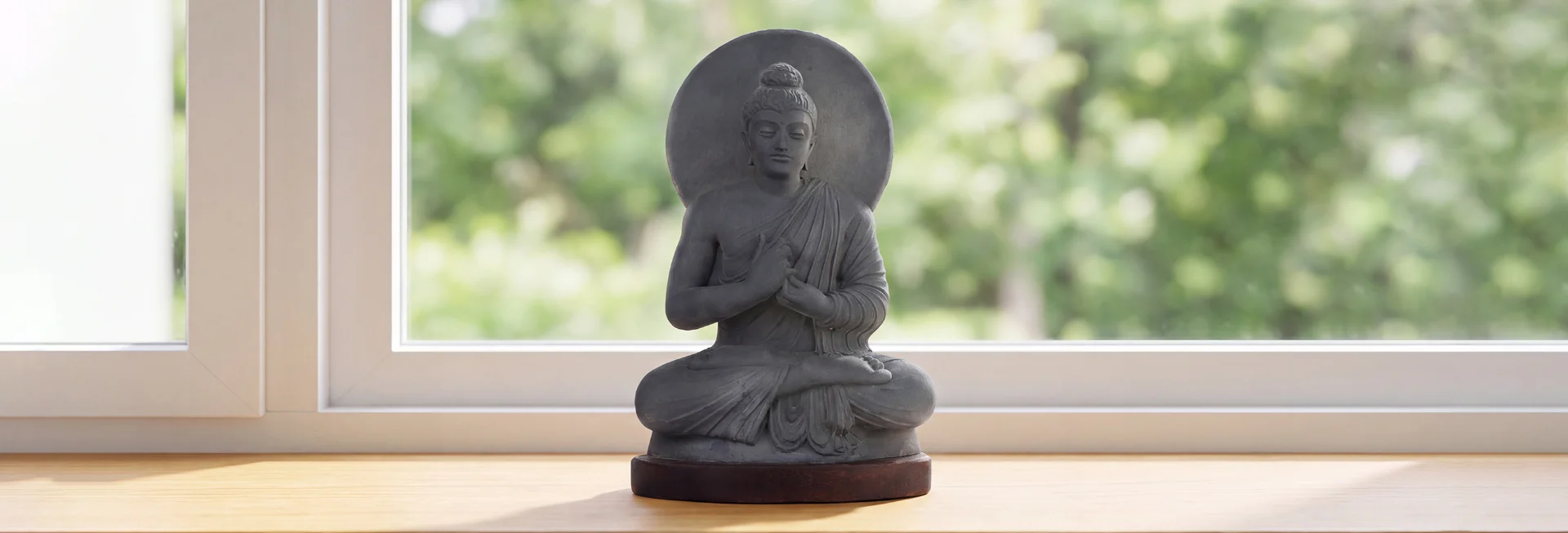
In 1896, Alexander Caddy was sent to a valley in what is now northern Pakistan to dig up Buddhist sculpture and photograph it, and he uncovered an unmistakable Buddha in a heavy, rippling robe that wouldn't look out of place on a Greek citizen. This guide follows that puzzle, from the robe's origins to the Preaching Buddha's posture and how to choose a Buddha statue for home. Along the way you'll also meet the thirty-two marks of a great man, which early Indian writers took surprisingly seriously. But first, who taught the sculptors of Gandhara to dress the Buddha like that?
The Gandhara Buddha: A Buddha Statue for Home with Roots in the Kushan Age
Gandhara was a stretch of the ancient north-west centred on the Peshawar basin, the Swat valley and Taxila, which today lie in Pakistan and across the border in eastern Afghanistan. Under the Kushan Empire, in roughly the 1st to 3rd centuries CE, the workshops of this region produced the earliest surviving devotional images of the Buddha shown as a person, and they worked mostly in grey schist and in stucco, a plaster that stays soft long enough to be modelled by hand.
That gives a Gandhara piece an unusual claim if you're shopping for a Buddha statue, because you aren't simply choosing a calm face from a shelf of similar ones. You're choosing a face that belongs to a particular century, a particular origin and a particular museum collection. The originals now sit in museums at Peshawar and Taxila and in the Indian Museum in Kolkata, which received most of the Loriyan Tangai finds.
A Road Everyone Used
Gandhara lay on the route between India and Central Asia, and armies kept arriving along it. Ashoka's Rock Edict 13 lists the Yavanas, meaning the Greeks, among the peoples who were following his dharma (moral law), which tells us there were Greek communities living in the region and that they were listening to Buddhist teaching.
After the Mauryas came the Indo-Greek kingdoms, the Indo-Scythians, the Parthians and, the Kushans, traders, monks, soldiers and craftsmen moved through this region, each of them carried habits and tastes along with the goods. That is the plainest answer to why Gandhara art blends Greek and Indian styles: the artists lived at the very place where the two met.
How to Read the Preaching Buddha: Posture, Gesture and Marks
Every detail of a Preaching Buddha answers to a story, so it's worth hearing the story first. After a long search, the Buddha reached enlightenment while meditating under the Bodhi tree at Bodh Gaya, and then, as the tradition tells it, he said nothing for several weeks before deciding that the insight was too important to keep to himself.
He walked to Sarnath, to the Mrigadava (the Deer Park), where five companions from his earlier wanderings were staying, and these five became his first disciples. That first sermon is called the Dhammacakkappavattana Sutta, "Setting the Wheel of Dharma in Motion", and in it he laid out the Four Noble Truths, which deal with dukkha (suffering), its cause, its end in nirvana (release) and the path that leads there, together with the Noble Eightfold Path. A Preaching Buddha freezes that afternoon in stone.
Padmasana: The Lotus Seat
In Padmasana, the lotus position, both legs are folded with the feet resting on the opposite thighs, which is a stable and grounded way to sit and the natural posture of someone who has finished searching.
Vyakhyana Mudra and the Wheel of Dharma
The Vyakhyana Mudra is the gesture of teaching, marking the moment at which the Buddha stops being a seeker and becomes a teacher. The closely related Dharmachakra Mudra stands for the turning of the wheel of law, which is the same wheel that was set rolling at Sarnath.
The Urna and the Ushnisha
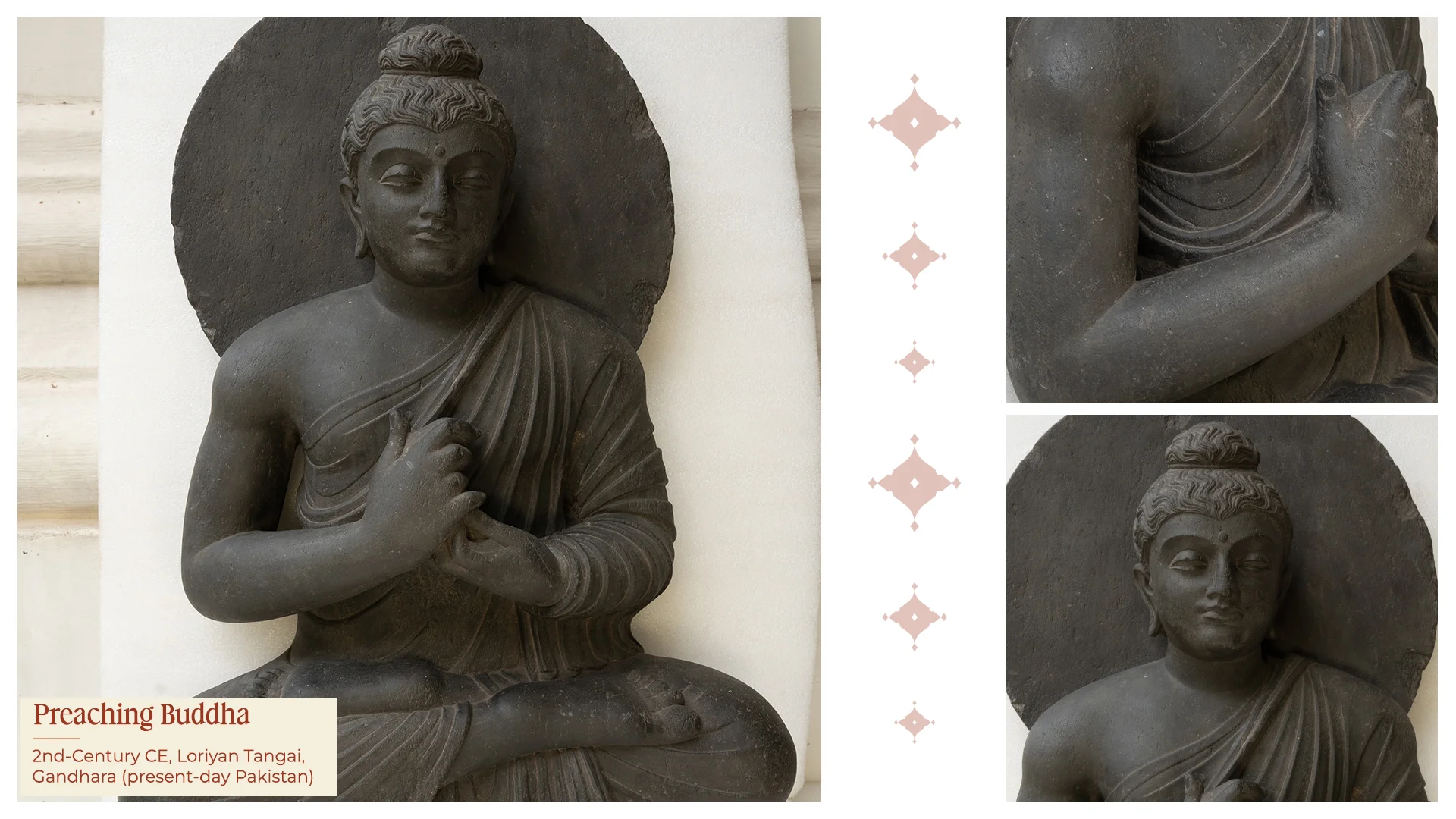
The urna, a small mark on the forehead, signifies deep knowledge and spiritual vision, while the ushnisha is the cranial topknot that counts among the traditional marks of a great being, and in Gandhara it usually appears as wavy hair gathered upward. Between them these two details tell you who you're looking at before you've read a single inscription.
Look at the face again and you'll notice that a Gandhara Buddha's calm is never blank, because it reads as the expression of someone who has settled the biggest question there is. Yet early writers were not content to describe only his calm, and they spent an astonishing amount of ink on his body.
The Ultimate Man: How Early Texts Imagined the Buddha's Body
There is no manual on masculinity in early India, and yet the idea of a perfect man runs through Sanskrit, Pali and Prakrit texts. Sanskrit has words for the man (purusha, vira) and for manliness (paurusha, viryam, parakrama), and it also has words for those set against the ideal, such as the pandaka and the napumsaka, terms the texts use for men they classed as impotent or sexually non-normative, so that virility, strength and bravery sit at the heart of the whole vocabulary.
Purusottama, the Man-Lion
Popular Western culture tends to picture the Buddha as androgynous and asexual, smiling serenely, and monks such as the Dalai Lama have come to stand for a Buddhism that supposedly sets gender aside. Indian Buddhist literature paints someone quite different, because there the Buddha is the purusottama, the "ultimate man", who is beautiful, immensely strong, skilled at archery, wrestling and other martial arts, attractive to women and admired by men.
Pali texts credit him with two kinds of power, jnanabala, the power of wisdom, and kaya-bala, the power of the body, and while scholars have written a great deal about the first, some argue that the authors who created his character considered the second just as important. The Samyutta Nikaya compares him to a mighty lion stretching as it comes out of its lair, roaring so that the animals tremble and even the gods are afraid, and elsewhere he is called the Man-Lion, with the Four Noble Truths as his teeth and claws and the four Brahma abodes as his canines.
Thirty-Two Marks
The Buddha's body carries thirty-two mahapurusha-lakshana, the marks of a great man, which appear only on buddhas and on a cakravartin, the universal monarch, and the Digha Nikaya's discourse on the physical characteristics lists them. Some are easy to picture, such as flat feet, hands that reach the knees without bending, golden skin so smooth that no dust can settle on it, a straight torso, legs like an antelope's, a chest and jaw like a lion's and eyelashes like a cow's, while others are stranger, among them a thousand-spoked wheel pattern on the palms and soles, webbed fingers and toes, a long and wide tongue, and a curl of white hair between the brows that would reach his elbows if it were unwound.
Celibacy, Bodhisattvas and Siddhas
Celibacy did not clash with any of this, because brahmacarya, celibate conduct, meant mastery over desire, and in the monastic sangha it defined manhood as self-control. Mahayana Buddhism later honoured the bodhisattva as a "greater man" who was still tied to male embodiment, with women's enlightenment remaining contingent on rebirth as men, and in Tantric Buddhism the ideal became the siddha, an enlightened adept who wielded supernatural power and even used sexual yogas to turn desire into spiritual energy. Put briefly, Buddhist masculinity moved from physical perfection to disciplined renunciation and then on to esoteric mastery.
Gender scholars such as R. W. Connell, whose words open this piece, and Judith Butler argue that every culture builds and performs its own ideal of manhood and then treats it as natural, and the Buddha's body may be one of the oldest and most detailed examples of that process anywhere. It brings us back to Gandhara, because when its sculptors gave the Buddha an upright spine, a broad chest and an unhurried calm they were turning a textual ideal into stone, and his strength lies in how still he is.
From Loriyan Tangai to Your Shelf: Documenting and Recreating the Original
Back to Caddy. The Loriyan Tangai stupas were excavated in 1896 under the direction of the Secretary of the Government of Bengal, who wanted Gandharan sculpture for the Indian Museum in Calcutta and a photographic record to go with it, and Caddy's photographs of the finds survive. Most of the sculpture went to Calcutta, now Kolkata in West Bengal, though pieces were later shared with museums in Taxila, Lahore and London.
Varaha Heritage builds on that record, and each of its pieces is recreated from a specific museum-held original, which means the form, the iconography and the findspot can all be traced. The Preaching Buddha is a hand-finished stone composite replica that follows an original from Loriyan Tangai.
Choosing and Placing a Buddha Statue for Home
Now for the practical part, which is where most searches begin, and it's easier once you know what you're looking at.
Which Buddha Statue Is Good for Home?
That depends on what you want the figure to say. A seated, meditating Buddha with hands resting in the lap suits a quiet corner, a standing figure with a raised palm shows the abhaya mudra, the gesture of fearlessness, and a hand touching the ground is the bhumisparsha mudra, which recalls the moment at Bodh Gaya when he called the earth to witness. A Preaching Buddha in Vyakhyana Mudra feels right wherever people read, talk and learn, and the Laughing Buddha is a separate character altogether, generally identified with Budai, a Chinese folk figure, rather than with Gautama.
Material and Finish
Brass is durable and warm in colour, marble is bright and calm but heavy, and hand-finished stone composite gives you the texture of a museum piece at a weight that's easy to put on a shelf. Size matters too, because a buddha head statue sits happily on a desk while a full seated figure wants a shelf with room around it, and whatever you choose you should look closely at the face and hands, since crisp detail there tells you the maker cared.
Can We Keep a Buddha Statue at Home?
The question people type most is "can we keep buddha statue at home", and the short answer is yes. Many Buddhist households keep images of the Buddha, and many Hindu families honour him too, since some traditional lists count him among the incarnations of Vishnu, so what counts is respect, whether you treat the figure as sacred, as art or as both.
Buddha Statue for Living Room
A buddha statue for living room use needs a calm surface and a little space around it, and a console table, a bookshelf or a wall niche works well. If you're wondering where to keep buddha statue in home, start with the places people naturally pause, such as a seating area, a reading corner or a hallway alcove with clean, uncluttered space, and put it where guests will ask about it, because a piece with a documented past gives you a good story to tell.
Where to Keep Gautama Buddha Statue at Home
Many Vastu guides suggest the northeast or east of a room, with the figure kept off the floor, though schools of Vastu differ and Buddhist custom itself doesn't depend on compass directions, so treat that as an optional tradition and not a rule. As for how to keep buddha statue at home with care, a few common courtesies cover most of it: place the figure on a clean, raised and stable surface, keep the space around it calm and free of shoes, laundry and storage, dust it gently with a soft dry cloth, and light a lamp or offer fresh flowers if you like. Avoid setting it on the floor where it could be stepped over, avoid bathrooms, and avoid using it as a hook for keys or hats.
The Preaching Buddha from Varaha Heritage
Everything above comes together in the Preaching Buddha | Masterpiece of Gandhara Art, which is inspired by a 2nd-century original from Loriyan Tangai, Gandhara (present-day Pakistan), made under the Kushan Empire. The product page places the original in West Bengal today.
The Buddha sits in Padmasana with his hands in Vyakhyana Mudra, and the urna on his forehead marks deep knowledge and spiritual vision, while the piece as a whole commemorates the first sermon at the Deer Park in Sarnath. The original was worked in dark grey schist, and Varaha Heritage's replica is a hand-finished stone composite sculpture, available in three sizes: 5 inch, 7 inch and 9 inch.
If you're still asking which buddha statue is good for home, a teaching figure like this makes a strong answer, because it would work as a buddha statue for living room display and just as well in meditation room decor, and it tells a complete story wherever it sits. Whichever room you pick, the answer to where to keep gautama buddha statue at home is simple: somewhere raised, clean and calm.
Frequently Asked Questions
What makes a Gandhara Buddha different from other Buddha statues?
A Gandhara Buddha blends Hellenistic realism with Buddhist iconography, a style that developed in the north-west under the Kushan Empire. Typical signs are heavy, toga-like drapery, wavy hair in a topknot (ushnisha) and naturalistic faces, unlike the more idealised Mathura and Gupta traditions. Most were worked in grey schist.
Why does Gandhara art blend Greek and Indian styles?
Gandhara sat at the crossroads of India and Central Asia and was ruled in turn by Persians, Greeks, Indo-Greeks, Scythians, Parthians and Kushans, so Greek artistic habits reached Buddhist workshops. Scholars still debate whether the influence came from Alexander's successors or from Greco-Roman artists some centuries later.
What does the Preaching Buddha's posture and gesture signify?
He sits in Padmasana, the lotus position, with his hands in Vyakhyana Mudra, the teaching gesture; the related Dharmachakra Mudra represents turning the wheel of law. Together they recall his first sermon at the Deer Park in Sarnath, and the urna on his forehead signifies deep insight.
Where should a Buddha statue be placed at home?
Choose a clean, raised and stable surface, such as a shelf, console or meditation corner, at or above eye level when you're seated. Keep it away from the floor, bathrooms, shoes and clutter.
Conclusion
A robe that looks Greek, a face that finally replaced the footprint, and a body that early writers described in astonishing detail: the Gandhara Buddha holds more history than most objects you could put on a shelf, which is what makes it such a rewarding Buddha statue for home. You can read it, trace it to a findspot and live with it, and the old question, can we keep buddha statue at home, gets a warm answer: yes, with respect.
If you'd like to begin, explore the Preaching Buddha, or browse the wider Varaha Heritage collection of museum replicas.