
In Brief: What You Will Discover
This blog explores the fascinating evolution of India's iconic Great Stupa at Sanchi, focusing on its world-renowned toranas (stone gateways). You will discover how these plain brick structures were transformed into intricate narrative manuals of early Buddhism by unexpected craftsmen. Let’s dive into the unique tradition of symbolic art that defined an era and learn how full-scale modern replicas are keeping this ancient legacy alive in museums across the globe.
What secrets do these gateways still whisper today?
Have you ever looked at a masterpiece of ancient architecture and felt the stories embedded in its stones whisper to you? Have you ever marvelled at the sheer persistence of sacred art across millennia? You’ve likely seen images of India's iconic Great Stupa at Sanchi, but do you know the real story behind its most famous feature?
Did you know that the Great Stupa, as originally constructed, was a rather simple brick structure? The breathtaking, intricately carved gateways that make it world-renowned were actually added much later, by different hands, and they are not just entranceways but complex narrative manuals of early Buddhism. Today, perfect replicas of these ancient gateways greet museum visitors worldwide, taking this legacy global.
During a recent visit to a museum, Qila Rai Pithora in Delhi, I was welcomed by a towering, full-scale replica of a Sanchi gateway. It’s a striking example of how these masterpieces continue to inspire and educate new generations far beyond their original home.
Join us on a journey through time and stone as we explore the rich tapestry of the Sanchi Toranas, from their initial creation to their modern-day, immaculate replicas.
Introduction: The Stone Gateways of Faith
The story of the Sanchi Stupa gateways is a story of profound devotion, evolving artistic expression, and historical preservation. While the Great Stupa itself stands as a symbol of the cosmos and the enlightened mind, its four magnificent toranas are the sacred apertures through which devotees and history buffs alike engage with the foundational stories of early Buddhism. These torana architecture marvels are, effectively, stone manuscripts, preserving the rich oral traditions of Buddha's life and previous births for hundreds of generations. Let's delve into who built them, who rediscovered them, and how they are replicated today.
Part I: The Origins and Evolution of the Great Stupa
To understand the gateways, we must first understand the Stupa they serve.
Who Built Sanchi Stupa?
The foundation of this ancient complex was laid by none other than the legendary Mauryan Emperor Ashoka in the 3rd century BCE. Driven by remorse after the Kalinga war, Ashoka became a devout Buddhist and sought to spread the dharma. The Great Stupa at Sanchi was one of his principal creations, meant to house the sacred relics of the Buddha. However, the original Ashokan stupa was a relatively plain, hemispherical brick structure, and its most iconic elements – the ornate stone railings and the toranas – were not yet part of the design.
Expansion in the Shunga Period
Following the Mauryan empire, the Shunga dynasty (2nd century BCE) took control of the region. Despite some initial conflict, the Shunga rulers contributed significantly to the Sanchi complex. They enlarged the Stupa, covering the original brickwork with stone casings and adding the lower and upper circumambulatory pathways (pradakshina patha) and the stone railing (vedika). This set the stage for the next and most significant addition.
Part II: The Golden Age of Torana Construction
This is the critical answer to the question: who added torana to sanchi stupa? Or who built the sanchi stupa gateways?
The Satavahana Period Contribution
The highly ornate, free-standing torana gateways we admire today were not built by the Mauryans or Shungas. They were added around the 1st century BCE, during the Satavahana period, a time when Central India was flourishing under the rule of the Satavahana dynasty, also known as the Andhras. It was the Satavahanas who effectively introduced torana in stupa architecture on such a grand scale at Sanchi.
There are four main toranas at Sanchi, placed cardinally around the Stupa: Southern, Northern, Eastern, and Western. They are not merely ornamental entrances; they are sculptural masterpieces, standing at approximately 8.53 meters high, crafted from fine sandstone.
The Significance of the Southern Torana: Vidisa's Ivory Carvers
The Southern Torana, chronologically, is considered one of the earliest to be built and, critically, it provides a crucial clue to the authorship of these masterpieces. An inscription found on its architrave (the horizontal crossbeam) records that the gateway was a gift from the guild of ivory workers of Vidisa (a nearby ancient city, now Vidisha).
From Ivory Carving to Stone Masterpieces
This inscription reveals a key historical point. The Sanchi Stupa toranas were built by master craftsmen whose usual medium was ivory.
These artisans applied their sophisticated, delicate, and miniature-focused skill set to the monumental medium of stone. This explains the incredible, almost chiseled and synoptic precision of the narrations found throughout the structures.
This seamless transition from ivory to sandstone, accomplished without any loss in intricate detail, remains a defining characteristic of the torana architecture at Sanchi.
Chronology and Perfection of the Toranas
The building of the toranas was likely a decades-long process. Let's look at the sequence:
Southern Torana: Generally considered the earliest (1st century BCE). It also features a depiction of the Ashokan lion pillar and is thus linked to the Ashokan heritage of the site.
Northern Torana: Following closely, this is often described as the best-preserved torana, displaying the immaculate perfection of the lithic art. It is a spectacular representation of how the carving evolved, presenting scenes with incredible depth and complexity.
Eastern Torana: Chronologically, the Eastern torana was constructed second last, amongst all, and offers yet more spectacular detail.
Western Torana: This is widely believed to be the last of the four gateways to be constructed.
Together, these four define the gateway of the Sanchi Stupa or torana. Each faces a Cardinal point, directing the devotee as they begin their circumambulation.
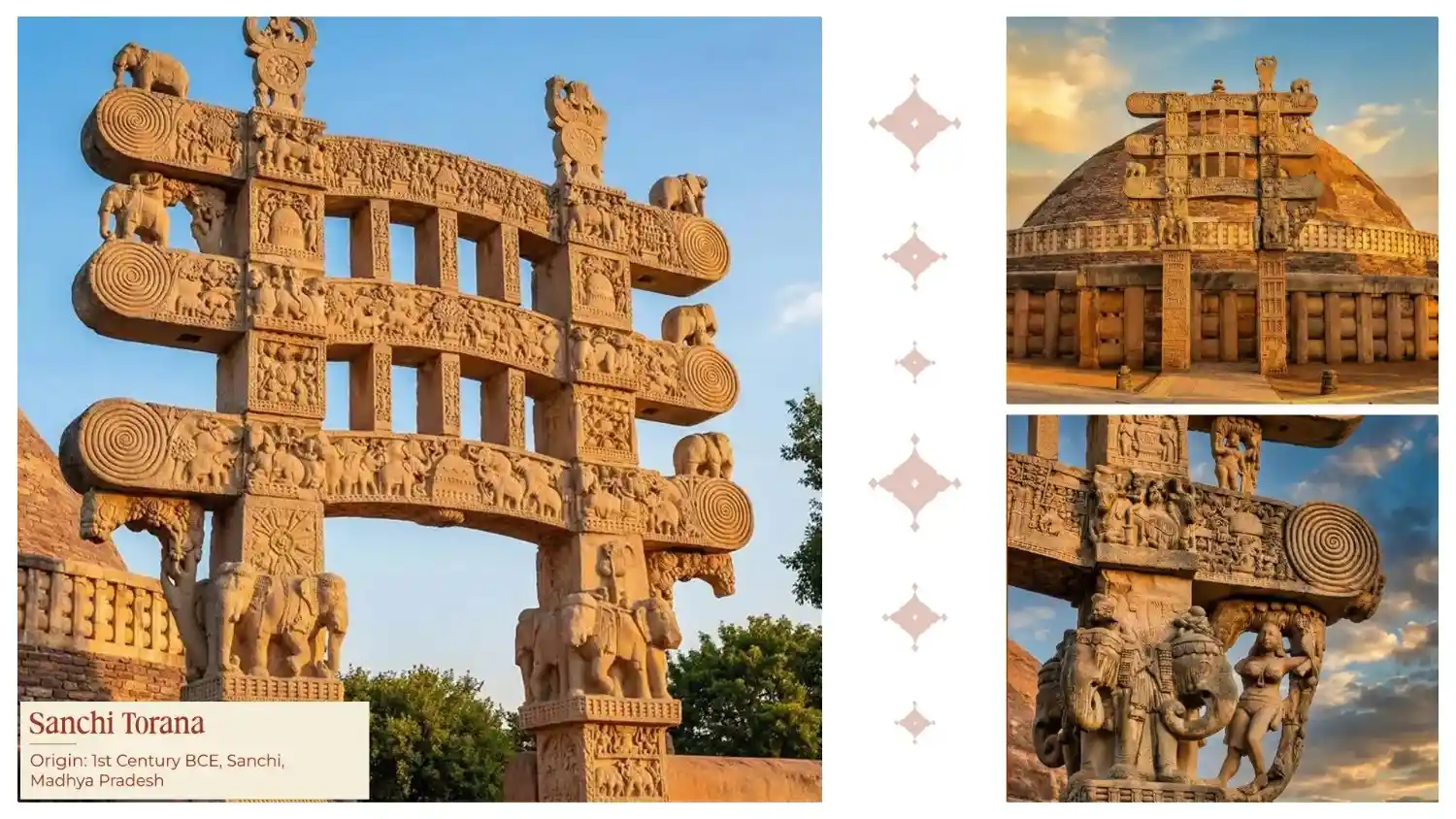
Part III: The Art and Themes of the Sanchi Gateways
The toranas of Sanchi Stupa are not decorated at random. Instead, they are rich narrative panels organised around specific themes. Perhaps the most intriguing element to modern observers is actually what is not depicted.
The Tradition of Aniconism: Symbolism Over Portraiture
Have you ever looked at an ancient masterpiece and realised the main character was missing? When you study the Great Stupa toranas, you’ll notice something surprising: there is no human figure of the Buddha to be found.
In this early period of art, the Buddha was considered too enlightened to be captured in a simple human portrait. To tell his story, the artists turned to symbols. The craftsmen who chiseled these narrations followed the early Buddhist tradition of Aniconism.
Sacred Symbols of the Buddha
This is a vital point of historical art. The tradition of portraying the Buddha through sacred symbols - such as footprints (pada), empty thrones under a bodhi tree, the dharmachakra (Wheel of the Dharma), and stupas - is beautifully carried out across these gateways.
Early Buddhists believed it was disrespectful to represent the perfectly enlightened Buddha in a mere human form.
Because of this, the themes on the gateways are layered. They can be classified into five groups - four of which are directly narrative and one general. To find the Buddha in these scenes, you must read between the lines and the symbols.
Buddha’s life scenes: His birth, enlightenment (with an empty throne), and first sermon (a wheel) are all represented symbolically.
Jataka Tales: These are crucial. They depict stories of the Buddha in his previous births, as an animal (like the deer-king) or a human, teaching moral lessons. The Depictions related to Manushi-Buddha (Mortal Buddhas) are found in some lists as a separate category, but frequently merge with Jataka and life scenes.
Subsequent history of Buddhism: These panels may depict scenes like Ashoka visiting a Stupa or other events in the history of the faith.
Miscellaneous and Decorative: This category includes elaborate friezes of dwarves (yakshas and yakshis), mythical animals, repeating patterns of the dharmachakra, and the ubiquitous, beautifully carved elephants (especially prevalent on the Southern Gate).
Part IV: Oblivion and Rediscovery
After centuries of being a major spiritual hub, Sanchi's light began to dim.
The Decline
The site lost its prominence in the fourteenth century and went into oblivion. The reasons behind Sanchi’s decline are still debated. Some believe it was due to the decline of royal patronage for Buddhism. Others point to the rise of powerful Hindu and Islamic dynasties, along with gradual neglect over time.
Eventually, Sanchi – with its magnificent toranas – became overgrown and forgotten. Its stories fell silent.
Today, Varaha Heritage is helping revive these forgotten narratives, along with many other lost stories of India.
General Taylor and Sir John Marshall: The Revival
It wasn't until the early 19th century that Sanchi was rediscovered. In 1818, General Taylor, a British officer, came across the neglected structures. This sparked an initial, albeit sometimes clumsy, wave of curiosity and looting.
It would take another century for true restoration to begin. After extensive excavation and conservation, led by Sir John Marshall, the Director General of the Archaeological Survey of India (from 1902 to 1928), the monuments were brought to their present condition. Marshall's efforts were meticulous, and his conservation philosophy was key to stabilising the site.
Today, the whole Sanchi Stupa complex is a UNESCO World Heritage site, protected for its outstanding universal value.

Part V: Sanchi Toranas Beyond Sanchi: The Replicas
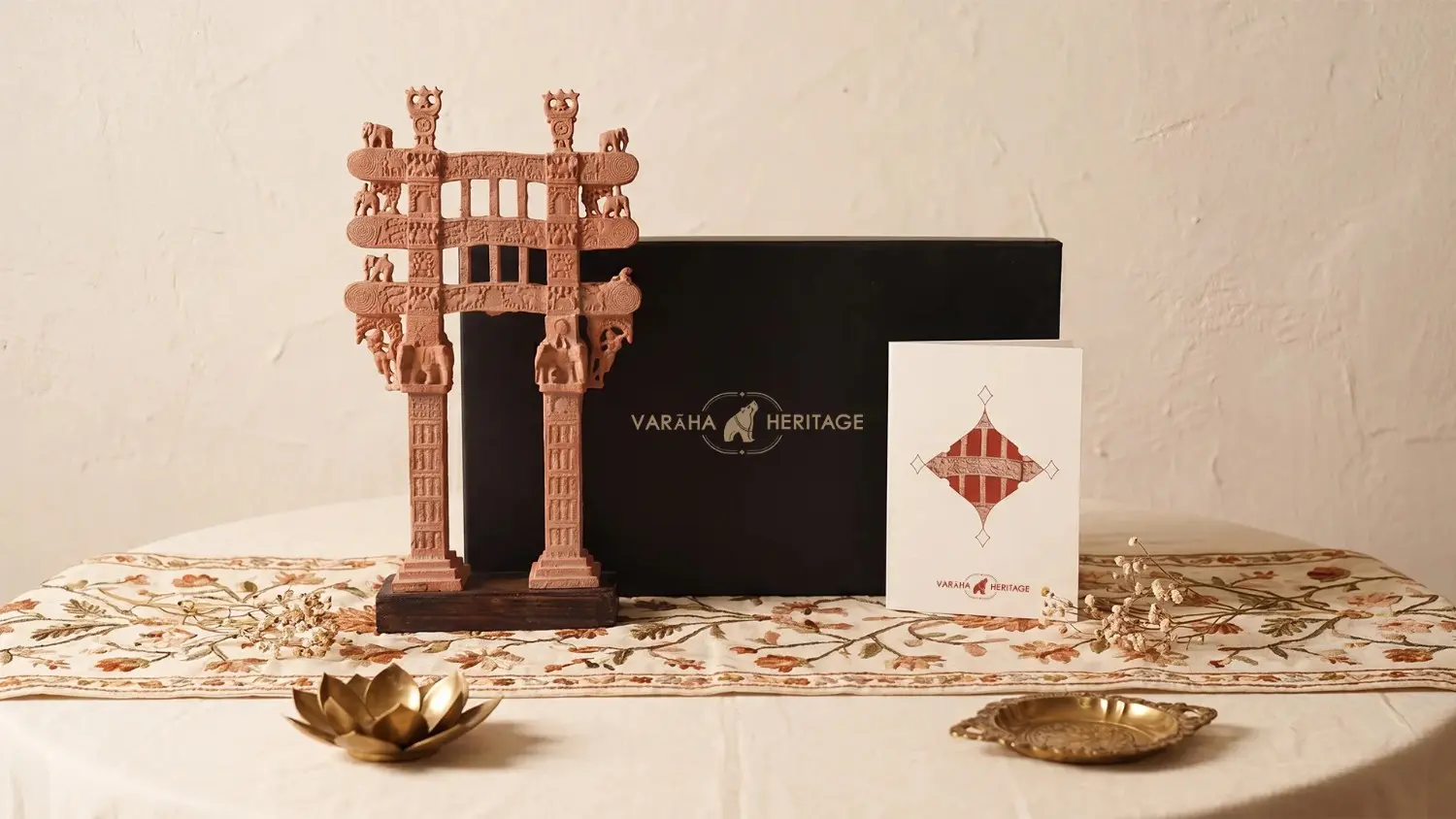
The History of Sanchi Stupa Gateways doesn't end in Madhya Pradesh. In a remarkable testament to their beauty and historical importance, these toranas have found a new kind of life. When one visits major historical museums around the world, one might be greeted by a towering, full-scale replica of Sanchi Torana: The Great Stupa Gateway
The Purpose of a Replica
For centuries, Sanchi was a hidden gem, difficult to reach. In the 19th and early 20th centuries, as European museums sought to educate their publics about global history and art, full-scale architectural plaster casts were popular. A Sanchi Stupa replica was the ultimate educational tool.
Iconic Replicas Around the World
You can also find a majestic replica of the Sanchi Stupa Gate outside the museum at the entrance of the Ethnological Museum of Berlin (Humboldt Forum). The Victoria and Albert Museum (V&A) in London also possesses significant Sanchi gate casts. There are other examples, like the Sanchi Gateway replica museum instances at the Indian Museum in Kolkata and even a monumental one that stands outside a major international institution.
These replicas serve a vital educational and aesthetic function:
They provide a full-scale, three-dimensional experience of ancient torana architecture without needing to travel to India.
They are immaculate, often based on early-restoration-era casts that capture the details perfectly.
They act as powerful ambassadors for ancient Indian art, leading many to learn about the gateway of Sanchi Stupa and its history.
The Contemporary Challenge
Building these replicas today is a massive challenge. Even with modern technology, it is not an easy job.
Back in the 1800s, people made "plaster casts" (moulds) of the gates to show them in museums. Today, those old moulds are so old that they have become historic treasures themselves! They now need special care just like the original stone.
The original gates were carved by ivory workers who were used to working on a very small scale. The fact that we are still trying to copy their work today shows how amazing they were. Even thousands of years later, their art is the best way to show India’s rich history to the rest of the world.
Part VI: Conclusion: A Stone Legacy Endures
The journey of the Sanchi Stupa gateways and toranas is one of continuous relevance. They began as sacred additions to a pre-existing stupa, created by ivory workers who translated their delicate craft into monumental sandstone. They served as silent teachers of early Buddhism, using symbols instead of portraits to represent enlightenment. They survived centuries of neglect, were rediscovered and restored to a place of international prominence, and are now so venerated that their likeness, in the form of massive, perfect replicas, greets visitors around the world. The history of sanchi stupa gateways is a story of faith, craftsmanship, and the enduring power of a beautifully chiselled stone manuscript to bridge millennia.
FAQs
1. Who built sanchi stupa and the toranas?
The core structure of the Great Stupa was built by Emperor Ashoka. However, the magnificent stone toranas (gateways) were added much later, around the 1st century BCE/CE, during the Satavahana period. An inscription on the Southern Gateway names the guild of ivory workers from Vidisa as the creators of that specific gateway.
2. Who introduced torana in stupa architecture at Sanchi?
While the concept of gateways was established, it was the Satavahanas (specifically the 1st century BCE/CE phase of their rule) who introduced the free-standing, highly ornate torana on such a grand scale at Sanchi.
3. The gateway of sanchi stupa is called?
A torana.
4. Can I see a replica of sanchi stupa gate?
Yes, several major museums around the world feature full-scale, precise replicas of Sanchi's gateways (most commonly the Eastern or Southern one). Notable locations include the British Museum, the Humboldt Forum in Berlin, the UN headquarters in Geneva, and the Indian Museum in Kolkata. You can also buy a replica of the Sanchi Torana: The Great Stupa Gateway.
5. Why are there no human depictions of Buddha on the gateways?
This is due to the early Buddhist tradition of Aniconism. Early practitioners believed that after his complete enlightenment and death (parinirvana), Buddha had transcended physical form, and thus it was disrespectful to represent him in human form. Instead, he is represented by symbols like an empty throne, a Bodhi tree, his footprints, or a stupa.
6. Where can I buy a replica of the Sanchi Toran?
You can purchase a high-quality replica of the Sanchi Toran directly through our website, Varaha Heritage. We specialise in reviving forgotten historical narratives and creating detailed, authentic reproductions of ancient Indian art and architectural marvels.