
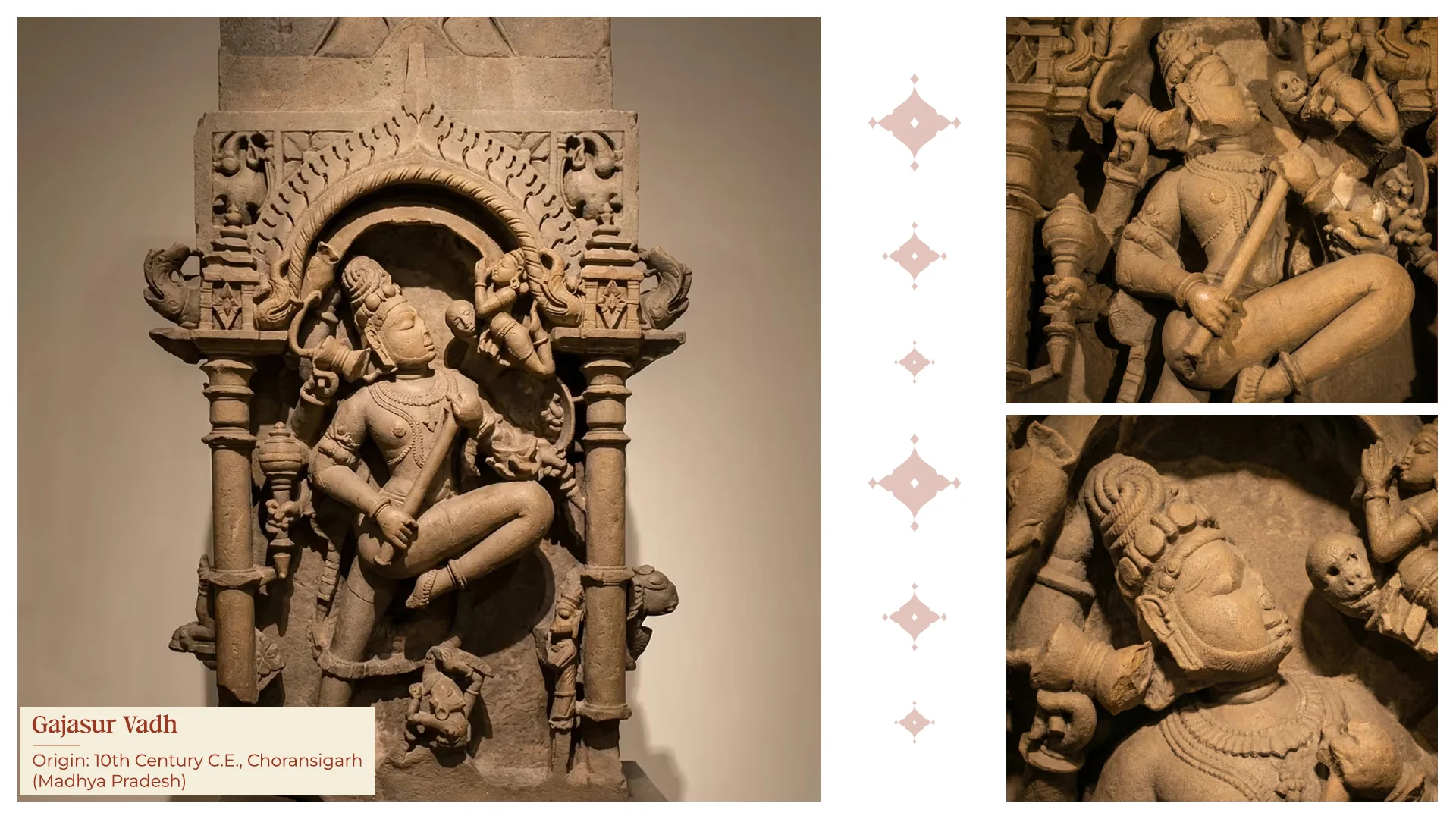
Among the fierce forms of Shiva carved across Indian temples, few combine violence and composure as deliberately as Gajasurasamhara - Shiva as the slayer of the elephant demon, Gajasura. A tenth-century sandstone relief of this subject, now held at the State Museum Bhopal, is a striking example of how early medieval sculptors handled a scene of triumph without letting it tip into chaos. This article traces the myth behind the image, the iconography sculptors settled on to depict it, and what the composition is understood to symbolise.
A Subject That Spanned Centuries and Regions
Gajasurasamhara - also referred to as Gajantaka or Gajaha, both meaning "slayer of the elephant" - belongs to a group of icons showing Shiva in decisive, victorious action. Scholars trace its earliest sculptural depictions to around the sixth century CE, and the subject remained popular in temple art for close to a thousand years afterward, well into the sixteenth and seventeenth centuries. It found particular favour in Pallava, Chola, and Hoysala workshops in the south, where Shiva is typically shown dancing on the elephant's severed head, and in North Indian relief traditions, where the moment is rendered in a more narrative, bas-relief style - closer to the sandstone treatment seen in the tenth-century Bhopal piece.
The chief temple associated with this form of Shiva stands at Vazhuvur (Valuvur) in Tamil Nadu, one of the eight Atta-virattam shrines marking sites of Shiva's heroic acts, where the presiding image is an eight-armed bronze Gajasurasamhara. Iconographic treatises such as the Amshumadbhedagama ( अंशुमद्भेदागम ) describe the pose in detail: Shiva dancing within the elephant's hide, arranged like a prabhamandala - a radiating aureole - around him, one leg planted on the demon's head and the other raised in utkutikasana ( उत्कुटिकासन ), a bent, elevated stance.
The Story Behind the Image
Gajasura, the elephant demon, is described in Puranic tradition as the son of Mahishasura, the buffalo demon slain by Goddess Durga. Seeking to avenge his father, Gajasura undertook severe penance and was granted a boon of invincibility by Brahma. Emboldened by this power, he went on to terrorise the people of Varanasi, until Shiva intervened and killed him.
As Gajasura lay dying, tradition holds that his arrogance gave way to surrender - he asked Shiva to wear his flayed hide as a mark of his devotion. Shiva accepted, taking on the epithet Krittivasa, "one who wears skin as his garment," a name that also appears in the Vedic hymn Shri Rudram Chamakam in connection with Rudra, and recurs through devotional Tevaram hymns describing Shiva as the wearer of the elephant hide. This single act - triumph followed by an act of acceptance rather than discard - is what temple sculptors across centuries returned to again and again.
Reading the Symbolism
Indian sculptural tradition rarely depicts violence for its own sake, and Gajasurasamhara is a clear example of that restraint. Even mid-slaying, Shiva's expression across most depictions remains composed rather than wrathful - a deliberate choice that separates this fierce (Rudra) form from purely destructive imagery. The rhythm of the pose, the dancer's balance on the demon's head, gives the sculpture a sense of controlled motion rather than raw aggression.
In traditional symbolic readings, the elephant is associated with tamas - the heaviest of the three gunas in Indian philosophy, linked to inertia, delusion, and material attachment. The demon's thick hide, in this reading, stands for the layer of ignorance that keeps a being bound to illusion. By flaying it and wearing it rather than discarding it, Shiva is read as transforming that very obstruction into something worn openly - power drawn from what once concealed the truth. It is a symbolic act of liberation rather than mere destruction, consistent with Shiva's broader role in Hindu thought as the force that removes what stands between a devotee and realisation.
The Bhopal Relief and Its Place in Sculptural History
The specific piece this article centres on is a sandstone carving dated to the tenth century CE, now held at the State Museum Bhopal - itself founded in the early twentieth century by Sultan Jahan Begam as the King Edward Museum, and home today to one of Madhya Pradesh's most significant collections of early medieval sculpture, including other major icons such as Uma-Maheshwara, Trivikrama, and Mahishasuramardini. The relief captures Shiva standing just after the act, the elephant's hide worn across his back and its head arched over his own - a composed, balanced image of a decisive act just completed, rather than a scene still in motion.
Recreated with Historical Precision
Varaha Heritage's Gajasura Vadha sculpture is modelled directly on this tenth-century relief. It is a hand-finished stone composite piece, crafted to replicate the texture, weight, and worn surface quality of the original sandstone carving, with the details of the pose, the flayed hide, and Shiva's composed expression faithfully recreated from the museum piece.
Finish: Hand-finished stone composite, replicating the original sandstone's texture and finish
Care: Wipe gently with a soft, dry cloth; keep away from direct sunlight and moisture
Delivery: Dispatched within 7 business days across India, with same-day delivery available in Delhi NCR on lunch-time orders, securely packed in premium protective packaging
A sculpture like this suits both a home altar or living space and a considered place in an office - a fierce, composed image of strength and transformation, and a piece with real documented lineage behind it rather than a generic decorative idol.
The Last Word
Gajasura Vadha endures as a subject because it resists a simple reading. It is a scene of violence rendered without chaos, a demon's defeat that ends in acceptance rather than erasure, and a nearly thousand-year-old visual argument that strength, properly understood, is inseparable from composure. The tenth-century Bhopal relief - and the replica it inspired - carries that argument forward, one carved gesture at a time.
FAQ :
What is the story behind the Gajasura Vadha sculpture?
Gajasura, the elephant demon and son of Mahishasura, gained invincibility through a boon from Brahma and began terrorising the people of Varanasi. Shiva slew him to end the destruction, and as Gajasura lay dying, he asked Shiva to wear his flayed hide - an act of surrender that gave Shiva the epithet Krittivasa, "one who wears skin as his garment."
What does the elephant symbolise in Gajasurasamhara iconography?
In traditional symbolic readings, the elephant represents tamas - the heaviest of the three gunas, associated with inertia, delusion, and material attachment. Shiva flaying and wearing the hide is read as a transformation of that obstruction into strength, rather than simple destruction, aligning with his broader role as the remover of what stands between a devotee and liberation.
How old is the original Gajasura Vadha relief, and where is it kept?
The relief this piece is modelled on is a sandstone carving dated to the tenth century CE, currently held at the State Museum Bhopal in Madhya Pradesh, one of the region's major collections of early medieval Indian sculpture.
Is the Gajasura Vadha sculpture suitable for a home or office setting?
Yes - as a fierce yet composed form of Shiva, it works well as a striking, meaningful piece for a home altar, living space, or office setting where a considered, historically grounded sculpture is preferred over generic decor. Its documented tenth-century origin also makes it a distinctive choice for heritage-minded gifting.