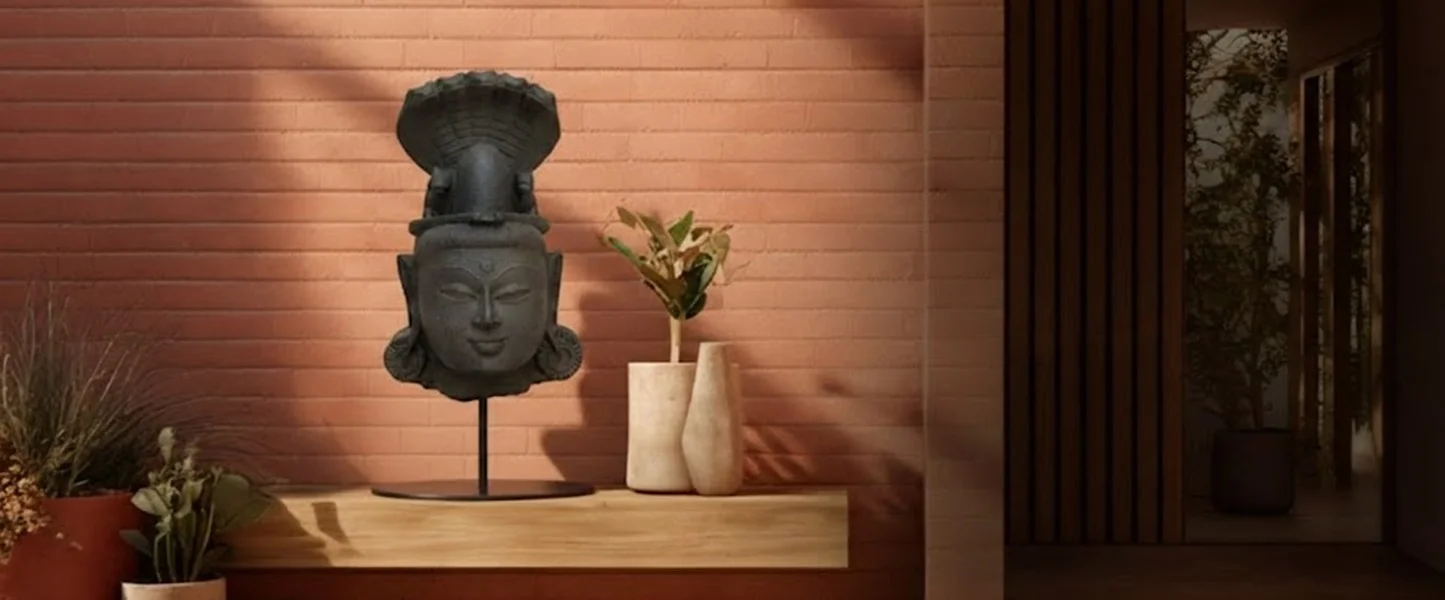
Seeking more than just a pretty gift, something that carries weight, memory, and a story. Those are rare. A Shiva Lingam offers just that: a tactile symbol of healing, fertility, potency, and a deeper junction of wellbeing, power, and energy.
Most of us end up going for generic options: candles, photo frames, resin showpieces that look the same in every shop. And then someone asks, "what about a Shiva Lingam?" and you realise you don't fully know what it represents, where it comes from, or whether it's even appropriate.
This guide is for exactly that moment. It covers what the Shiva Lingam truly symbolises, why a museum-authenticated heritage sculpture is in a different category from the Lingam idols sold on every street corner, and which occasions make it the most meaningful gift you can give.
What Is a Shiva Lingam, Really?
The Shiva Lingam is one of the oldest and is one of the most profound and enigmatic symbols in Hinduism, sacred forms in Indian religious art.
At its core, the Lingam is Shiva's aniconic form; the formless, infinite consciousness that resists image or shape. It rests within a Yoni base representing Shakti, the generative feminine energy. Together, Lingam and Yoni embody the union of consciousness and creative power: the idea that all creation arises at this meeting point. It's a metaphysical concept given physical form.
In the Shaiva tradition, which regards Shiva as the Supreme Being, the Lingam has been venerated since at least the Indus Valley Civilisation, making it among the earliest known religious symbols on earth. Scholars and historians have documented Shiva Lingam worship as far back as 2500 BCE, though the art form flourished most visibly during the Gupta, Pratihara, and medieval periods of Indian temple architecture.
Contrary to popular belief, the Lingam is rarely left plain. Sanctums often place Nandi, Shiva's bull, facing it in eternal vigil, though Nandi is a separate sculpture, not part of the Lingam's form. In another variant, a serpent (Vasuki or another Naga) coils around the shaft or fans out as a hood above it, a form called the Nagalingam.
The rarest and most striking variation, though, is the Mukhalinga: a Lingam with one or more faces of Shiva carved directly onto its surface, so the formless divine appears to emerge from the pillar itself.
Among the earliest known examples of Shiva in Indian sculpture is the Gudimallam Lingam in Andhra Pradesh, dated by most scholars to somewhere between the 3rd and 1st century BCE, which carries a single carved figure of the deity on its shaft.
The Sculpture: What we Recreated?
The Shiva Lingam recreation in Varaha Heritage's collection is not based on a generic form. It is a scaled replica of a museum-preserved original dating to the 13th–15th century CE, likely from the Late Chola or Vijayanagara period.
What makes this piece exceptional is the iconographic combination it presents.
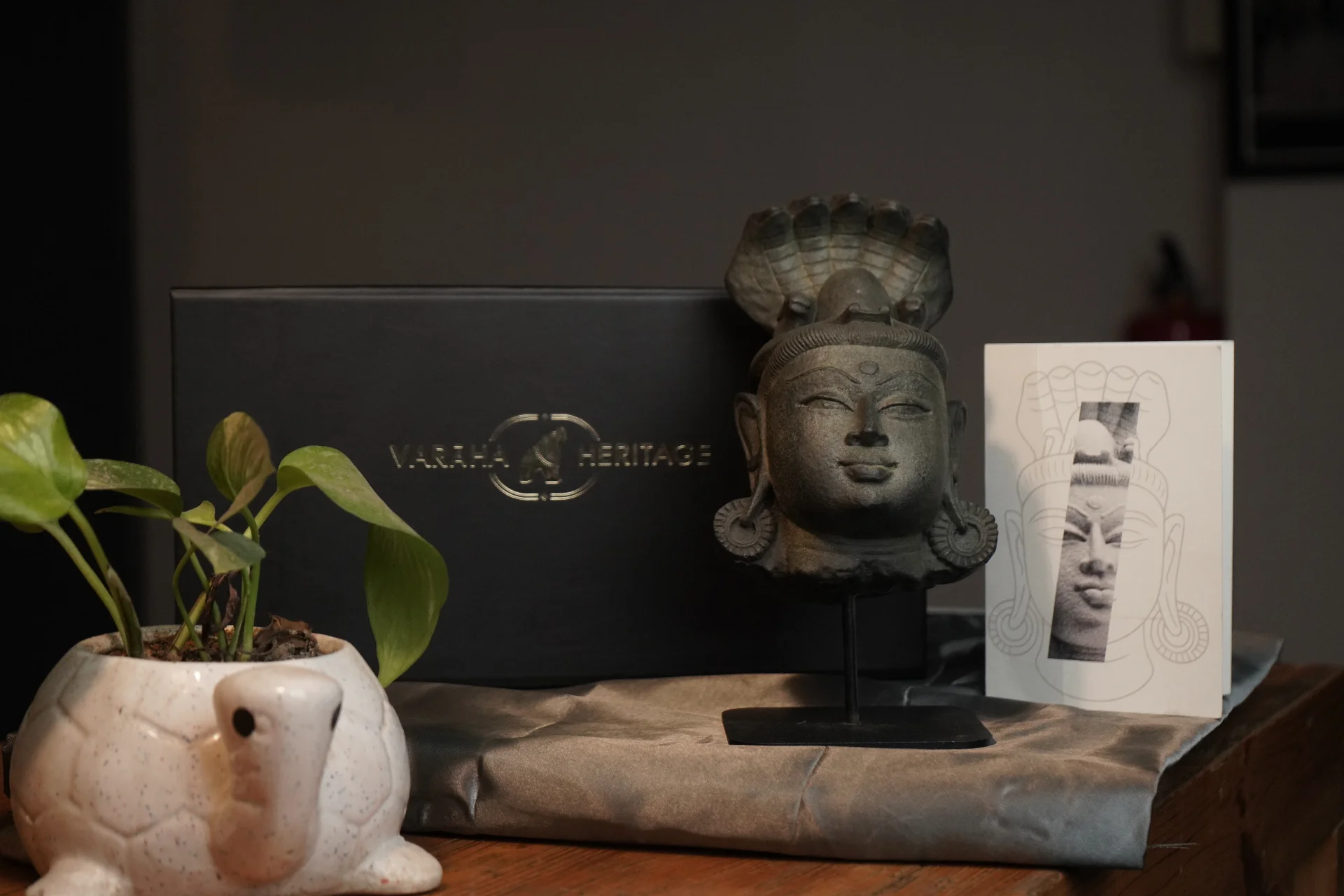
The Lingam itself rises from the base as the abstract, formless aspect of Shiva called the Nirguna (without attributes) form. Above it, the face of Shiva appears in serene composure, representing the Saguna (with attributes) aspect. This union of formless and form on a single sculpture is a theological statement: that the infinite and the personal are not separate.
Flanking the sculpture are two Nandis, the sacred bull who is Shiva's gatekeeper, companion, and symbol of dharma. Above them arches the five-hooded serpent, the Nagadevata whose spread hood forms a canopy of protection over the deity.
This isn't décor. This is a millennium of devotional philosophy compressed into stone composite, hand-finished by skilled artisans.
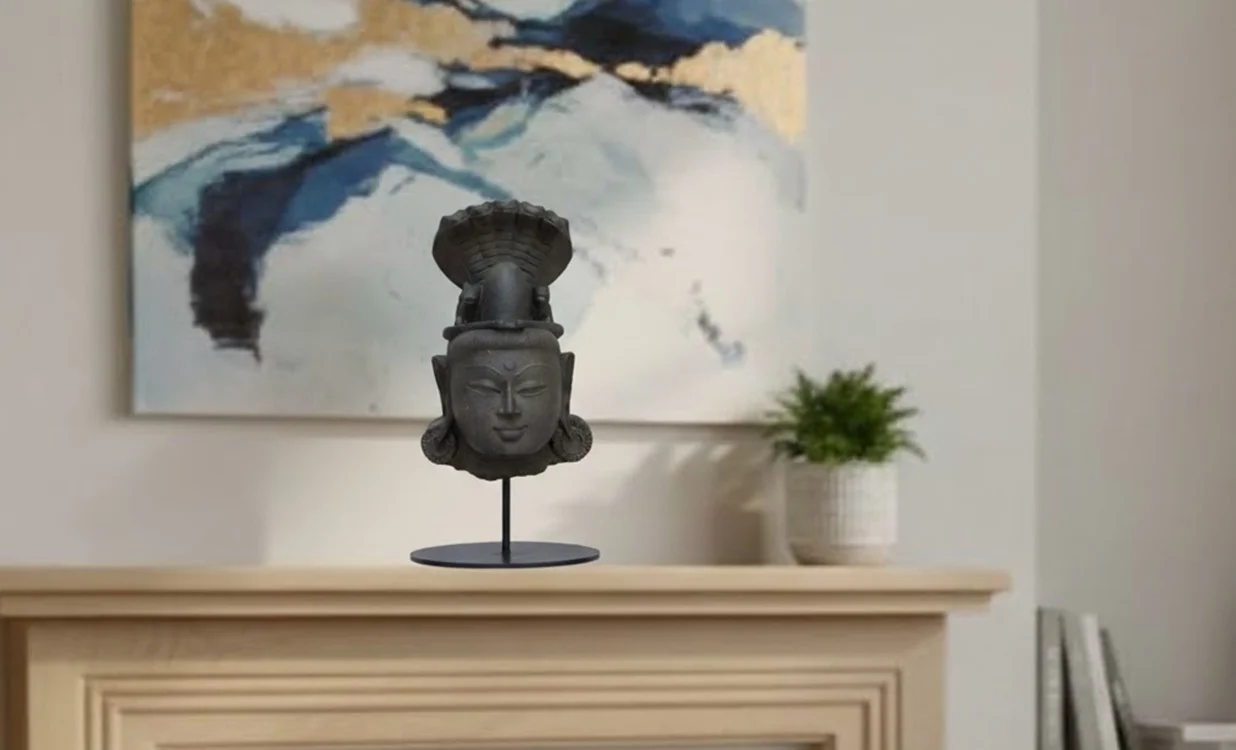
The piece is available in two sizes: 4 inches and 7 inches, both hand-finished in stone composite, making it suitable for a mandir shelf, an office desk, or a thoughtfully arranged entryway.
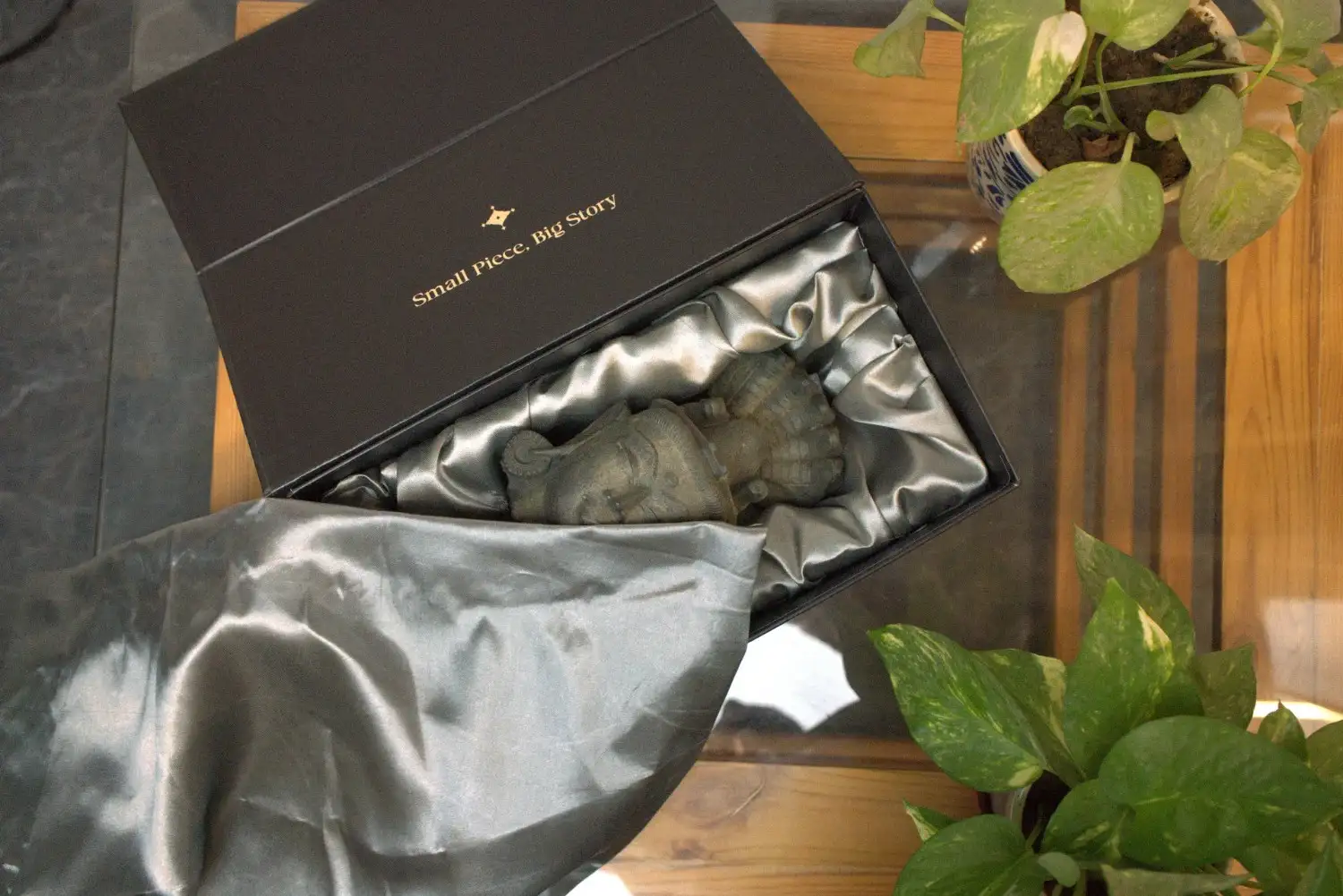
Ready to see it for yourself? The Shiva Lingam sculpture is available in 4-inch and 7-inch sizes, each shipped with a keeper's card and museum certificate of authenticity. View the Shiva Lingam replica on Varaha Heritage → |
|---|
How Our Heritage Sculptures Are Different
What we offer is simply a different kind of piece, made with a different intention.
A widely available Lingam is usually crafted from a general, time-honoured form, without ties to a specific origin, museum, or documented site. A heritage recreation from Varaha's collection is different, each one is traced back to a dated artifact, held in a named museum, from a documented site, and recreated with research-grade precision down to the proportions and iconographic details.
Every piece ships with a keeper's card telling its history, a museum-issued certificate of authenticity, and a written acknowledgement from us.
So you're not just choosing a form for your home, you're holding onto a specific moment in Indian art history. which is what makes it such a meaningful gift: the thought behind it spans the original sculptor, the historians who documented the piece, and the artisans who brought it back to life.
The Occasions That Make This Gift Perfect
A Shiva Lingam sculpture is one of the few gifts that works across a surprisingly wide range of occasions, and for the same reason in each case: it carries meaning that doesn't expire.
Housewarmings and Griha Pravesh ceremonies
The most natural fit. The Shiva Lingam placed in a new home invites protective energy and auspicious beginnings. In Vastu Shastra, Shiva-related pieces are traditionally placed in the North or North-East zone to encourage divine consciousness and positive energy flow. Gifting it at a housewarming means the piece will be placed with intention and observed every day.
Weddings and anniversaries
The Lingam-Yoni form represents the union of Shiva and Shakti (consciousness and creative energy, the formless and the manifest). For a couple, this symbolism is quietly profound: a union not framed in religious sentiment alone, but in a philosophical vision of creation itself, arising from two complementary forces meeting as one.
Corporate and professional gifting
This is where the piece surprises most people. A piece rooted in a documented, centuries-old sculptural tradition carries an intellectual prestige that generic corporate gifts simply don't. It says something specific about the giver: that they value depth, craftsmanship, and cultural memory over convenience. For founders, senior leaders, or international colleagues, this is the gift that starts a conversation.
Varaha Heritage offers bulk ordering for corporate requirements.
Mahashivaratri and Sawan
The obvious religious occasions, when Shiva devotees are most actively expressing their connection to the deity. A museum-verified replica in this season carries enormous emotional weight.
Milestone celebrations
Retirements, promotions, landmark birthdays. These are occasions where you want to give something that lasts, not just materially but meaningfully. A sculpture that carries a thousand years of history is the kind of gift someone keeps for decades.
Gifting soon and need help choosing? Varaha Heritage's replica collection includes the Shiva Lingam, Natesh Shiva (8th century, Bhopal State Museum), and the Ganesha from the Triveni Museum, Ujjain - each with documented provenance and bulk ordering available for corporate gifting. Explore the full heritage gifting collection → |
|---|
How to Display a Shiva Lingam at Home
Many people hesitate to place a Shiva Lingam at home because they aren't sure of the rules. This is worth clarifying.
Traditional guidelines suggest the Lingam should ideally face east, so the worshipper faces east while offering prayers. It is placed at a clean, elevated position, a mandir shelf, a dedicated surface, or an entry table - not on the floor. A clean, clutter-free space around it is preferred.
In a more contemporary home setting, the 4-inch piece works beautifully on a study shelf, a bedside table, or an office desk. The 7-inch version commands attention as a centrepiece - whether in a prayer space, a reading corner, or a curated display of art objects.
The important thing is intention. The Shiva Lingam has been placed in millions of homes across thousands of years. There is no single rigid rule. What matters is care and respect for the object.
For care, the stone composite surface responds best to a soft dry cloth. Avoid harsh chemical cleaners. Occasional gentle cleaning is all this piece needs to retain its finish and presence.
What Makes a Shiva Lingam Sculpture a Heritage Piece?
The word "heritage" is used freely in the gifting market. Here is a simple framework for telling the difference.
A genuine heritage piece has documented origin, a specific site, period, and artistic tradition. It is not a generic representation of an icon. Varaha Heritage's Shiva Lingam traces to the Late Chola or Vijayanagara period (13th–15th century CE) and is replicated from a museum-held original. You can verify this through the certificate of authentication that ships with every piece.
It has research-grade iconographic accuracy. The Nandis, the serpent hood, the proportions of the Lingam and the Mukha (face) above it, these are not approximated. They replicate what a scholar, an art historian, and a trained eye would recognise from the original.
And it carries a story that can be told. When you hand this sculpture to someone, you can say: "This is based on an artifact from the 14th century, kept in a museum in South India. The two Nandis flanking it represent dharma. The serpent above is Vasuki. The face that appears on the Lingam is the Saguna form of Shiva, the idea that the infinite can also be personal." That is a gift that educates, not just decorates.
If you are looking to explore other sculptures with a similar depth of provenance, the Natesh Shiva replica - from the 8th century Bhopal State Museum collection, and the Ganesha sculpture from the Triveni Museum in Ujjain are both powerful companions in the same tradition.
Conclusion
The best gifts don't just occupy a shelf. They carry something - a memory, a meaning, a story that grows the longer you look at it.
A museum-authenticated Shiva Lingam sculpture does exactly this. It connects the person who receives it to a tradition that predates most of the world's current civilisations and does so with the grace and precision of art made by human hands that cared deeply about what they were making.
That is what makes it a heritage gift. Not the price. Not the size. The story inside it.
Every piece at Varaha Heritage carries that story. Browse the full collection of museum-authenticated Indian sculpture replicas - each one traced to a real artefact, a real period, and a real place in India's artistic history. Shop heritage replicas at Varaha Heritage → |
|---|
Frequently Asked Questions
1. Is it okay to gift a Shiva Lingam to someone who isn't a Shiva devotee?
Yes, provided the recipient respects Indian culture and religious art. The Shiva Lingam has deep philosophical meaning beyond devotional practice - it represents creation, consciousness, and the union of opposites. Many non-religious buyers and art collectors keep it as a culturally significant sculpture. Use your judgement about the recipient's sensibilities.
2. Where should a Shiva Lingam be placed in the home?
According to Vastu Shastra, the North or North-East zone of a home is considered ideal for Shiva-related pieces. It should be placed at an elevated, clean surface avoid placing it on the floor and ideally facing east. A mandir shelf, a study desk, or a display cabinet at eye level all work well.
3. What is the difference between a regular Shiva Lingam idol and a heritage replica?
A standard Shiva Lingam idol is produced from a general template with no specific historical reference. A heritage replica is traced back to a dated museum artifact, a real sculpture from a specific site, period, and artistic tradition and reproduced with research-grade iconographic accuracy. Every Varaha Heritage piece ships with a keeper's card and a museum-issued certificate of authenticity.
4. Is a Shiva Lingam appropriate for corporate gifting?
Absolutely. A museum-authenticated heritage replica carries intellectual and cultural prestige that generic corporate gifts don't. It is particularly well received by leaders who appreciate Indian art, by clients who value cultural depth, and in international contexts where the uniqueness of the piece makes a strong impression. Varaha Heritage also offers bulk ordering for corporate requirements.
5. How should I care for a stone composite Shiva Lingam sculpture?
Use a soft, dry cloth for routine cleaning. Avoid water immersion, acidic or chemical cleaners, and abrasive materials. Keep the piece on a stable surface away from direct sunlight for extended periods. The stone composite finish is durable, but gentle handling preserves the surface detail.
6. Can a Shiva Lingam sculpture be given as a wedding gift?
Yes, and the symbolism is particularly apt. The Lingam-Yoni form represents the union of Shiva and Shakti (consciousness and creative energy, the formless and the manifest). For a couple, this is a deeply meaningful blessing rooted in a philosophical vision of union and creation. It's also a striking piece of art that will hold a permanent place in their home.
7. What is the Mukhalinga form depicted in this sculpture?
The Mukhalinga is a composite iconographic form in which a face of Shiva (Mukha = face) appears on or above the Lingam pillar. It represents the meeting of Shiva's formless, abstract aspect (the Nirguna Lingam) with his personal, manifest aspect (the Saguna face). This form is relatively rare in surviving Indian sculpture and is considered one of the most sophisticated theological statements in Shaiva iconography.