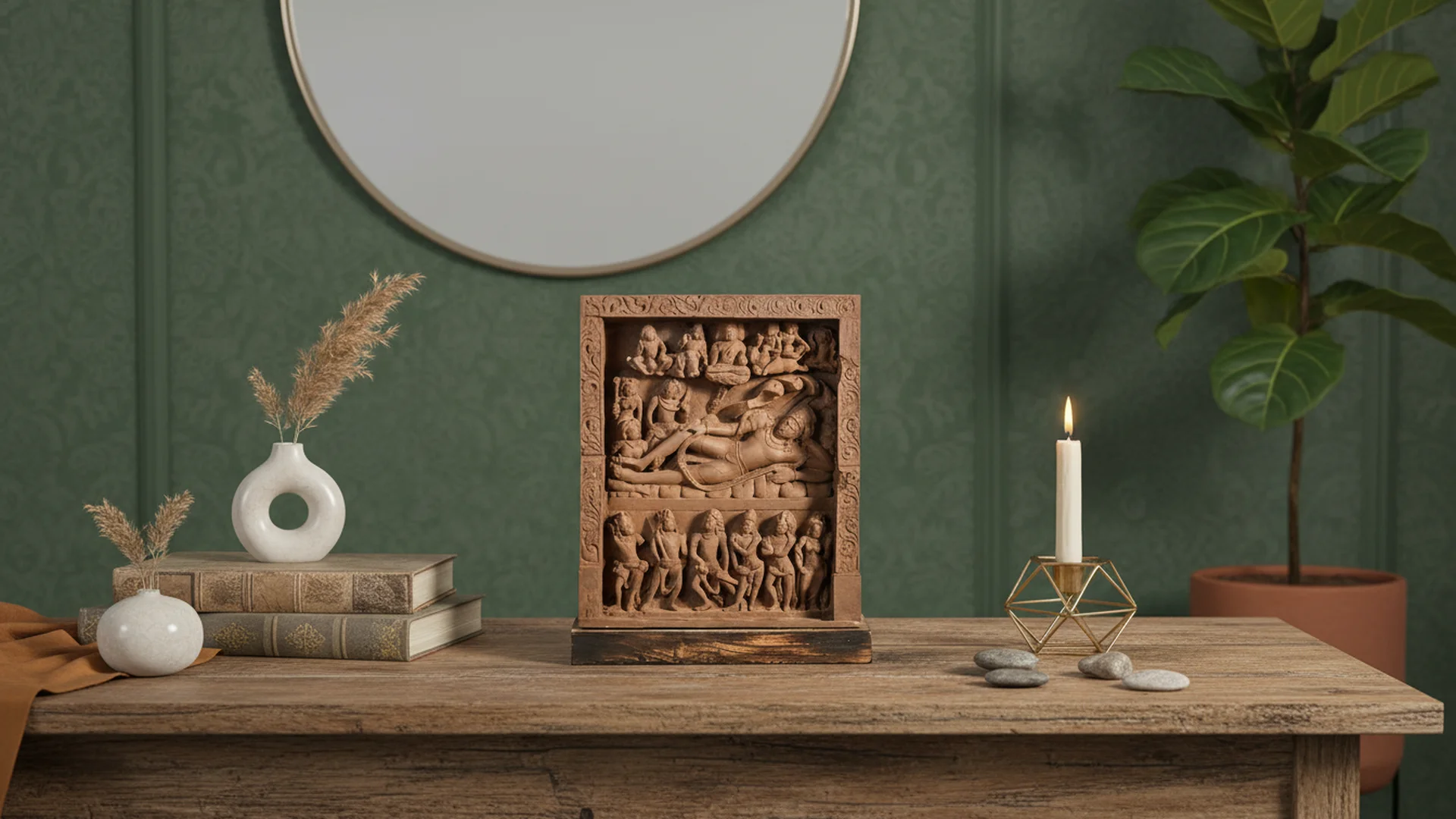
“Anantā has thousands of hoods. Each sustains a global sphere that appears like a grain of mustard.”
The idea of the Cosmic Serpent is not limited to Indian tradition. Nearly all early civilizations have myths associated with the cosmic serpent. For this reason, there are parallels between the Indian tradition's Ananta and the Norse mythological figure Jörmungandr. They are both semi-divine entities connected to the underworld and water. The Bhagavat Purana states that the universe is on Ananta's hoods.
Serpents are held in great regard and are still revered throughout India. They embody profound symbolism. We encounter the serpent motifs across India’s temples and paintings. India has a rich heritage and culture. To understand the cosmic serpent in Indian art, it is absolutely necessary to understand its symbolism and associated customs first.
Symbolism of serpents in Indian art
India is known as “the Land of Snakes and Snake Charmers.” However, many Indians consider the snake to be a divine entity or guardian deity! Popular legends label Nagas (serpents) as powerful, semi-divine beings who dwell in the netherworld. They are linked with water, fertility, and the underworld. They are also seen as protectors of gods and treasures.
There are many popular Nagas in Indian culture, like Ananta or Shesha, Vasuki, Taksha, and Mansa. We know the legend of Shiva having Vasuki around his neck or Vasuki's role in Samudra Manthan. Mansa Devi, the serpent goddess, is revered across Eastern India. According to the Mahabharata, the Kali Yuga started when Taksha killed King Parikshit.
In Buddhist tradition, the serpent Mucalinda shelters the Buddha when he was in a meditative state in Bodhgaya. Even the Jaina tradition has adopted snake symbolism. Parsvanath is often depicted under the shadow of a snake hood.
The coiled snakes are also visualized with the awakening of Kundalini. They represent untapped potential. With each awakening chakra, one can finally attain enlightenment. Thus, the serpent also represents wisdom.
Why is Ananta important in Hindu iconography?
Ananta symbolizes eternity. The literal meaning of the word "Ananta" is "infinite." In the Bhagavad Gita, Vishnu declared himself Ananta among the serpents. That’s why there is a close relation between Ananta and Vishnu. The most popular form of visual representation is Anantsayana Vishnu.
According to popular beliefs, Ananta resides in the underworld and serves as the bridge between the profane and spiritual worlds. He played an important role in the creation of the universe. Artists have impeccably captured the Hindu mythological concept of cosmic creation in this Anantasayana Vishnu iconography. It shows Vishnu lying atop the coiled serpent (Ananta Shesha) in yog nidra. The universe's creator rises from the sleeping Vishnu's navel. Here, eternity and untapped potential are symbolized by the coiled serpent. One can find this depiction in the Deogarh Vishnu Temple.
What are the different types of serpent iconography in Indian art?
Craftsmen carved stories on stone. As their skill and stories changed over time, so did the iconography. In Indian art, the mythical serpents are generally visualized in these forms:
The earliest forms are simple, just serpents with numerous heads.
With time, serpents are visualized in human form with a polycephalous serpent hood.
The third kind blends the two, with the lower half like a coiled snake and the upper section resembling a human body.
From the seals of the Harappan period to present-day lore, snakes have always intrigued the imaginations of many. There is much folklore about snakes, like changing forms, having precious gems on their hoods, or being protectors of a hidden treasury. Snake worship is still a common tradition in various cultures. This reflects the continuity of the age-old tradition of paying reverence to the cosmic serpent.