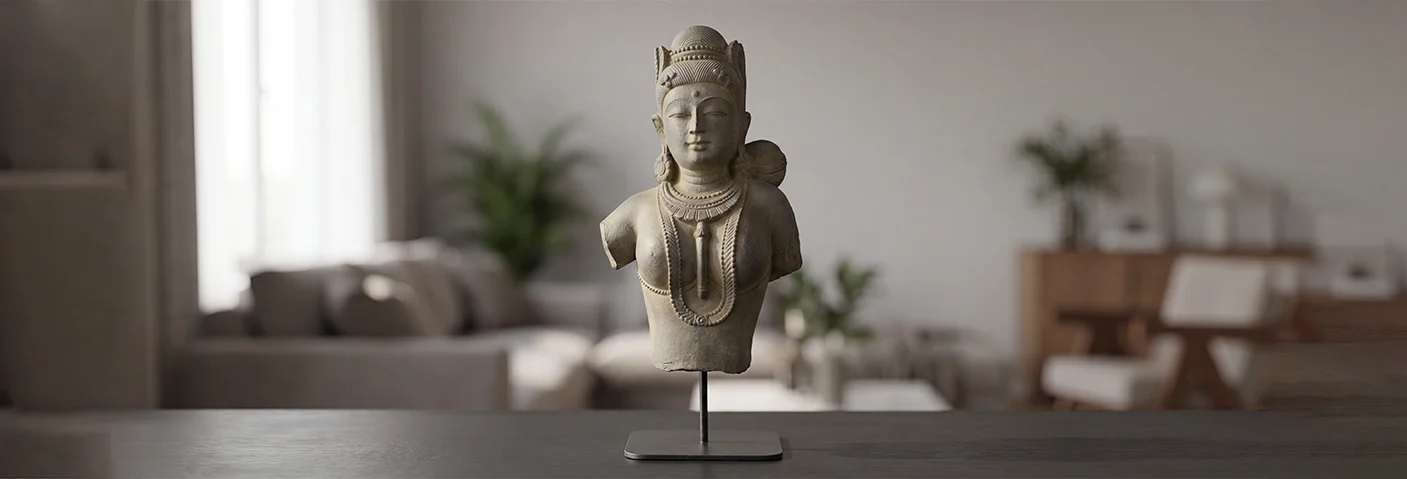
Among the many deities represented in South Indian temple art, Parvati holds a distinct place. Chola-era sculptors, working between the 9th and 13th centuries CE, developed one of the most technically refined traditions of religious image-making in world art history -and Parvati, as Shiva's consort and the embodiment of Shakti, was among their most carefully rendered subjects. This article traces her iconography, her philosophical significance in Hindu thought, and why Chola-period representations of her continue to be studied by historians, collectors, and craftspeople today.
Who Is Goddess Parvati?
Parvati is the consort of Lord Shiva and one of the central figures of the Hindu pantheon. Her name derives from parvata, meaning mountain, referencing her birth as the daughter of Himavan, lord of the Himalayas. She represents Shakti - the primordial cosmic energy said to animate all creation.
Among the essential facts about Parvati as a Hindu goddess: she is worshipped in multiple forms depending on context and function. As Durga and Kali, she is fierce and protective. As Gauri, Ambika, and Sivakami, she is associated with gentleness, radiance, and maternal care. In Chola temple bronzes, she appears most frequently as Sivakami - "she who is dear to Shiva" - shown in the tribhanga stance with restrained facial expression and finely detailed ornamentation.
Parvati and the Concept of Shakti
In Hindu philosophy, Parvati is identified with Prakriti, the active and generative principle, standing in complement to Purusha - pure consciousness, embodied in Shiva. Their union is treated in Shaiva Siddhanta and related textual traditions as cosmological rather than simply marital: Shakti gives form and motion to consciousness, while consciousness gives Shakti direction and purpose. Temple agamas describe this relationship through the concept of Ardhanarishvara, the composite half-male, half-female form of Shiva and Parvati, which Chola sculptors occasionally rendered in stone to express the idea that divinity is complete only when both principles are united.
There is also a householder dimension to her role. Marrying Shiva -traditionally depicted as an ascetic and wanderer - draws him into structured domestic and social life. In this capacity she is called Jagatjanani, or universal mother, associated in devotional literature with nourishment, patience, and the maintenance of dharma. This dual identity - cosmic energy and nurturing householder deity - is part of why her image recurs so consistently across South Indian temple art.
Why Parvati Holds a Central Place in Hindu Devotional Life
Parvati's prominence in Hindu worship stems from the range of roles she occupies. In her fierce, independent aspect she is Durga, associated with the defeat of the demon Mahishasura, and Kali, associated with time and transformation. In her gentler, domestic aspect she is Gauri and Ambika, associated with the protection of home and family. She is also linked with fertility and childbirth, which is why South Indian temple communities have historically invoked her during life-cycle rituals. This capacity to hold seemingly opposed roles - power without cruelty, gentleness without weakness - is a recurring theme in scholarship on her iconography.
The Evolution of Chola Sculpture
The Chola dynasty go`verned large parts of South India from roughly the 9th to the 13th century CE, reaching its political and artistic height under Rajaraja I and his son Rajendra I. Chola temple patronage -most notably the Brihadeeswarar Temple at Thanjavur and the temple complex at Gangaikonda Cholapuram -drove an extended period of sculptural production, both in granite temple reliefs and in bronze processional imagery.
Early Chola sculpture, from the 9th and 10th centuries, tends toward formal, frontal compositions. By the 11th and 12th centuries, under Rajaraja I and Rajendra I, figures become more elongated, poses more fluid, and facial treatment more individualized. This later phase produced the images most closely associated with mature Chola style: composed, self-possessed figures rendered with close attention to anatomical accuracy.
Chola Bronze vs. Chola Stone Sculpture
Both traditions developed alongside each other but served distinct temple functions.
Aspect | Chola Bronze Sculpture | Chola Stone Sculpture |
Purpose | Processional deity, carried during festivals | Fixed temple imagery, carved into walls and pillars |
Technique | Lost-wax casting (madhuchchhista vidhana) | Direct carving into granite |
Mobility | Movable, ritually consecrated and taken in procession | Immovable, integral to the architecture |
Famous example | Nataraja, Shiva as the cosmic dancer | Wall reliefs and niche figures at Thanjavur and Gangaikonda Cholapuram |
Material | Panchaloha alloy -typically copper, tin, and lead | Granite |
A Chola bronze Parvati figure was rarely produced in isolation. She was typically cast as part of a set alongside Shiva, positioned slightly behind and to his left -an iconographic convention reflecting her established role as consort within the ritual pairing, not a hierarchical subordination.
How Chola Bronze Was Made: The Lost-Wax Process
The lost-wax method, or madhuchchhista vidhana, is among the most technically demanding metal-casting processes developed in the ancient world. Sculptors modeled the figure in beeswax with full anatomical and ornamental detail, then encased the wax model in layers of fine clay to form a mould. Once the clay hardened, the mould was heated so the wax melted and drained away, leaving a hollow cavity in the exact shape of the figure. Molten bronze -an alloy of copper, tin, and lead -was then poured into the cavity, and once cooled, the clay mould was broken away to reveal the finished casting.
Because the mould had to be destroyed to release each statue, no two Chola bronzes are true duplicates -every surviving figure is a singular, non-reproducible object. This is a key reason an original bronze of a standing Parvati from the Chola period is treated as an object of exceptional rarity by museums and collectors today.
What Distinguishes Parvati of the Chola Period
Chola sculpture is best known for its bronzes, but the stone tradition -carved directly into temple walls, pillars, and pavilions -is equally central to understanding Parvati as a subject in Chola art. What distinguishes both traditions is a commitment to anatomical naturalism that was unusual for its period. Chola artists studied musculature, weight distribution, and the fall of drapery closely, giving their figures a sense of controlled movement rather than static symbolism.
A Chola-era Parvati sculpture, in bronze or stone, typically balances idealization -the goddess rendered in accordance with prescribed iconometric proportion -with a naturalistic sense of presence achieved through posture and gesture rather than through decorative excess.
Artistic Features of Chola Sculptures
Several recurring features define mature Chola style, and are visible in nearly every well-preserved Parvati figure from the period:
Tribhanga posture -a triple-bend stance through the neck, torso, and legs, producing the characteristic S-curve associated with Chola figural sculpture
Proportion following iconometric canon, as prescribed in the shilpa shastras, the classical texts governing temple image-making
Detailed jewelry -crowns (karanda mukuta), armlets, anklets, and multi-strand necklaces, cast or carved with individual precision
Restrained facial expression, with half-closed eyes conveying inward, meditative composure rather than outward drama
Fine incised drapery, indicating fabric through minimal linear detail rather than heavy carved folds
Frontal orientation with subtle asymmetry, giving a sense of controlled, gentle motion within a formally posed figure
Symbolism of the Standing Parvati
A standing Parvati bronze generally follows strict iconometric proportion as laid out in the shilpa shastras. Her right hand is frequently shown in a relaxed, lowered gesture, while her left hand often rests along the thigh or holds a lotus, a recurring symbol of purity in Hindu iconography. The standing form, as distinct from a seated one, is generally read by scholars as emphasizing her active aspect -Shakti in motion rather than at rest.
Why Chola Sculpture Still Informs Contemporary Practice
Nearly a thousand years after they were cast, Chola bronzes remain a reference point in Indian art, dance, and design. Bharatanatyam practitioners study the Nataraja's stance for its anatomical precision. Jewelry and textile designers draw on Chola ornamental motifs. Architects working in the Dravidian temple idiom use Chola-era proportion systems as a benchmark.
This influence rests substantially on restraint. Chola sculpture, at its best, avoids excess -figures are composed rather than dramatized. That formal discipline is part of why scholarly and collector interest in Chola-period sculpture has continued to grow over recent decades.
Why Museum-Quality Replicas Help Preserve This Heritage
Original Chola bronzes are irreplaceable and largely held in protected institutional collections -the Government Museum in Chennai and the Thanjavur Art Gallery among them, with a smaller number held internationally, including at the Metropolitan Museum of Art in New York. Direct public access to originals is, by necessity, limited.
This is the context in which carefully produced replicas serve a genuine preservation function. At Varaha Heritage, hand-finished stone composite reproductions are made with close attention to the proportion, posture, and iconographic detail established in Chola-period imagery -drawing on the same iconometric conventions and ornamental vocabulary documented in temple sculpture and museum bronzes. A well-made Parvati reproduction does more than furnish a room: it extends the legibility of a centuries-old visual language beyond museum glass, into settings where it can be studied and lived with daily.
Collectors are drawn to this category of work for reasons beyond aesthetics. Chola-style sculpture represents a documented, continuous artistic lineage -from 9th-century temple ateliers to present-day sthapathis in towns such as Swamimalai, who continue to practice lost-wax casting using methods that have changed relatively little over a thousand years. A faithful reproduction connects a home to that continuity: a living craft tradition rather than a static historical artifact.
Key takeaway: Parvati in Chola art is a sustained study in iconographic balance -technical precision paired with restraint, idealized proportion paired with anatomical naturalism. Chola artists spent roughly three centuries refining that balance in stone and bronze, and the resulting body of work remains a benchmark in the history of Indian sculpture.
FAQ
What was unique about Chola sculpture?
Chola sculpture combined technical precision with anatomical naturalism rarely seen in earlier Indian art. Artists balanced iconometric idealization with lifelike proportion, using lost-wax casting for bronzes and direct carving for granite temple reliefs.
What was the most famous sculpture of the Chola age?
The Nataraja -Shiva as the cosmic dancer -is the most widely recognized Chola-era sculpture. Cast in bronze using the lost-wax process, it is regarded as a landmark work in the history of Indian metal sculpture.
What are some of the most notable statues associated with Indian sculptural tradition?
Notable examples include the Chola Nataraja bronzes, temple sculpture at Thanjavur and Gangaikonda Cholapuram, and the medieval sculptural traditions of Khajuraho and Hampi, each reflecting distinct regional and dynastic styles.
Is a Chola-style Parvati sculpture a meaningful gift for weddings, housewarmings, or spiritual occasions?
Yes. Parvati is associated with marital harmony, nurturing strength, and prosperity in Hindu tradition, which makes her image a considered choice for weddings, housewarmings, and spiritual milestones.
Why are Parvati sculptures associated with balance, prosperity, and family harmony?
Parvati embodies Shakti, the generative energy paired with Shiva's consciousness in Shaiva philosophy. This pairing is read as a symbol of balance between complementary forces, which is why her image is traditionally associated with household harmony and prosperity.
Where should a Parvati sculpture be placed according to Vastu Shastra?
Vastu guidance generally suggests placing Parvati alongside Shiva in the northeast direction of a home, at eye level or higher, in a clean, well-lit space set aside for worship or quiet reflection.
What distinguishes Chola-era Parvati sculptures from other Indian sculptural traditions?
Chola-era Parvati sculptures are distinguished by their adherence to iconometric proportion, the tribhanga stance, restrained facial treatment, and detailed ornamentation, achieved through lost-wax bronze casting or precise granite carving.
What is the significance of displaying a Parvati sculpture in a modern home?
Displaying a Parvati sculpture connects a home to a documented craft and devotional tradition, while introducing museum-referenced proportion and iconographic detail into a contemporary interior setting.